
TOK — Alaska’s rugged and frigid interior, where it can get as cold as minus 50 Fahrenheit, is not the place you’d expect to find an electric school bus.
But here is Bus No. 50, with a cartoon horse decal on its side, quietly traversing about 40 miles of snowy and icy roads each day in Tok, shuttling students to school not far from the Canadian border.
It works OK on the daily route. But cold temperatures rob electric vehicle batteries of traveling range, so No. 50 can’t go on longer field trips, or to Anchorage or Fairbanks.
It’s a problem that some owners of electric passenger vehicles and transit officials are finding in cold climates worldwide. At 20 degrees F (minus 7 C), electric vehicles just don’t go as far as they do at the ideal 70 degrees. Part of it is that keeping passengers warm using traditional technology drains the battery.
So longer trips can be difficult in the coldest weather. Transit authorities like Chicago’s, which has pledged to convert its whole bus fleet to electricity by 2040, have to take extraordinary steps to keep electric buses charged and on schedule.
Some automakers and drivers fear lower battery range in the cold could limit acceptance of electric cars, trucks and buses, at a time when emissions from transportation must go down sharply to address climate change. There is hope. Scientists are racing to perfect new battery chemistries that don’t lose as much energy in cold weather as today’s lithium-ion systems.
Also, cars equipped with efficient heat pumps don’t lose as much range in the cold.
“It is a problem to have batteries in cold weather, and we have a pretty cold climate, one of the coldest in North America,” said Stretch Blackard, owner of Tok Transportation, which contracts with the local schools.
When the temperature hits zero, his cost to run Tok’s electric bus doubles. Tok has among the highest electricity prices in the nation.
In the coldest weather, 0 down to minus 10 F (minus 18-23 C) the electric bus costs roughly $1.15 per mile, versus 40 cents per mile for a diesel bus, Blackard said. The cost of the electric bus drops to about 90 cents a mile when it’s warm, but he says the costs make it unworkable and he wouldn’t buy another one.
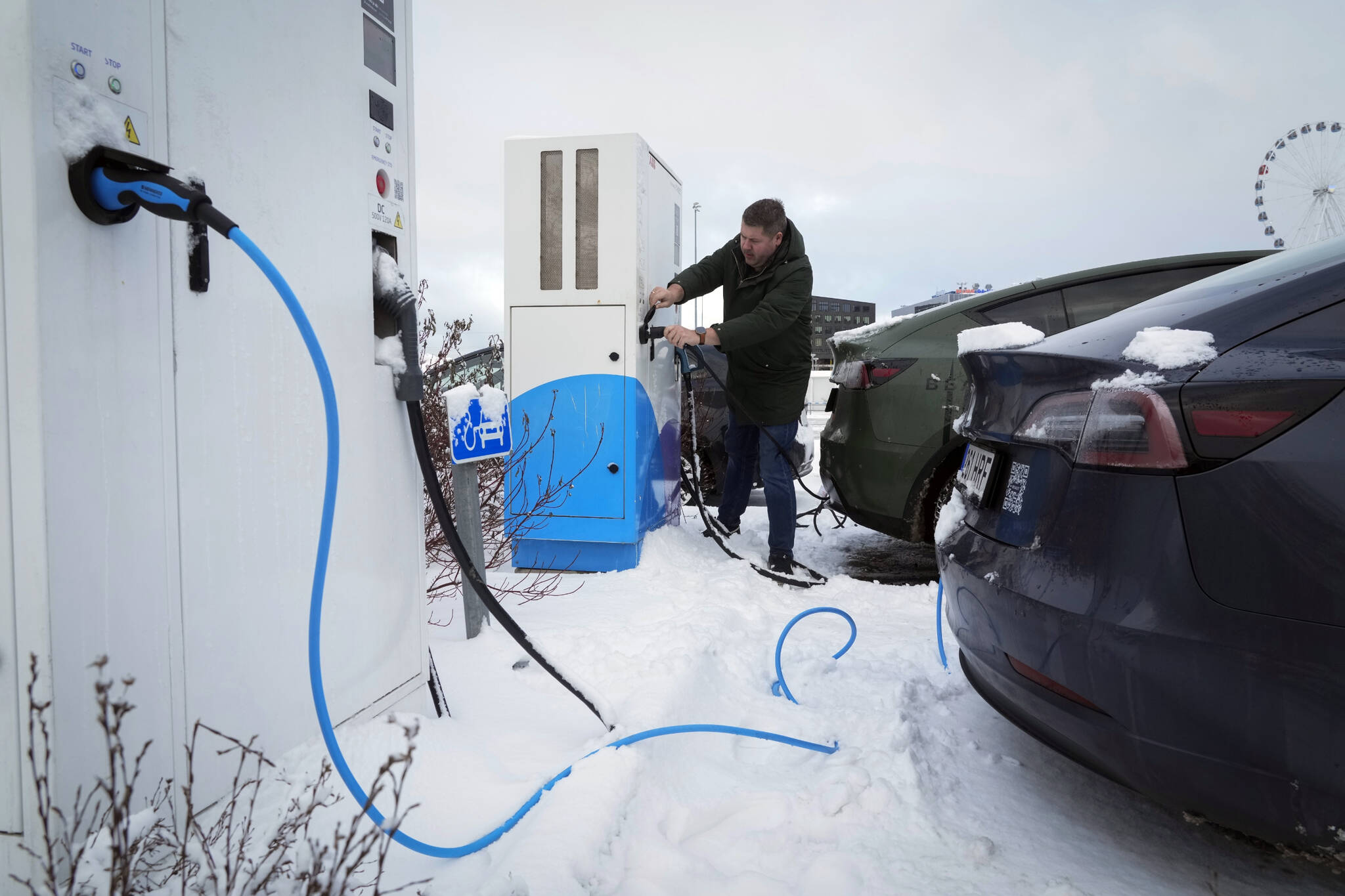
Many owners of personal electric vehicles also are finding that long-distance wintertime travel can be hard. EVs can lose anywhere from 10% to 36% of their range as cold spells come at least a few times each winter in many U.S. states.
Mark Gendregske of Alger, Michigan, said it starts to get serious when temperatures drop to the 10-20 F range (minus 7 to minus 12 C). “I see typically more than 20% degradation in range as well as charging time,” he said while recharging his Kia EV6 in a shopping center parking lot near Ypsilanti, Michigan. “I go from about 250 miles of range to about 200.”
Gendregske, an engineer for an auto parts maker, knew the range would drop, so he said with planning, the Kia EV still gets him where he needs to go, even with a long commute.
Some owners, though, didn’t anticipate such a big decline in the winter. Rushit Bhimani, who lives in a northern suburb of Detroit, said he sees about 30% lower range in his Tesla Model Y when the weather gets cold, from what’s supposed to be 330 miles per charge to as low as 230. “They should clarify that one,” he said while charging just south of Ann Arbor on a trip to Chicago.
Around three-quarters of this EV range loss is due to keeping occupants warm, but speed and even freeway driving are factors. Some drivers go to great lengths not to use much heat so they can travel farther, wearing gloves or sitting on heated seats to save energy.
And to be sure, gasoline engines also can lose around 15% of their range in the cold.
The range loss has not slowed EV adoption in Norway, where nearly 80% of new vehicle sales were electric last year.
Recent tests by the Norwegian Automobile Federation found models really vary. The relatively affordable Maxus Euniq6 came the closest to its advertised range and was named the winner. It finished only about 10% short of its advertised 354 km (220 mile) range. The Tesla S was about 16% percent under its advertised range. At the bottom: Toyota’s BZ4X, which topped out at only 323 kilometers (200 miles), nearly 36% below its advertised range.
Nils Soedal, from the Automobile Federation, calls the issue “unproblematic” as long as drivers take it into account when planning a trip. “The big issue really is to get enough charging stations along the road,” and better information on whether they’re working properly, he said.
Temperatures ranged from just freezing to minus 2.2 F (0 to minus 19 C) during the test, over mountains and along snow-covered roads. The cars were driven until they ran out of juice and stopped.
Recurrent, a U.S. company that measures battery life in used EVs, said it has run studies monitoring 7,000 vehicles remotely, and reached findings similar to the Norwegian test.
CEO Scott Case said many EVs use resistance heating for the interior. The ones that do better are using heat pumps.
Heat pumps draw heat from the outside air even in cold temperatures, and have been around for decades, but only recently have been developed for automobiles, Case said. “That is definitely what needs to be in all of these cars,” he said.
Inside batteries, lithium ions flow through a liquid electrolyte, producing electricity. But they travel more slowly through the electrolyte when it gets cold and don’t release as much energy. The same happens in reverse, slowing down charging.
Neil Dasgupta, associate professor of mechanical and materials science engineering at the University of Michigan, likens this to spreading cold butter on toast. “It just becomes more resistant at low temperatures,” Dasgupta said.
General Motors is among those working on solutions. By testing, engineers can make battery and heat management changes in existing cars and learn for future models, said Lawrence Ziehr, project manager for energy recovery on GM’s electric vehicles.
Last week, GM sent a squadron of EVs from the Detroit area to Michigan’s chilly Upper Peninsula to test the impact of cold weather on battery range.
Despite stopping to charge twice on the way, a GMC Hummer pickup, with around 329 miles of range per charge, made the 315 mile trip to Sault Ste. Marie with only about 35 miles left, barely enough to reach GM’s test facility. After finding a charging station out of order at a grocery store, engineers went to a nearby hotel to get enough juice to finish the trip.
At universities too, scientists are working on chemistry changes that could make cold weather loss a thing of the past.
The University of Michigan’s Dasgupta says they’re developing new battery designs that allow ions to flow faster or enable fast charging in the cold. There also are battery chemistries such as solid state that don’t use liquid electrolytes.
He expects improvements to find their way from labs into vehicles in the next two to five years.
“There’s really a global race for increasing the performance of these batteries,” he said.
