
The National Park Service issued a vessel speed restriction in the eastern portion of Lower Glacier Bay until further notice.
Glacier Bay National Park and Preserve Superintendent Tom Schaff announced Friday that all vessels must comply with a 13-knot speed limit, according to a media release.
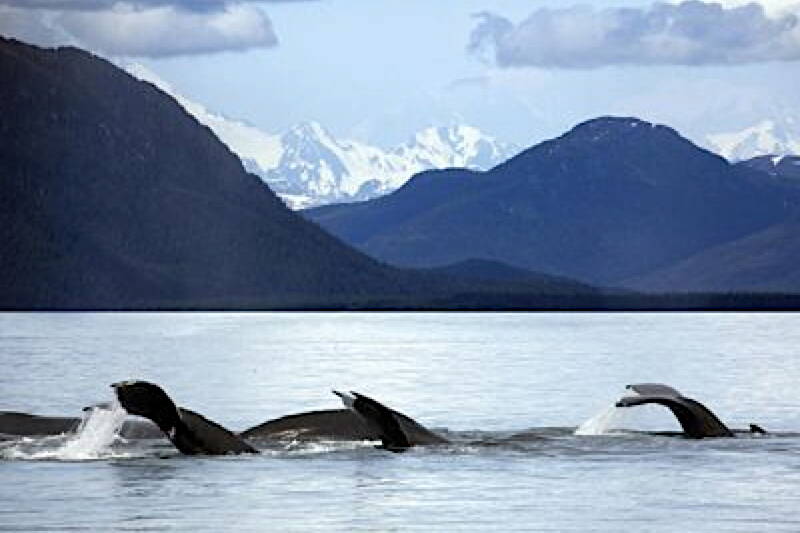
That’s because there are at least nine humpback whales, including a mother and calf pair, feeding consistently in the area, that are at risk of collisions with vessels, according to the release. In addition, new temporary whale waters are being implemented in an area centered around Sebree Island to protect at least 16 whales that are feeding in this area, including two mother and calf pairs.
This is the first speed restriction of the season in Glacier Bay, but they’re not uncommon depending on the time of year, said National Park Service spokesperson Matthew Cahill.
“So the whales show up here in spring, and they leave in the fall to head back to Mexico or Hawaii. And when they’re here and the concentrations are significant, we try to manage vessel speed limits to avoid collisions. And also to avoid disturbing their feeding,” he said.
Cahill said that to his knowledge there have not been any whale strikes in the area and law enforcement rangers are patrolling to ensure that boaters comply.
“This is our way of reducing disturbance and lowering the risk of whale or vessel collisions. And it’s been a long term project for us to carry that forward. Boaters really have some responsibility, no matter how fast they’re going in the waters, but we tried to help out by identifying where the concentration is and managing speed limits in response to that,” Cahill said.
Vessel strikes are the leading cause of death in whale populations, already decimated by intensive whaling over the last 200 years.
There’s still a lot to learn about these marine mammals, but scientists say they play a vital role in sustaining the ecosystem.
According to researchers at the National Oceanic and Atmospheric Administration or NOAA, when whales feed, like the ones in Glacier Bay, they’re doing it at depths in water that are often pitch dark and then returning to the surface to the photic zone, where there is enough light for
photosynthesis to happen. This is where they release “fecal plumes” rich in iron and nitrogen, which are often very scarce in the surface waters – it fertilizes the plant plankton that can only survive in the photic zone.
More plankton means more animal plankton, on which the larger creatures feed. In other words, more whales mean more fish and krill.
And, that plankton also absorbs carbon dioxide from the atmosphere – when eventually it sinks to the ocean floor, it takes this carbon out of circulation, down to a place where it remains for thousands of years.
Part of a larger effort to protect whales
The whale waters effort in Glacier Bay is part of a larger effort to reduce whale deaths.
Rachel Rhodes, project scientist at the Benioff Ocean Science Laboratory in Santa Barbara, California, leads the WhaleSafe project that aims at reducing the threat of ship strikes to endangered whales.
“It’s a near real time whale detection system, as well as it provides vessel speed analytics, for all large vessels that are traveling through the vessel speed reduction zones,” she said.
In California, the vessel speed reduction zones are voluntary, where all large vessels are asked to slow down to 10 knots or less to help protect endangered whales from the risk of ship strikes.
“There’s a number of these types of zones, there’s some up in Glacier Bay. And then on the East Coast, there are a number of zones that are put in place to protect the North Atlantic right whale. So they have some mandatory and voluntary zones that are all along the US Eastern Seaboard, as well as up in the Gulf of St. Lawrence.” Rhodes said.
WhaleSafe uses moored buoys to listen to whales 24/7 for whales, which then automatically classify the species of whale that is calling using software on board and checks it against the library of calls.
“So we’re getting that information via satellite,” Rhodes said.
The second component of WhaleSafe is oceanographic data. It uses a model to look at weather forecasts and satellite data to predict whether blue whales will be in shipping lanes on any given day.
The final component is data collected by naturalists, researchers, and citizen scientists who are out in the water.
“They’re collecting those sightings using Whale Alert, which I believe is actually what folks are using up in Glacier Bay as well. So we get those sightings in near real time. And that’s a great piece that I always like to tell folks, if anyone is ever out on the water, there is a cellphone app, you can download and use,” she said. “It’s a great physical science tool as well for anyone who’s interested.”
According to the latest report from NOAA, on the east coast there have been six North Atlantic right whale deaths. Three of them are confirmed fatal vessel strikes this year and three other calves presumed dead with one confirmed death from gear entanglement. NOAA estimates there are just 360 right whales left including fewer than 70 reproductively active females. But Rhodes said the numbers don’t tell the whole story.
“It should just also be mentioned that what we do see washing up on shore or on the bow of a ship is really just a fraction of what’s occurring out on the water. Because most of these strikes go unreported, or unnoticed,” she said. “You have these really massive ships that are 1000 feet [or more]. And so sometimes when they hit a whale, they don’t even know that it has happened. So it’s kind of a difficult number to get an exact correct amount on. But we do look at how many we are seeing washed ashore, and then folks will do necropsies on them to see if there’s any evidence of vessel strike.”
Whale ship strikes are a bit of a blind spot, Rhodes believes. Most people know what roadkill is, she said, but many have never thought about what is happening out at sea.
“But it’s something we’re all very connected to, especially as consumers, over 80% of our goods travel on a ship to get to us. Maybe we don’t think about it, but we should start thinking about whether the ways that we’re getting our goods and shipping things are done in a way that is safe for whales,” she said. “I know a lot of us don’t have the privilege of being out on the water next to the ocean, but it is something that we’re all very, very connected to.”
• This story was originally published by the Chilkat Valley News.
