
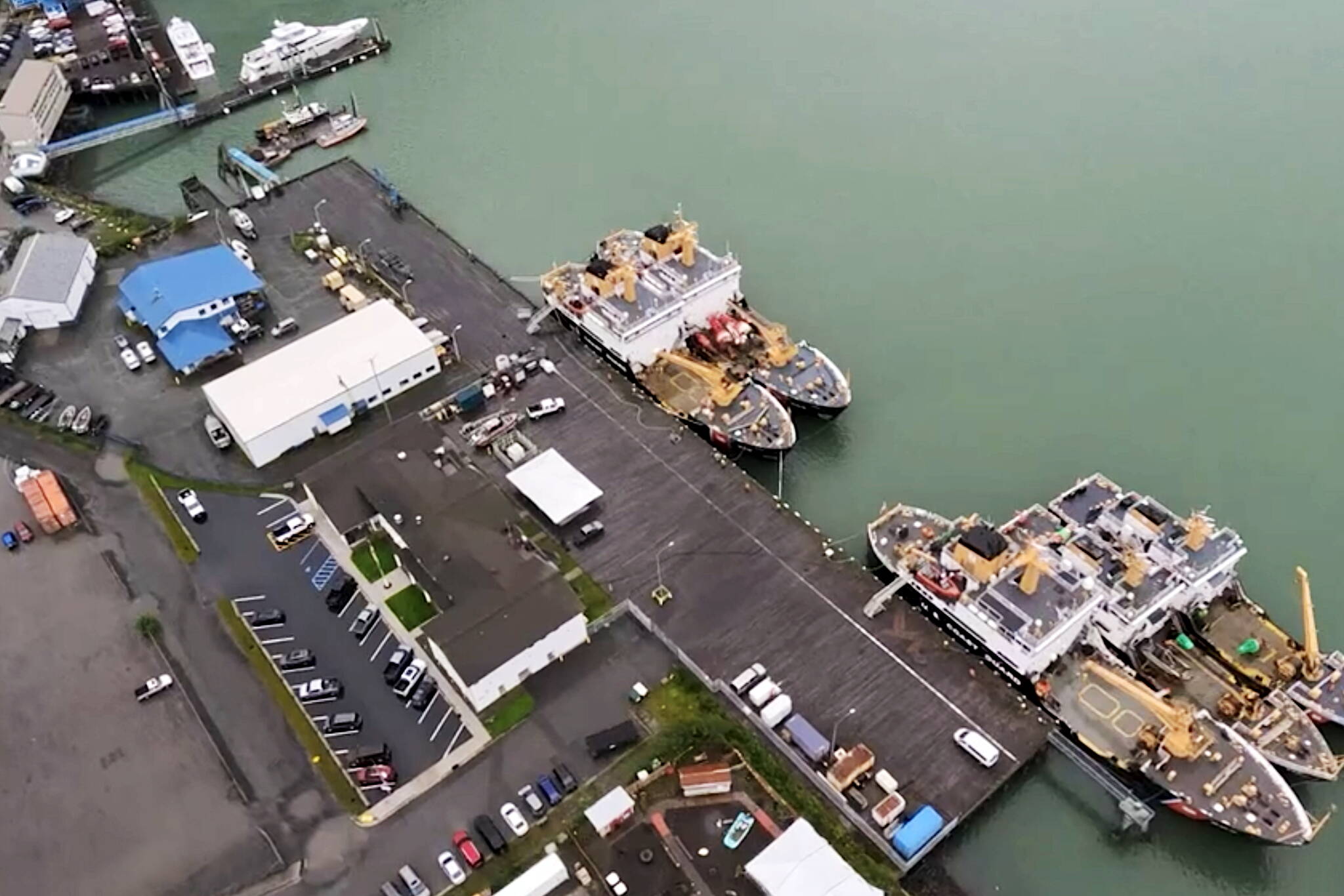
While the celebratory announcement is a private icebreaker acquired by the U.S. Coast Guard will be ready to homeport in Juneau within 18 to 24 months, a lot of work besides converting the ship needs to happen first and “unfortunately the Coast Guard hasn’t had a very good track record of aligning the assets that they’ve got coming,” U.S. Sen. Lisa Murkowski said during a visit to Juneau on Friday.
The Coast Guard announced last Wednesday the Aiviq, a 360-foot-long private U.S.-registered vessel built in 2012, will be converted for Arctic deployment and homeported at the Coast Guard’s dock in downtown Juneau. About 190 crew are expected to be assigned to the vessel, meaning infrastructure to support the ship’s operations as well as the crew and their families will be needed as well.
“There’s a lot of attention focused on the ship, but that’s just one piece of it,” Murkowski said in an interview. “Until you have the pier for the ship that ship is going to be somewhere else. Until you have the the shoreside facilities for the crew that ship may be someplace else.”
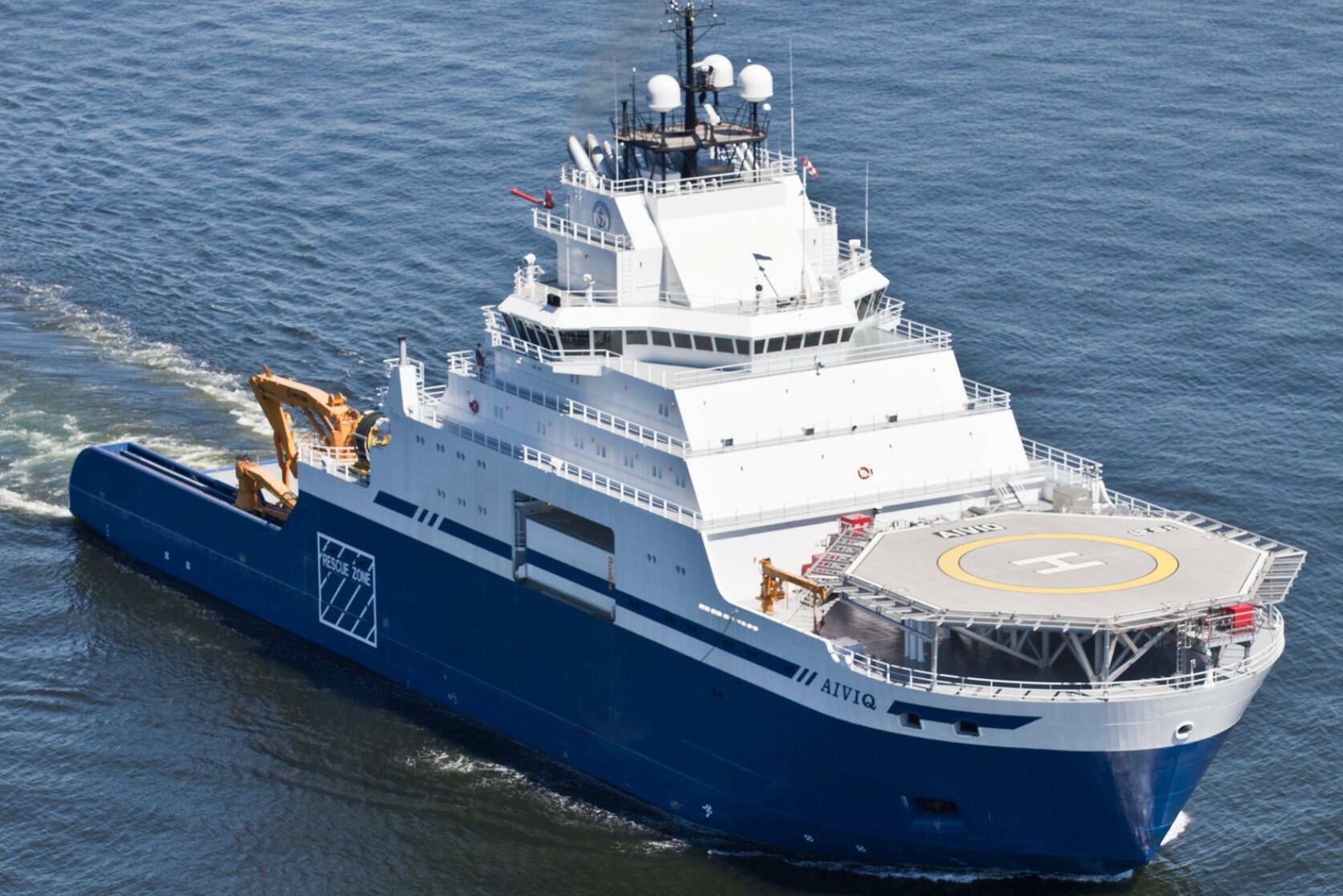
The Aiviq, a private icebreaker the U.S. Coast Guard is purchasing for Arctic operations with Juneau as its home port, is seen on March 24, 2012. (Courtesy of the U.S. Coast Guard)
Juneau already has an acute housing shortage, although Mayor Beth Weldon said in an interview Sunday a significant number of recently approved projects are underway throughout town. But in terms of what actions and/or funding Congress or the Juneau Assembly might need to take to help provide the facilities needed for the icebreaker, both Murkowski and Weldon said they essentially are waiting for a list from the Coast Guard.
“The big question is how do we help you make a transition to coming in here?” Weldon said. “What can we do as a community to help you find everything that you need? I mean, we definitely are behind this.”
A next step is forming a task group comprised of city staff in various departments, Coast Guard officials and other stakeholders to determine answers to such questions, Weldon said.
A concern, however, is delays by the Coast Guard in putting new ships into service, Murkowski said. She cited as an example Fast Response Cutters assigned for Sitka and Seward announced in 2018 that have stalled.
“We’ve authorized it, we’ve appropriated to it, but the Coast Guard wasn’t ready when the money was ready, so they reprogrammed it and so we got to start all over it,” she said.
Murkowski said she has discussed such issues at length with Coast Guard Commandant Adm. Linda Fagan, who announced the Juneau icebreaker during a visit to Alaska last week with Murkowski and U.S. Sen. Dan Sullivan.
“I’m pulling my hair out,” Murkowski said. “I talked to the commandant at great length about just the challenges that they have with alignment right now. We can’t have this icebreaker come before we’re ready to receive. We’ve got to have this all synced up.”
The somewhat encouraging news is “she is taking an approach that in my view is smart, but it’s not necessarily in keeping with how the Coast Guard likes to do things,” Murkowski said. “So she’s going to have to put her own political muscle into this and say ‘stop trying to make the perfect be the enemy of the good here.’”

U.S. Sen. Lisa Murkowski, R-Alaska, discusses on Friday support infrastructure that will be needed to homeport an icebreaker in Juneau. (Mark Sabbatini / Juneau Empire)
Homeporting a cutter is a multi-year process, according to Lt. Cmdr. Mike Salerno, a spokesperson for the 17th Coast Guard District, in an email responding to questions from the Empire.
“In addition to making a commercial icebreaker fit for military service, the Coast Guard will need to invest in a new pier designed for the loads associated with a ship of this size,” he wrote. “The design work needed to determine the scale and scope of the project will take approximately two years, and construction will take additional time. During that construction time, the ship can make port calls in the area.”
“In addition to the waterfront, the Coast Guard will work with the City of Juneau to address service member needs associated with vessel homeporting such as housing, medical, and childcare. I do not have data on exact numbers for housing units right now. It’s important to understand military crew requirements differ from commercial vessels.”
Officials have stated the Aiviq will need significant upgrades to be ready for military deployment, and even then won’t have the capabilities the Coast Guard is seeking for its heavy-duty ships. Murkowski said Fagan has stated “her admonition is we want this ship up north.”
“We need it in the water, so don’t, don’t tell me that it’s going to take four years to outfit this,” Murkowski said, paraphrasing Fagen’s remarks. “I want us to figure out a way to get its markings right. Basically, paint the ship to make it look like a Coast Guard ship and do the bare minimums, get it up there to work the summer, up here to work in Alaska, and then during the winter you can work to build out some of the more sophisticated comms packages.”
Murkowski said she’s hoping the Aiviq can be ready for deployment in Juneau with at least a limited crew by the summer of 2026. Weldon said deployment with a full crew may take longer.
“When we last talked to Adm. Fagan she said three to four years out before everybody would be fully up,” the mayor said.
“In the meantime we are working on things like childcare,” Weldon said. “That’s one of the reasons we opened up (former school buildings) Floyd Dryden and Marie Drake, was to try to get more childcare. As far as the docks go we have already told them that they can use ours because it would be mainly in the winter when they would be here. They can use our docks as they fix the Coast Guard docks on the waterfront.”
Officials have estimated up to 600 people could move to Juneau, including the families of personnel, with the deployment of the icebreaker. While that will include plenty of children added to a school system that this year underwent a consolidation due to budget shortages, Weldon said Juneau School District leaders did factor the possibility of an icebreaker into their planning and there would be room to distribute the new arrivals throughout local schools.
Congress approved $125 million for the purchase of the icebreaker and in February a transfer of 2.4 acres of waterfront property near the Coast Guard’s downtown facilities for support infrastructure was completed by the National Oceanic and Atmospheric Administration was completed in February.
Sullivan, earlier this year, said it will likely take six to seven years before the Aiviq is fully equipped and has the support mechanisms in place for full service.
Members of Congress, notably Sullivan, spent several years attempting to approve the purchase of the Aiviq for the Coast Guard as part of a larger effort to boost the U.S. icebreaker fleet and military capabilities in the Arctic, citing aggressive expansion in the region by Russia and China as a primary motivator. But the Coast Guard’s Polar Security Cutter (PSC) program, which seeks to replace three aging vessels with three heavy-duty ships for polar region deployment, has experienced a multitude of delays that means the first such ship may not be ready until 2030 instead of this year as initially hoped.
Murkowski said she doesn’t know yet from the Coast Guard what the possible cost of support infrastructure such as a new dock, a maintenance warehouse, administrative building and other facilities will be. Once that’s known, the issue becomes “how do we make sure that whoever the (U.S.) president is understands that this has to be a priority” and is included in his/her budget — adding she believes both Democratic Vice President Kamala Harris and former Republican President Donald Trump would support such funding.
Local funding for projects — plus other actions such as donating land — will likely be part of the Juneau Assembly’s agenda as part of providing support for the icebreaker, Weldon said. But she said she believes the benefits the ship will provide far outweigh the costs of bringing and homeporting it here.
”They’re going to buy things and pay property tax,” she said. “They’re going to buy stuff and pay sales tax, so it would be a nice financial move for the city.”
• Contact Mark Sabbatini at mark.sabbatini@juneauempire.com or (907) 957-2306.
