
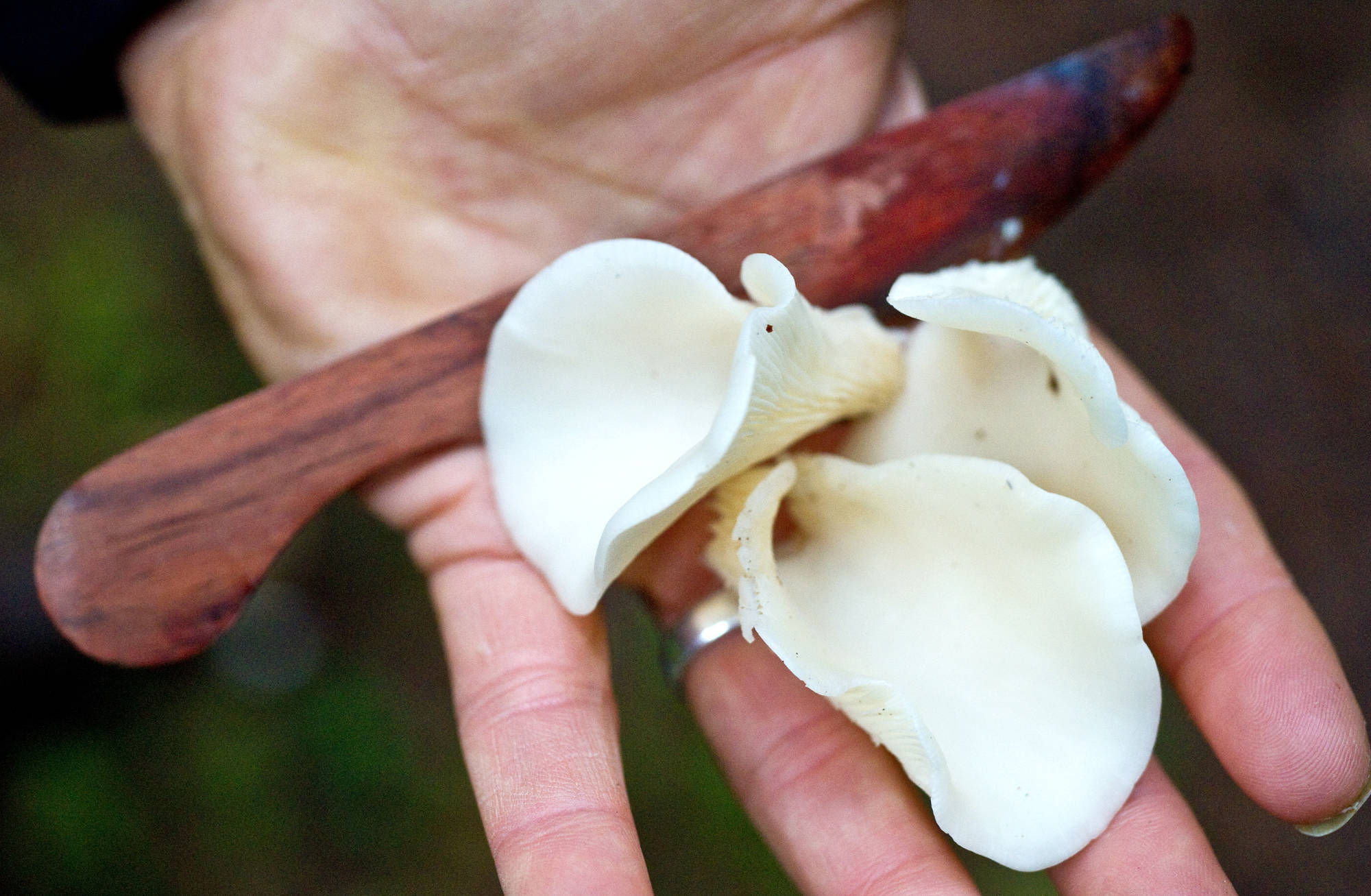
There are tens of thousands of fungal species, which are classified in a kingdom all their own, neither plant nor animal. We become acquainted with some of them in unlikable ways, when they infect us or show up as mildew on our roses. Although we bemoan those fungal invasions, other fungi have been useful to humans in many ways.
Just consider, for a moment, what our lives might be like in the absence of fungi. There wouldn’t be yeast-leavened bread, so no hot-cross buns, chocolate eclairs or ordinary PB&J sandwiches. No beer or wine, so although South Franklin Street might become more attractive, New Year’s Eve parties might be staid and quiet — and the highways would be much safer. Without penicillin and other antibiotics derived from fungi, we (collectively) would a lot sicker and maybe, in some cases, dead. Some folks would miss the hallucinogenic fungi and many would rue the lack of delectable chanterelles and boletes. Those that create fabric items would miss the many hues of dyes derived from fungi.
Of more fundamental importance, however, are the ecological roles of fungi. Many fungi form connections with the roots of trees, shrubs and herbaceous plants, providing nutrients from the soil to the plant in trade for carbohydrates from the plant’s photosynthesis. These mycorrhizal fungi contribute significantly to the health and growth of the partnered plants. Our forest would be a poorer place without them!
Thus the fungi give, but they also take away: they are major decomposers of plant and animal matter. If dead trees and leaves didn’t decompose, ultimately the forest floor would be buried and no understory could grow. So, no winter food for deer, no high-bush cranberries or blueberries. Leaves and stems of dead grasses and sedges would make a thick, impenetrable mat over the meadows. Perhaps the only places new trees or grasses could grow would be on recently exposed bare soil (think of receding glaciers, landslides, post-glacial uplift), and then it would be only certain kinds of plants that could cope with conditions there. Furthermore, we’d be surrounded by carcasses of dead animals and small trailside mountains of dog poop that would be only partially diminished by bacterial action.
The activities of fungi sometime appear in unexpected places. For example, recent research has shown that fungi play a role in the formation of hair ice — those wonderful curls of extremely slender filaments of ice (only about one hundredth of a millimeter thick!) that emerge from sodden branches when the temperature is just below freezing, and the air is humid and still. This story has a beginning over a hundred years ago, with Albert Wegener, the astute fellow who recognized the fact that the continents move around. In addition, he noted that hair ice appeared on damp branches of deciduous trees and shrubs that were also laden with fungi; he then surmised that the fungi had something to do with the formation of that hair ice. After a long delay, recent research has confirmed that surmise. Although those old, wet branches harbor several kinds of fungi, one in particular is consistently associated with hair ice. That fungus (Exidiopsis effusa) is a decomposer of wood; it somehow also shapes the ice hairs, preventing the tiny crystals from coalescing into bigger ones. Organic matter in the hair ice, such as decomposed lignins from the wood, might be involved, but that remains to be determined.
Scientists have also discovered a new genus and species of fungus that has medicinal value, known and used in Chinese folk medicine for hundreds of years. This fungus grows on a certain kind of bamboo, as do other species in a related genus. These fungi contain compounds called hypocrellins, which are effective against viruses, bacteria and fungi, when they are activated by light. And now we know that this new species does too. It just took science a while to catch up with traditional knowledge.
• Mary F. Willson is a retired professor of ecology. “On The Trails” is a weekly column that appears every Wednesday.
