
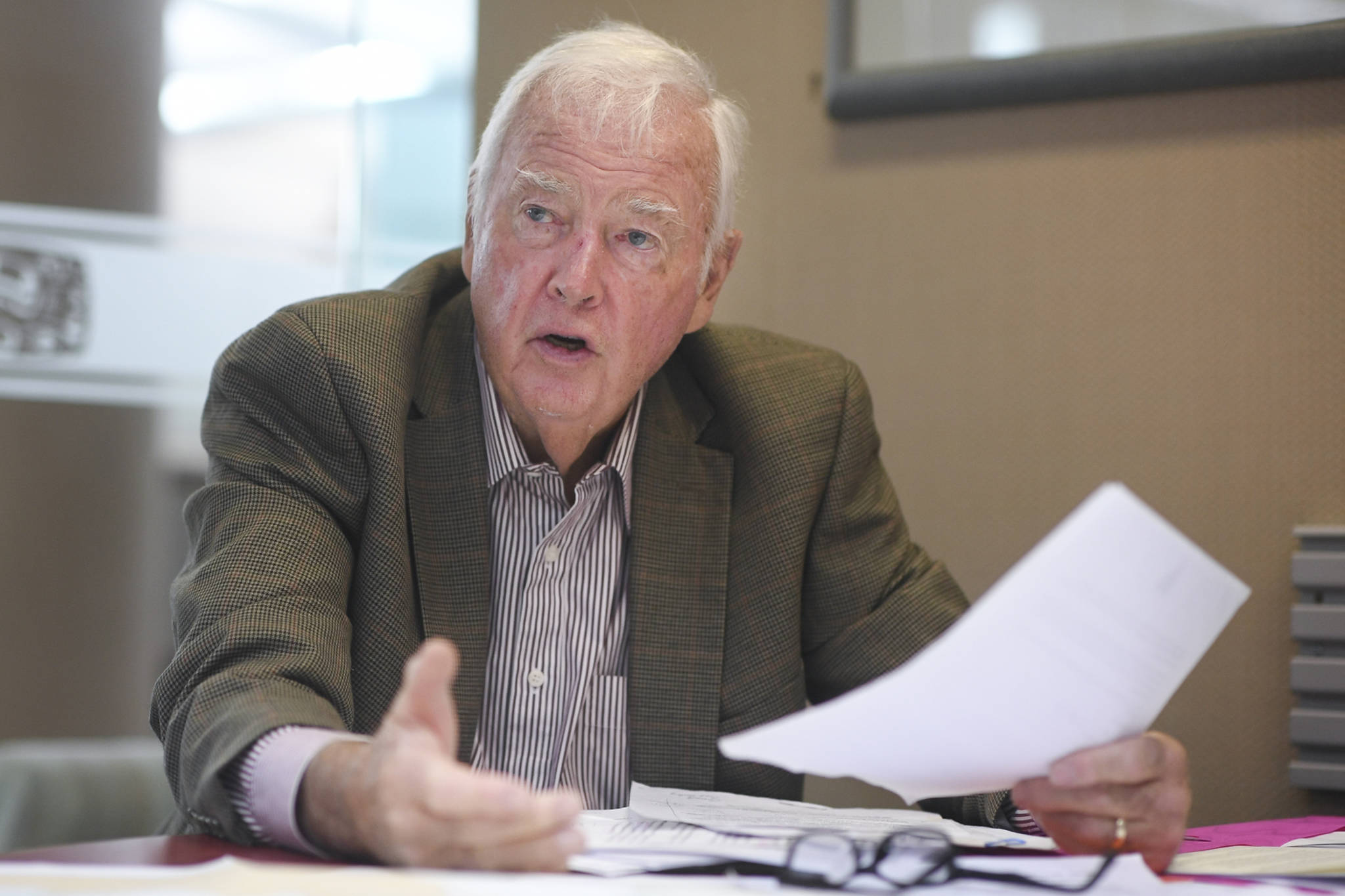
Thirteen years after his time as Alaska’s governor, Frank Murkowski still has some unfinished business.
In an interview with the Empire, Murkowski explained that while he was governor, the United States Department of Agriculture’s Forest Service and the State of Alaska entered into an agreement to build roads through federal lands in Southeast Alaska. That agreement, detailed in a memorandum of understanding, laid out a plan to build roads that would connect communities, shorten ferry trips and even lead to Canada.
There were and still are multiple roadblocks to making that plan a reality, both Murkowski and his former Chief of Staff Jim Clark explained Thursday. The 2001 Roadless Rule, which prohibits road building on protected National Forest land, is the main one. After a request from former Gov. Bill Walker, the Forest Service is examining the possibility of having an Alaska-specific exemption from the Roadless Rule that could allow for the construction of roads and timber operations in the Tongass National Forest.
[Land swap to lead to logging in Southeast]
Murkowski, 86, said he’s meeting with leaders throughout the state, including Department of Transportation and Public Facilities Commissioner John MacKinnon and Ben Stevens, a policy advisor to current Gov. Mike Dunleavy, to talk about the importance of building roads in Southeast.
“I’m not retained by anybody, I do this on my own,” Murkowski said. “My interest is expanding Alaska’s resource development. Without a strong economy, the state can’t exist. That’s why we are in trouble now, because we depended on one source of revenue.”
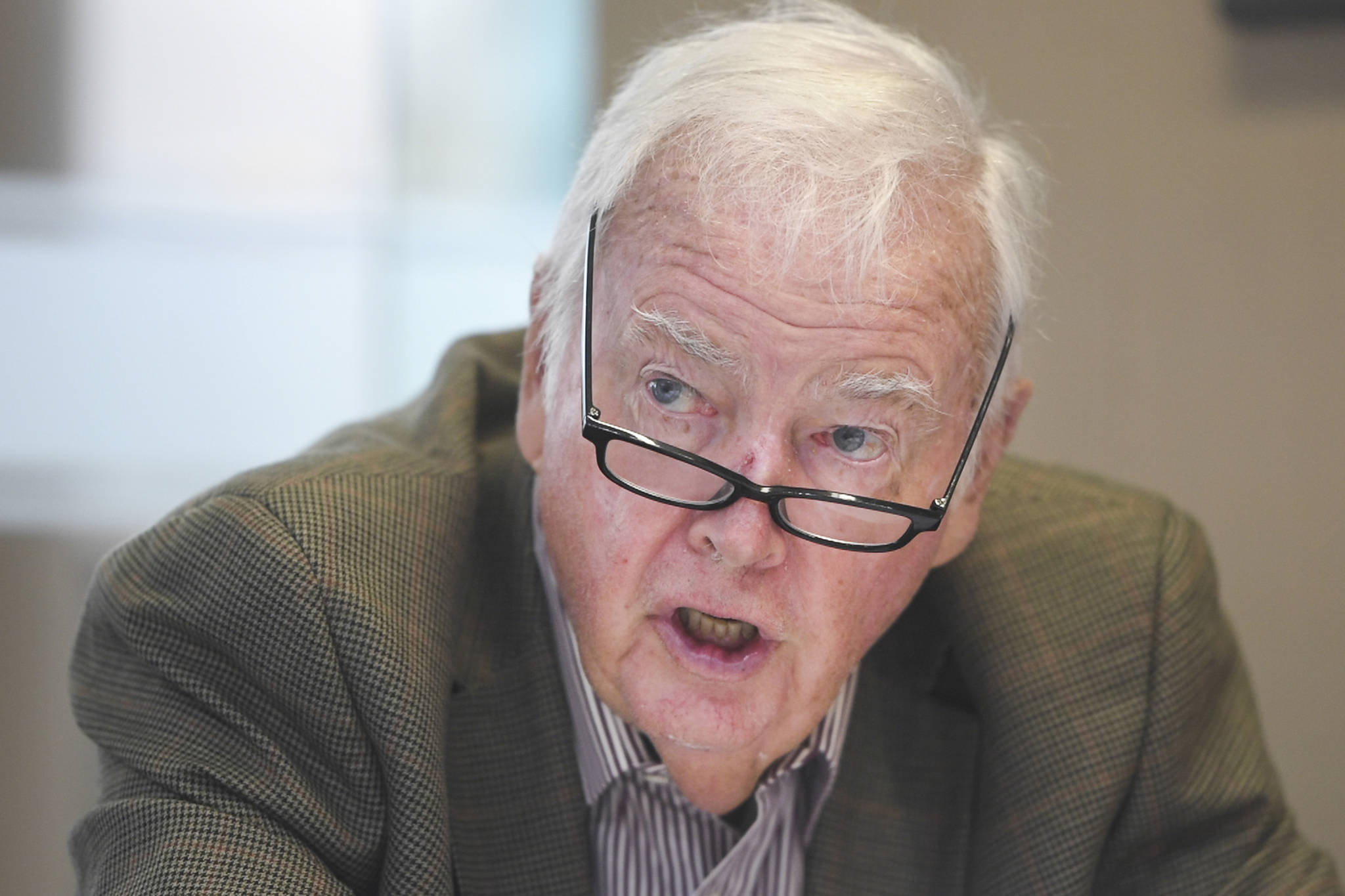
Former Gov. Frank Murkowski speaks on a range of subjects during an interview with the Juneau Empire on Thursday, May 9, 2019. (Michael Penn | Juneau Empire)
As Murkowski, who was a U.S. senator from 1981-2002 and served as Alaska’s eighth governor from 2002-2006, watched the current legislative session, he started thinking more about this plan. In particular, talks about the future of the Alaska Marine Highway System got him thinking.
Dunleavy has proposed massive cuts to the ferry system, including a proposal to stop ferry service at the beginning of October for the winter, to help balance the state’s budget. The Alaska House’s budget proposal cuts about $10 million compared to the Senate’s $44 million cut and the governor’s proposed cut of about $98 million. Building more roads and reducing the length of ferry runs would make the system more efficient, Murkowski said.
“While it isn’t going to necessarily address the immediate cash flow problem associated with the ferry,” Murkowski said, “its value is planning a future objective of roading in Alaska is what this thing is all basically about.”
[As final budget decisions approach, ferry supporters flood Capitol steps]
The plan of building these roads in Southeast is still only a general one. There’s not a current cost estimate, Clark said, and they haven’t heard back from British Columbia officials about whether there would be roads built on the Canadian side for Alaska’s roads to meet up with.
Murkowski wrote a letter to U.S. Department of Agriculture Secretary Sonny Perdue recently asking for a complete exception from the Roadless Rule. In the letter, Murkowski wrote that anything but a total exception from the rule would be a disservice to resource development in the region, including timber, mining, geothermal and hydroelectric development.
He’s particularly interested in reviving timber industry in the area after many pulp mills and timber projects went under in the early 2000s. Timber, Murkowski believes, is a reliable and renewable resource that can bring jobs and and economic boost to the region.
[State considers adding additional terminal in Juneau for new ferries]
Environmental groups near and far have pushed back against proposed timber sales in Southeast Alaska in recent years. Just this week, eight conservation organizations filed a lawsuit against the Forest Service over a large proposed timber sale on Prince of Wales Island. Murkowski said he believes Outside interests, including national environmental organizations, have gotten too involved in Alaska issues.
“The environmental groups are using Alaska as a poster child for expanding their base, generating revenue,” Murkowski said, “and we’re far away and people can’t objectively necessarily evaluate and we have such a huge federal ownership that Alaska belongs to everybody. Who owns Alaska? At times, we wonder.”
The federal government and Forest Service own nearly 17 million of Southeast Alaska’s 21 million acres, Murkowski said.
In 2011, the state filed a lawsuit against the Forest Service seeking to overturn the Roadless Rule. That litigation is ongoing, Murkowski said, and he feels the Dunleavy administration is on his side. Clark said Murkowski’s commitment, even at the age of 86, is admirable and that Murkowski is always busy.
“We are constantly in touch, constantly interested in these issues,” Clark said. “Why? Because he grew up in Alaska and spent 22 years in the Senate, and this one is, as he said, unfinished business from our administration.”
• Contact reporter Alex McCarthy at amccarthy@juneauempire.com. Follow him on Twitter at @akmccarthy.
