
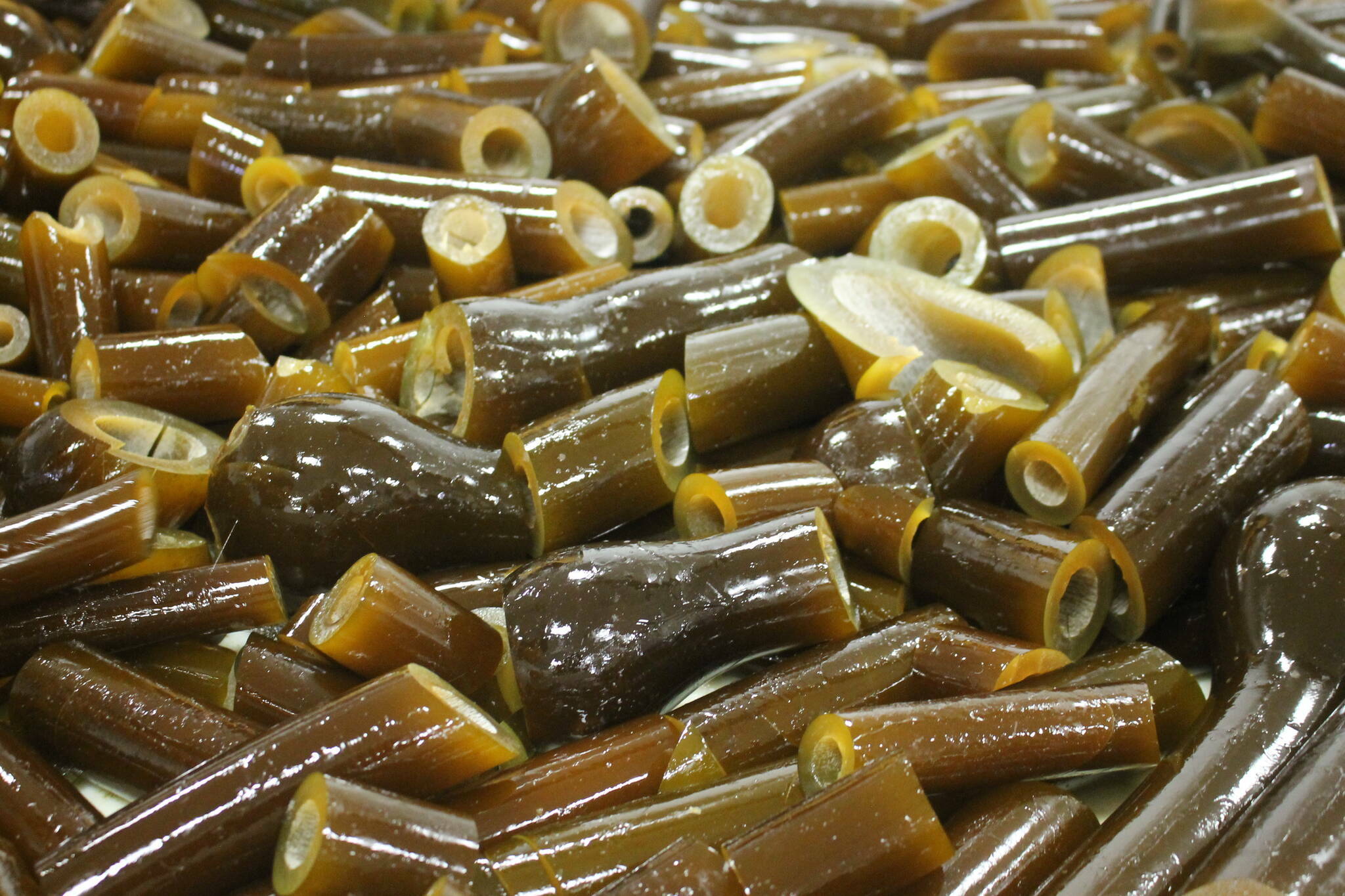
For the last year, Sea Quester, a seaweed farming company based in Juneau, has been making progress growing kelp. Among its creations is a kelp burger whose sales topped 500 at the Southeast Alaska State Fair. But its main focus is improving on ways to farm sea kelp for more than just burgers — and scalability is the key.
Sea Quester is one of 15 companies awarded grants totaling more than $1.27 million from Alaska Mariculture Cluster Joint Innovation Program through Alaska Fisheries Development. The cluster is designed to accelerate innovation in the Alaska mariculture industry by funding applied research and development projects which address barriers to growth in Alaska’s mariculture industry.
Juneau companies garnered four of the grants, which cover innovations in processing, bull kelp farming, mooring systems, and boosting oyster growth and shellfish enhancement. The companies are Barnacle Foods ($97,625), Ostrea Engineering Project ($100,000), Sea Quester Farms ($98,958) and Pacific Hybreed Project, which is in Juneau/Little Port Walter, ($90,723).
It comes at a very good time for Sea Quester, which is just starting its second year.
“This changes a lot for us,” said Jonny Antoni, founder of the company. “It allows us to test something we think will make it possible to scale farm production, to make a farmable product or commodity.”
They will use the grant to test two different ways of growing bull kelp. The first way is an array tethered to the surface, and the other, known as a benthic array, is tethered to the seafloor.
“The first is a long line with two anchors, laid down and picked up at the end of the season,” Antoni said.
The other one is much more difficult to put in place, he said. It involves attaching anchors to the ocean floor, a “brutal” dive to plant in November, and the last one to harvest. But the crop has to be monitored in the meantime and part of the grant money will be used for cameras.
“It is our theory that the array on the seafloor will do better because it mimics the tide,” Antoni said. Sea Quester will prepare a report on the results. The grant comes with a sense of relief.
“Last year I pretty much funded the whole thing myself,” he said. “This grant makes it so we can become profitable.”
The Mariculture Cluster is part of the work of the Southeast Conference, the winner of $49 million in EDA’s Build Back Better regional challenge. Its wider mission is to support efforts that promote strong economies, healthy communities and a quality environment in Southeast Alaska.
Here are the Juneau-based recipients:
• Title: Evaluating and Sharing Methods to Efficiently Dry Kelp for Rural Communities
Lead Entity: Barnacle Foods
Funding Amount: $97,625
Project Summary: Seeks to recommend a cost-effective method to dry kelp on a small scale in remote coastal communities that are closest to the site of kelp farms. Goal is to break down barriers to the growth of the mariculture industry, and involvement of rural and Native communities who are faced with high energy costs, limited labor capacity, and opportunity to cultivate kelp.
• Title: Evaluating Infrastructure and Seeding Methods for Scalable Bull Kelp Cultivation
Lead Entity: Sea Quester Farms Project
Funding Amount: $98,958
Project Summary: Aims to further develop food-grade, commercially viable bull kelp cultivation techniques through trials conducted at local farm site. The proposed experiment aims to compare two factors: the growth of bull kelp on a surface array (tethered to the surface) versus a benthic array (tethered to the seafloor), and the growth of bull kelp on grow lines based on continuous seed spacing versus interval seed spacing. The goal is to simulate bull kelp’s natural growing conditions, overcoming existing problems with growing the species in Alaska.
• Title: Optimizing the tumble culture method to improve Pacific Oyster quality, and reduce labor for shellfish farms in Southeast Alaska Lead
Entity: Ostrea Engineering Project
Funding Amount: $100,000
Project Summary: Seeks to optimize aquatic farm gear to reduce labor, and increase oyster growth and yield. A team of engineers, oyster farmers and a biologist will design, fabricate, and test Alaska-specific and farm-specific tumble culture gear. Caging systems will be tested at three existing oyster farms spread out throughout Southeast Alaska.
• Title: Developing improved seed of the Pacific oyster for the Southeast Alaska regions
Lead Entity: Pacific Hybreed Project
Funding Amount: $90,723
Project Summary: Proposes a selective breeding program that targets Alaska conditions using controlled genetic crosses and rigorous field assessments of seed performance. Improving seed performance for specific environmental conditions also facilitates the development of broodstock, a critical component for breeding of aquaculture species. Among the goals is boosting oyster growth at nurseries or farms. Seeks improved understanding of seed performance in specific cold-water ocean conditions and establishing genetic lines suitable for the Alaska shellfish industry.
• Contact Meredith Jordan at meredith.jordan@juneauempire.com or (907) 615-3190.
