
HAINES — Inside the American Bald Eagle Foundation aviary in Haines, Education and Outreach Coordinator Sidney Campbell moved slowly, calling Sarah, a great horned owl, and tapping a nearby perch. Sarah studied her audience — then her requested perch — before bursting into a quick succession of flaps, alighting and then swiftly gobbling a small rodent part off the platform, her reward for granting Campbell’s request.
“Right now what we’re working on with Sarah is getting voluntary weight,” Campbell explained as she eventually got the owl to land on a special scale that is shaped like a perch. “Good girl. 1494 (grams).”
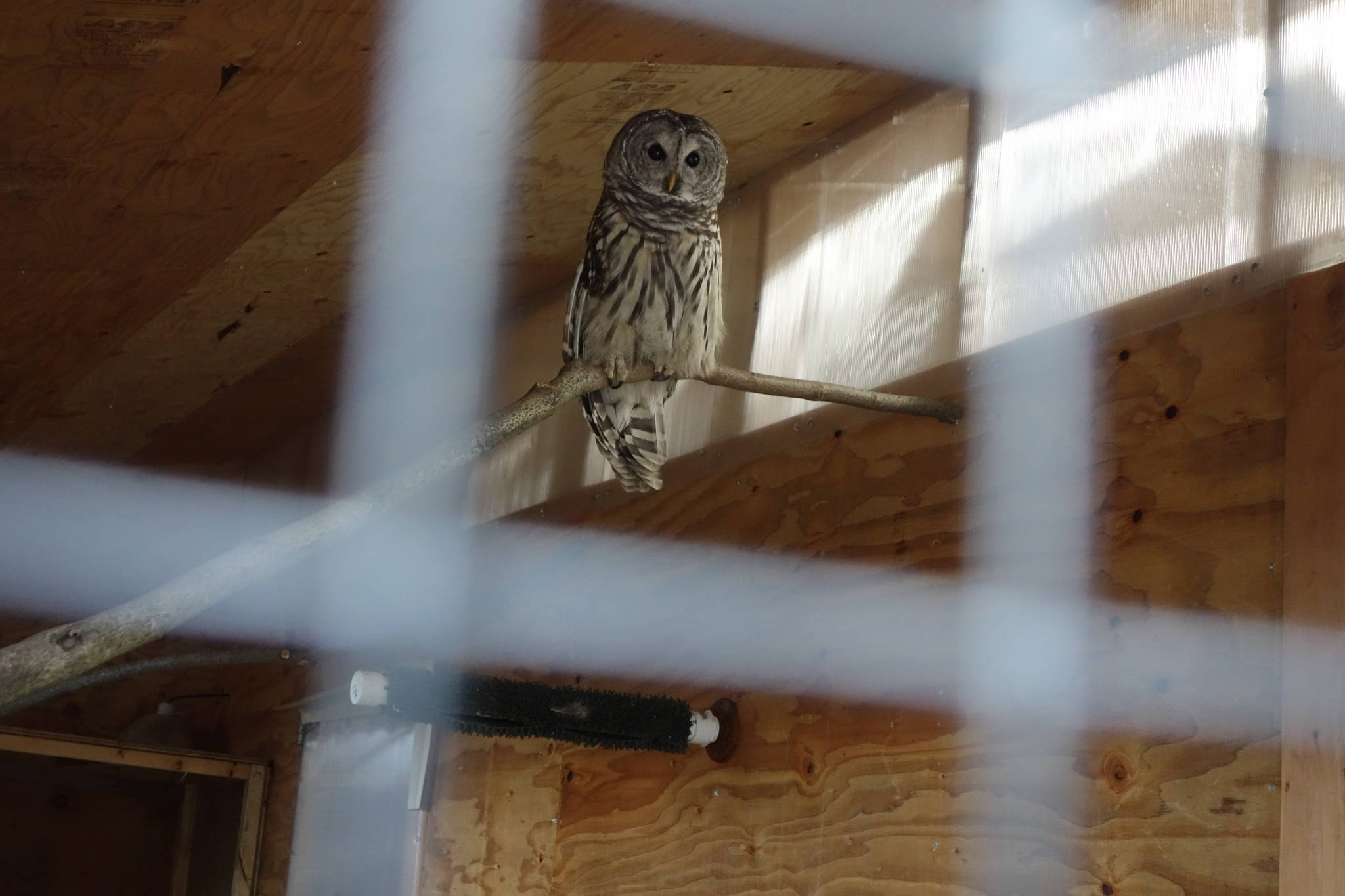
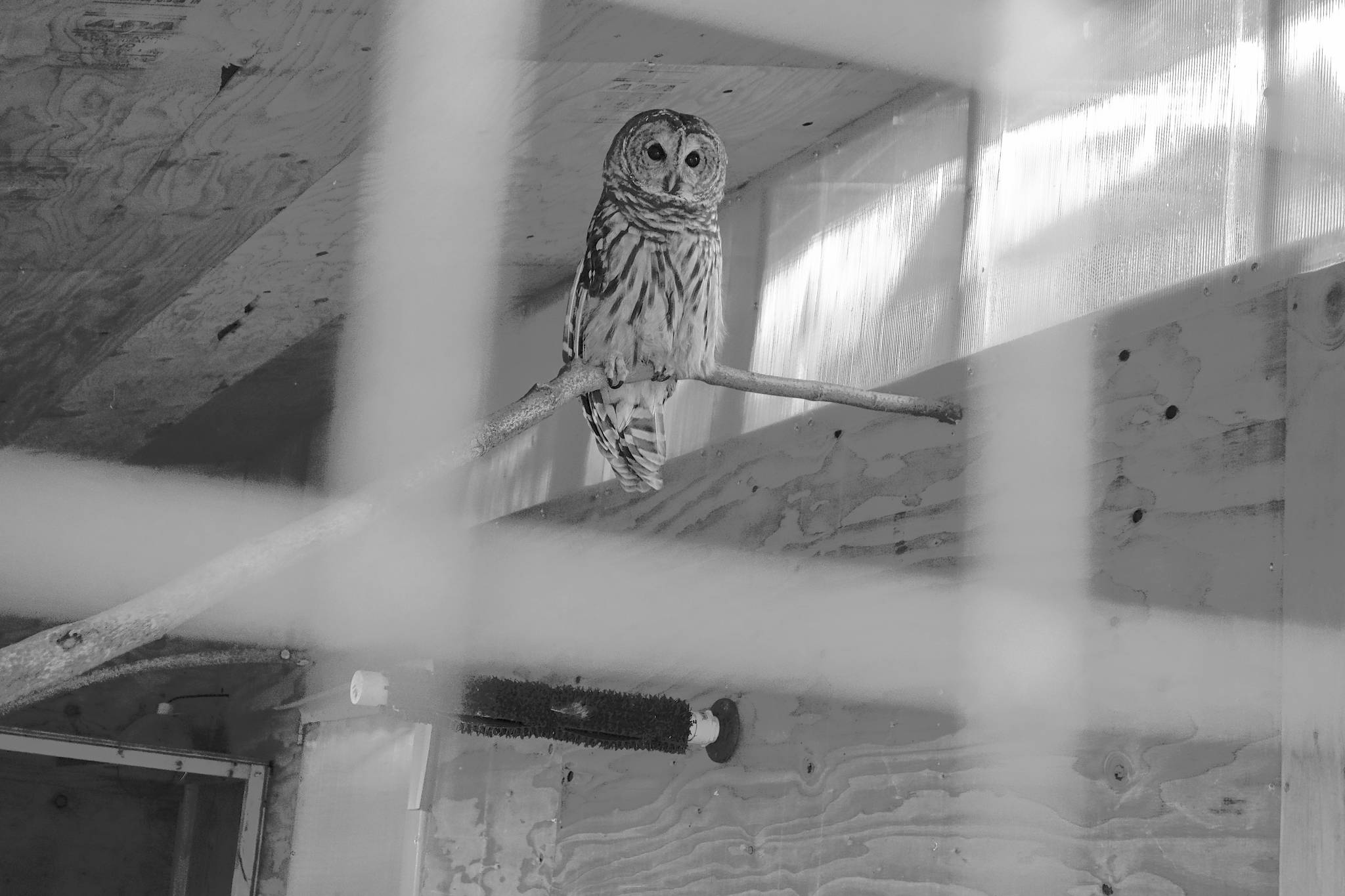
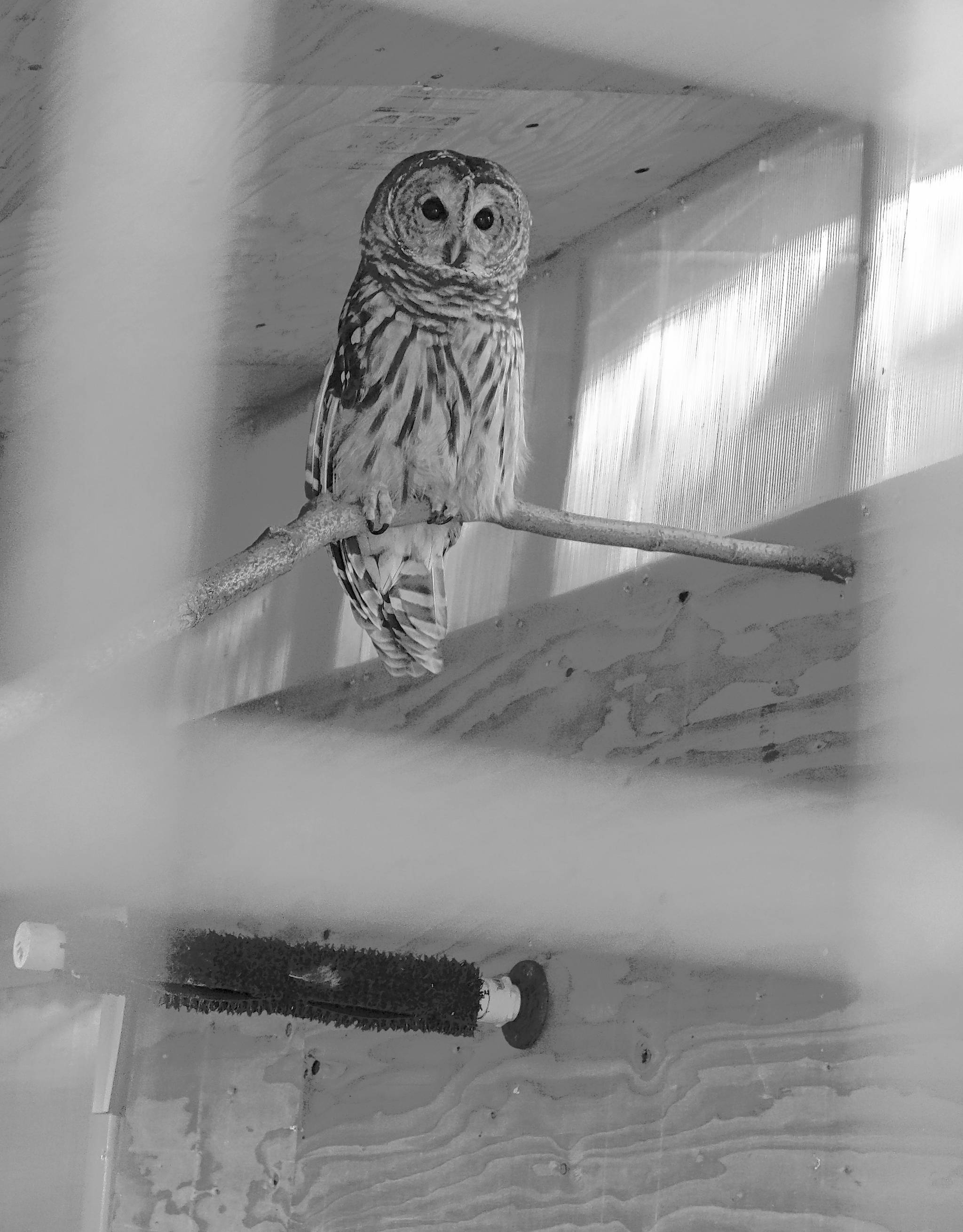
Currently, 12 avian ambassadors call the foundation home: three bald eagles, Arden, Bella and Vega; Zilla, a saker-lanner falcon; Warrior and Sitka, red-tailed hawks; Hans, a Eurasian eagle owl; Max, a merlin; Ole, a peregrine falcon; Dylan, an Eastern screech owl; and Hunter, a barred owl. Excluding Hans and Zilla who are conservation bred, non-native species of North America, and Ole, who was conservation bred for education, the other raptors were born in the wild but are unreleasable due to various circumstances. The birds serve as a public face to the foundation’s conservation message. Opened in 1994, the foundation’s mission is to educate visitors on the American bald eagle and other raptors through its aviary and natural history museum.
Each of the raptors has its weight regularly taken to ensure it’s healthy. Many of the raptors will eat directly out of a trainers’ hand, but Sarah is a nervous performing in front of others, something that Campbell and other trainers are working on her with.
All the training that the raptors undergo is done through positive reinforcement, Campbell said. Birds are never forced to do anything. This was clear when she and raptor care assistant Ashley Santiago went to the eagle enclosure with two female bald eagles, Vega and Bella.
“Right now the eagles are working on stationing, which is going to an assigned part of their enclosure when we ask them to. We’re working on scale training, so stepping on the scale when we ask them to, standing on it to get their weight. Then targeting, which is just going to the perch that we ask them to.” Sidney said.
Most of the birds were eager to participate, and some of the younger ones liked to be vocal about feeding time, like screeches from Ole.
“The birds are never asked to do something they’re not comfortable with. If they tell us no then the answer is no and that’s okay. When they choose to perform a behavior that we’re asking of them for they’re rewarded for that behavior,” Campbell said.
Each raptor is trained daily. At least once a week, birds are given puzzles to stimulate them mentally.
Caretakers try to make as comfortable a space for the birds as possible. They’ve done so well recently that they won the 2017 Enrichment of the Year award from the International Association of Avian Trainers and Educators. Campbell said Max’s enclosure, to which they’ve added higher perches, is an example. Now he can watch from a distance if that’s how he’s most comfortable.
The facility also boasts one of the only certified professional bird trainers in Alaska, Leia Minch, the raptor curator.
Minch took Hans, who she likes to call Alaska’s Most Handsome Owl, from the aviary inside the museum’s lobby so he could demonstrate his silent flight.
On command, Hans smoothly swooped off his perch and flew, low to the ground, all the way to Minch. Owls like Hans need to be silent to sneak up on their prey, Minch said, and the silence comes from the softness of their feathers. To give people a personal experience with that silence, she had a guest sit in a chair in the middle of the room while Hans flew right over their head.
“Rather than telling (guests) we get them involved in the process,” Minch said. “They experience it, they think they not only understand a little more but they care a little bit more. Ultimately, what we want all of the guests to do is have guests walk away caring about wildlife.”
A Mew Experience
The foundation launched a GoFundMe campaign in mid-February, “A Mew Experience,” in an effort to redesign the aviary and outside areas of the facility. The aviary is up to regulations for birds, but not all of it meets the requirements for humans, specifically the Americans with Disabilities Act.
Also, while the birds technically have enough room, the foundation would like more space for them to fly around. Campbell said they’d like to add more trees around the property as a wind and sound buffer. They’d also like to give birds the option of watching the world under a roofless enclosure or nestling in a corner under a roof, finding privacy from visitors and the elements.
“It’s all about adding more choice,” Campbell said.
There’s a planned learning plaza, a work space for demonstrations with the birds, a sunning yard and other landscaping to make the facility a more immersive experience for guests. Other improvements would address issues like not having to run hoses all the way between the main building and the aviary, and insulating the water line so it doesn’t freeze in winter (try cleaning cages without it!).
The proposed design changes will likely cost more than $800,000, Campbell estimated. Ideally, the foundation would be able to begin improvements this fall and finish before the tourist season begins in 2018. Campbell said they’ve been looking at grants, but the donations from the community have been critical. So far, they’ve received more than $13,000 dollars.
The museum portion of the foundation, which focuses on natural history, will not see many changes except the occasional display project by an intern or the donation of a new taxidermied animal. The museum hosts more than 200 taxidermied animals for display, models of sea life, local rocks and minerals, and interactive displays like pelts for petting (While a few of the animals were taxidermied after being hunted, a significant portion of the collection are animals that died of natural causes, Museum Coordinator Katelyn Dickerson said).
The foundation’s GoFundMe, along with a video explaining more on the foundation’s mission and design goals, can be found at: gofundme.com/amewexperience.
Contact staff writer Clara Miller at clara.miller@capweek.com.
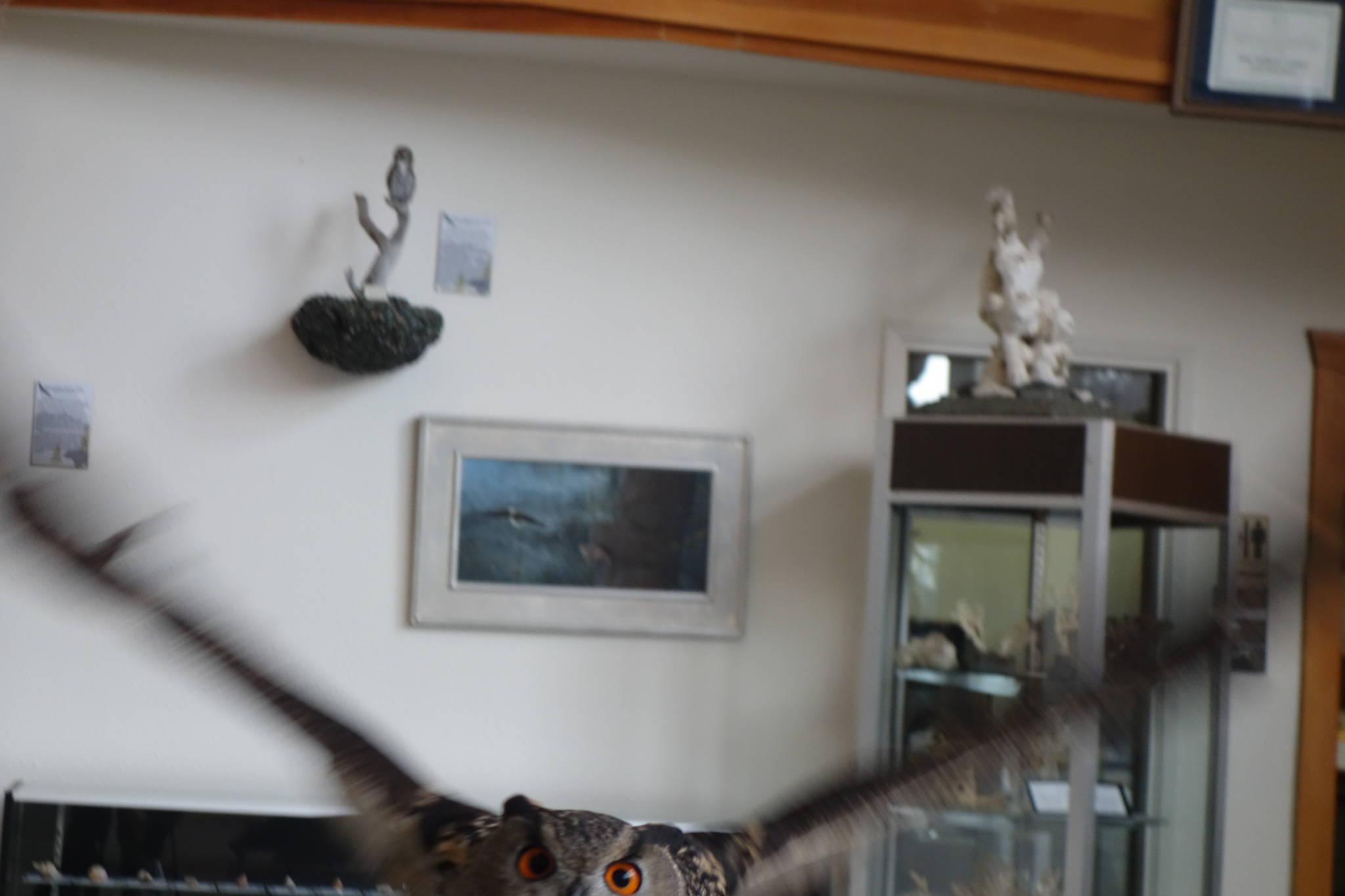
Hans takes flight over photographer’s head. Photographer was unable to capture his whole body due to his swiftness. Photo by Clara Miller.
Hans takes flight over photographer’s head. Photographer was unable to capture his whole body due to his swiftness. Photo by Clara Miller.
Hans takes flight over photographer’s head. Photographer was unable to capture his whole body due to his swiftness. Photo by Clara Miller.
