
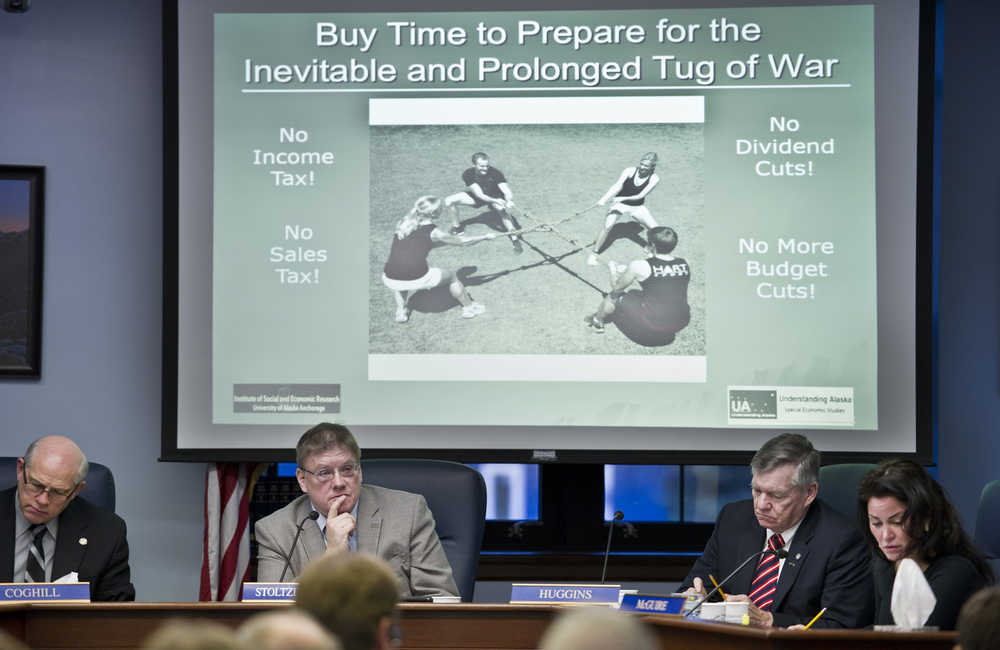
If there’s one thing Alaska’s lawmakers agree on, it’s this: No single trick or approach will solve the state’s annual deficit, now approaching $4 billion.
Most of the 60 legislators working in the Capitol agree on something else. No single trick or approach will do as much to solve the deficit as using the investment earnings of the $48 billion Alaska Permanent Fund. What they don’t agree on – not by a long shot – is how to use those earnings.
On Thursday morning, the Alaska Senate State Affairs Committee began considering three approaches that put the Permanent Fund to work generating revenue for Alaska’s state government. One approach comes from an Anchorage legislator. Another comes from the governor. A third comes from one of the state’s leading economists.
“This is the tool that we should make sure to put in place first,” said University of Alaska Anchorage economist Scott Goldsmith of all three plans, “because it provides the biggest part of the solution in terms of dollar amounts.”
In terms of impact on the state economy, using Permanent Fund earnings doesn’t have the negative implications of a tax on businesses or residents, and it’s something that can be done quickly.
“It’s the easiest to put in place,” he said.
All three proposals work similarly but differ in detail. All three involve preserving the Permanent Fund’s principal, the $48 billion investment account, and instead spending a fraction of the fund’s earnings reserve, an account that contains the money earned when the fund’s principal is invested in global markets. To compensate for spending from the earnings reserve, all three plans also channel some or all of the state’s oil revenue into the Permanent Fund. The fund invests that money, thus generating more money for the earnings reserve.
“None of these proposals produces money out of a hat,” Goldsmith said. “All of the proposals start out with the same asset base and the same revenue base.”
Goldsmith’s proposal, which has become known as the “Goldsmith Plan,” calls for diverting all of the state’s petroleum revenue into the Permanent Fund directly. The state would draw off $3.55 billion per year to pay for dividends and annual government expenses.
Senate Bill 114, proposed by Sen. Lesil McGuire, R-Anchorage, proposes taking 5 percent of the Permanent Fund’s value out of the earnings reserve every year. Dividends would be paid with three-quarters of all the state’s oil revenue. The other quarter of oil revenue would go to pay for state government. That would generate about $3.7 billion per year for the state.
Senate Bill 128, proposed by the governor, would sweep several of the state’s savings accounts, such as the Constitutional Budget Reserve, into the earnings reserve, supercharging it. Twenty-five percent of the state’s oil and gas royalties would go into the Permanent Fund, while 75 percent of those royalties and all of the state’s oil production taxes would go into the earnings reserve. The reserve would pay a dividend equivalent to half the previous year’s oil royalties. State government would be able to take a steady $3.3 billion per year for operations.
McGuire’s plan will receive its full debut and first discussion on Tuesday. The governor’s proposal will have its turn on Thursday.
This week was the Goldsmith plan’s debut. Legislators had few questions as the economist presented the proposal by phone, saying it offers the best chance for a sustainable draw without reducing state assets in the long term.
Goldsmith was followed by consultant Brad Kiethley, who offered his support for the Goldsmith plan, saying the other two proposals effectively cut the Permanent Fund Dividend and are a de facto tax on Alaskans.
“We need to consider under all of these government proposals … what the effect is on the private economy,” he said.
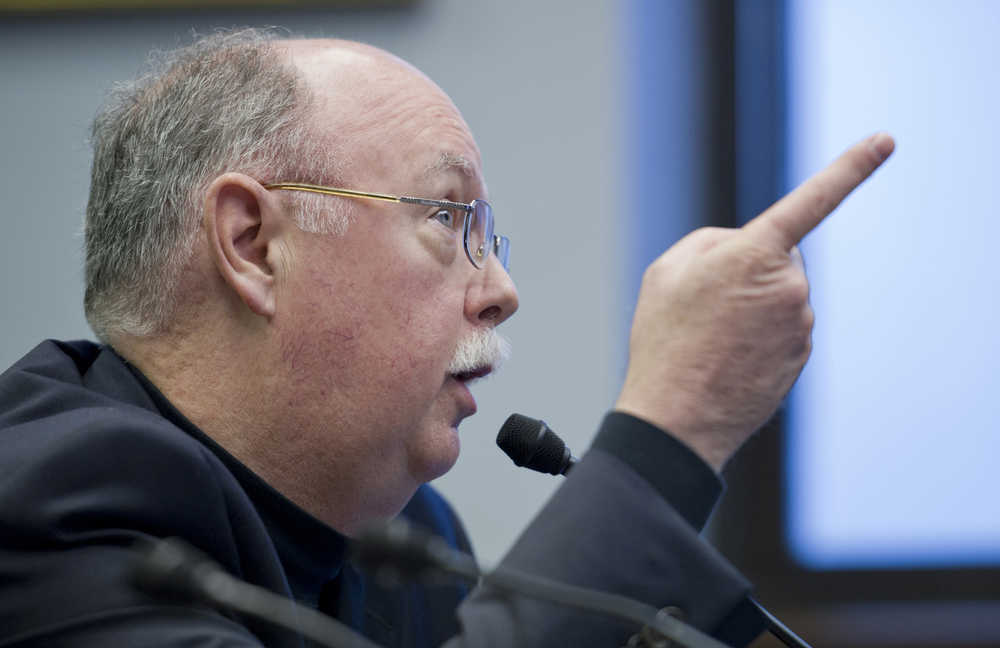
Brad Keithley, of Alaskans for Sustainable Budgets, speaks to the Senate State Affairs Committee about SB 128 and how it how affects the Alaska permanent fund at the Capitol on Thursday.
