
By Heather Holt
The start of a new year lends us the opportunity to look back through our photo files, think about what we are seeing and decide if we are loving what we are shooting or are just after the photo. A total reset is in order to take us into the New Year 2021 and make an impact with our photography to make it our best year yet!
Let’s start with capturing the shot. Great photography shouldn’t just document that you saw it; it should capture the moment. What will get you the best shot? Let’s start with a reminder and begin the year in Manual mode and Auto ISO.
■ Place the camera in manual mode and turn on Auto ISO
■ Then, set the shutter speed and the F/Stop (aperture); the camera will take care of the correct exposure.
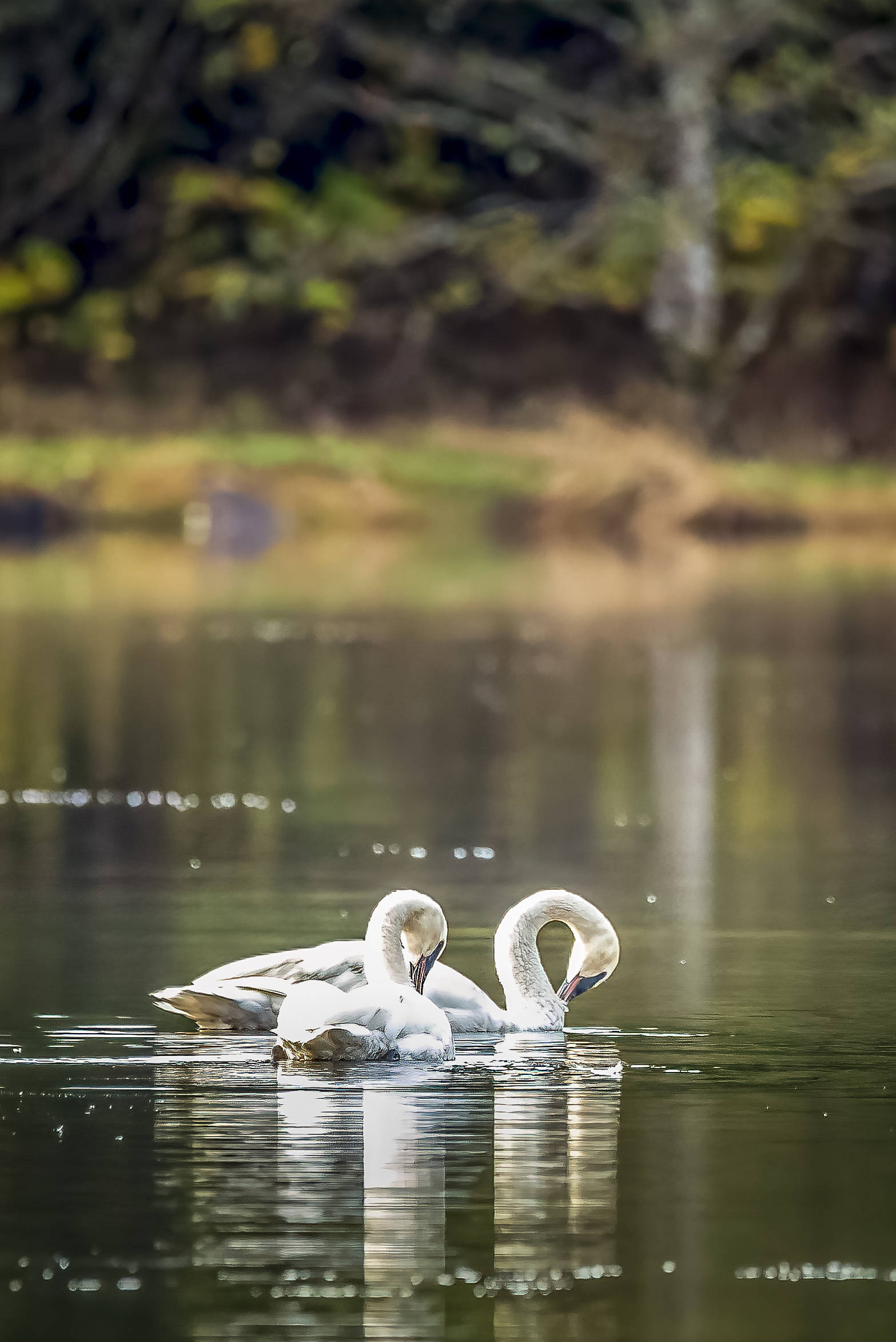
This pair of trumpeter swans were sighted at Amalga Harbor. In this case I was out looking for a nice subject that showcased the fall colors, my favorite time of year. I knew I wanted a compelling shot of these beautiful swans as soon as I spotted them; I found my sweet spot and started firing away. The perfect moment came with that brief moment of great lighting that I was able to take advantage of along with my fall inspired background that seemed to compliment and not compete with my subject!
In wildlife photography, in particular, the two most important factors are the shutter speed and aperture. You need to use enough shutter speed to get the sharp photo! Most of the issues people have with their photos usually are due to not enough shutter speed. The higher the shutter speed, the higher the keeper rate.
However, it’s not as simple as just plugging in shutter and aperture; you must be thinking about what you are shooting and what the shot is you are after! For Birds in flight, we know that a shutter speed between 1/1600- 1/4000 is a good range; 1/3200 being a great starting point. Be sure to use a faster shutter speed during takeoff and a smaller F-stop such as F 5.6 – F 8 if you have the light. For mammals 1/1250- 1/2000 is adequate although for fast moving animals you may need to bump that up. I haven’t gone higher than those numbers here in Southeast to include those rafts of fast moving sea lions we have witnessed lately!
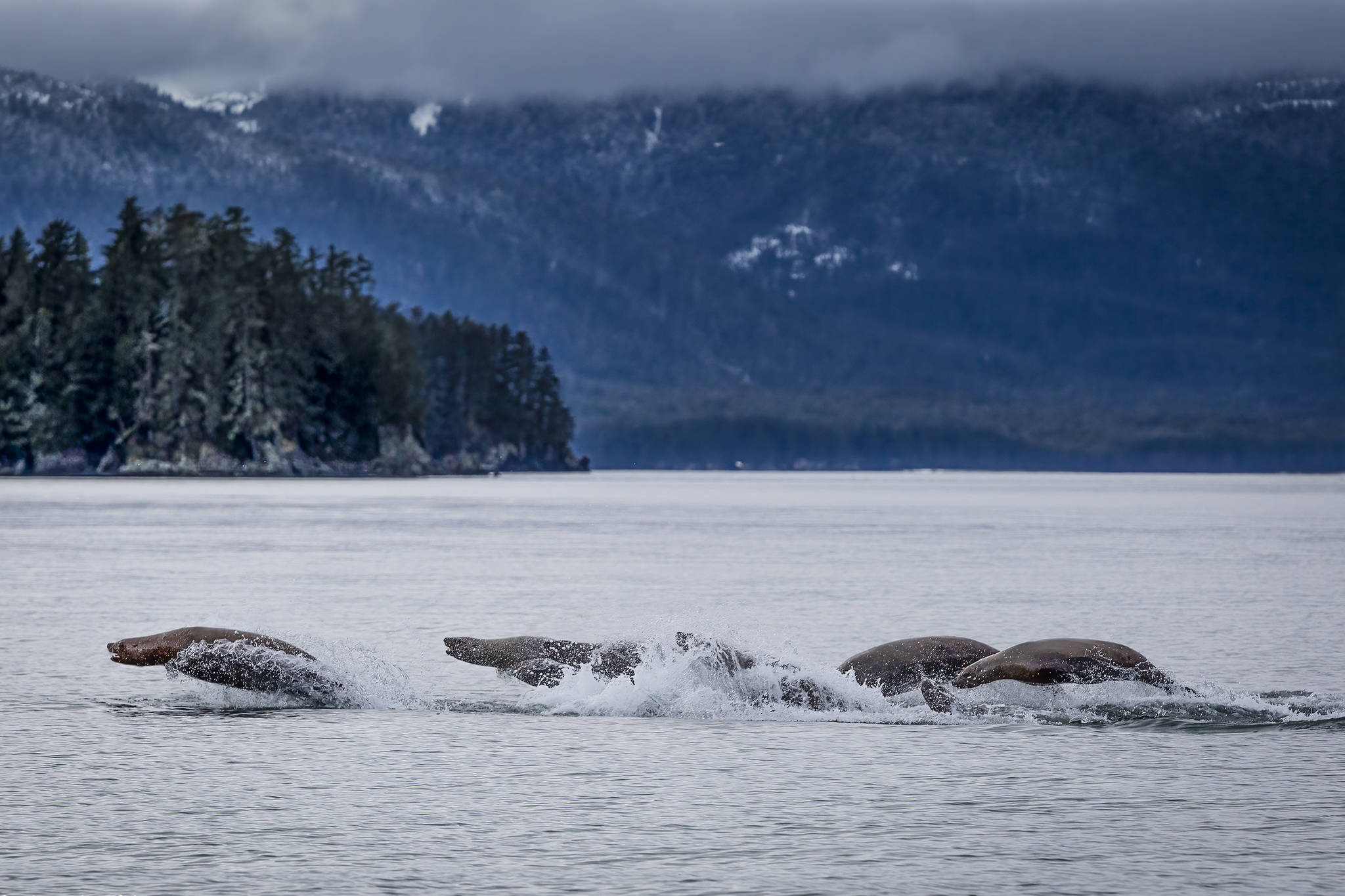
This raft of sea lions were playing escort to our local resident humpback whale, Flame, out near North Douglas. I was able to get just enough shutter speed at 1/1250th to stop the action and keep a balance with my ISO in these low light conditions being careful to keep in consideration the movement of the boat. Again, the more time you are out the better you get at it.
Keep in mind your ISO and the need to balance the shutter speed with it. However, if you have the light always favor the higher shutter speed to stop the action. You can be creative as well by dropping to a slower shutter speed and panning to create a blurred background — try using 1/15th – 1/60th with a tripod. For still subjects 1/60th – 1/250th can work as long as you have adequate support such as a tripod (yes breathing and chewing are motion) but be prepared if your still subject goes into motion (departing the branch); the tripod may not be helpful in this instance, so know your subject. Handholding? Depends on the individual so get out into your backyard and practice and decide if you are happy with the results.
A shallow depth of field is controlled by your aperture allowing you to separate your subject from the background. The closer to your subject the better results you will have so move to get a better background either by changing the photographer to subject distance or by using a longer focal length even if you don’t need it. Fast F-stops wide open create the separation between the background and the subject. I like to start with F4 on a full frame camera to capture that clean, smooth background. Keep in mind that your background can be as important as the subject so find the subject then get the background.
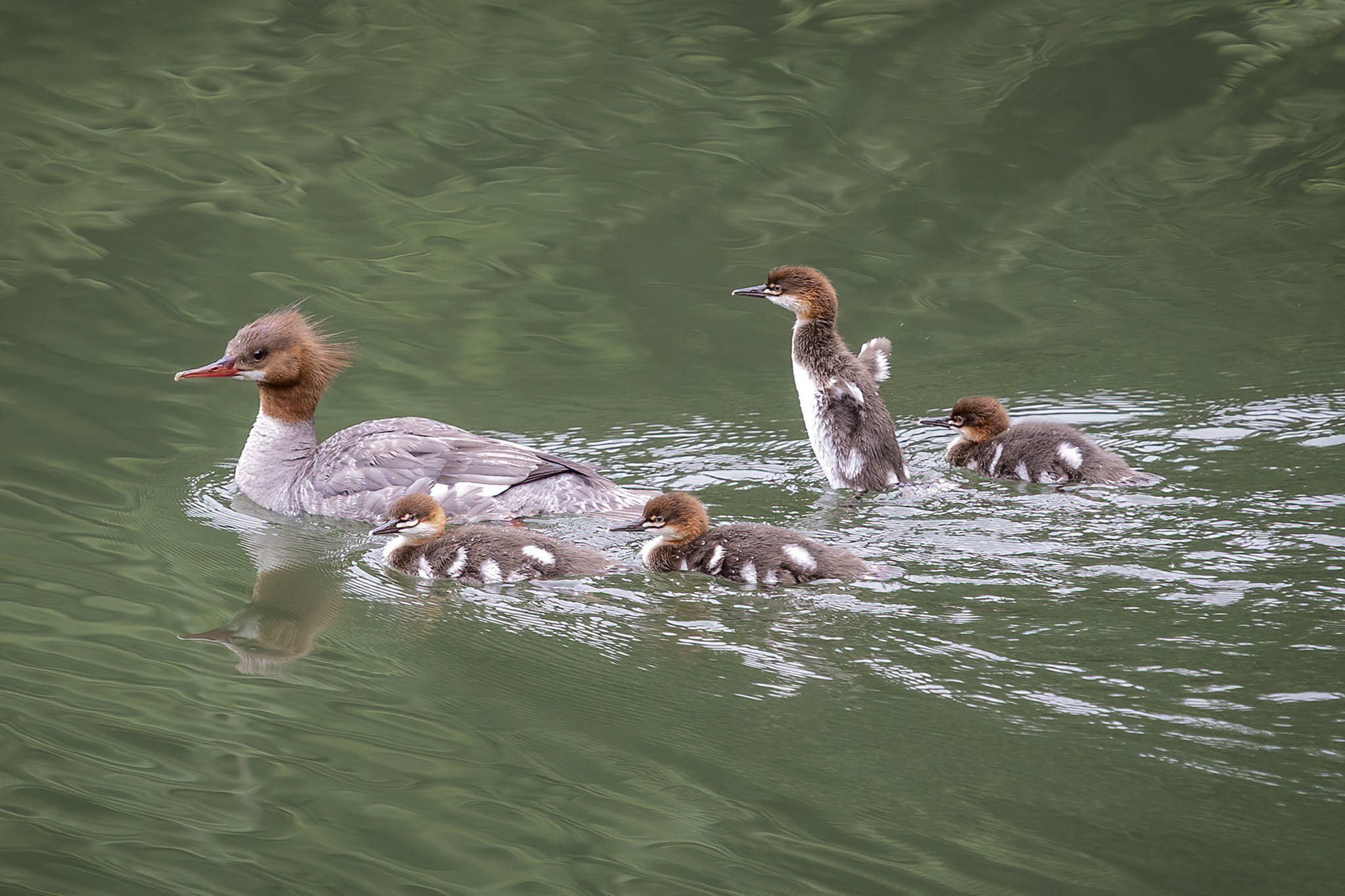
As I was leaving the overlook at the Mendenhall Glacier I saw movement in the pond along the boardwalk under a tree; this Common Merganser popped out followed quickly by her babies. The warm colors of the subject comes forward against the cool color and clean, smooth background achieving separation, an almost 3D look.
As we wrap up, don’t get greedy; pick an appropriate shutter speed and F-stop and watch your ISO in your viewfinder! Get in the habit of checking your settings anytime you bring that camera up to your eye. You can set you camera to ISO caps; my ISO Auto is set in the camera for 100-6400 as that would be the highest ISO I would like to use. Remember the amount of light you get is the amount of light you get. That’s especially true for those of us shooting year-round in Southeast Alaska. With that said, if you have a high shutter speed and the light drops; you will start noticing noisy photos so drop the shutter speed and let the Auto ISO do the work. The more time you spend in the field, the better you get at it and the more things you see!
A couple of tips:
— Focus on the eye! – Everyone looks at the eye first. If the eye is sharp, the rest of the image is sharp enough!
— Get to eye level! – it creates a unique look and grabs the attention of your audience!
— A good background can add to the story.
■ Watch for blurred out objects between you and your subject. Take a look over the lense for things such as twigs and blades of grass covering the eye of the cute fawn you just spotted.
— For Southeast photographers, overcast can be your friend. You can shoot all day and possibly get some shots that create a nice, soft look.
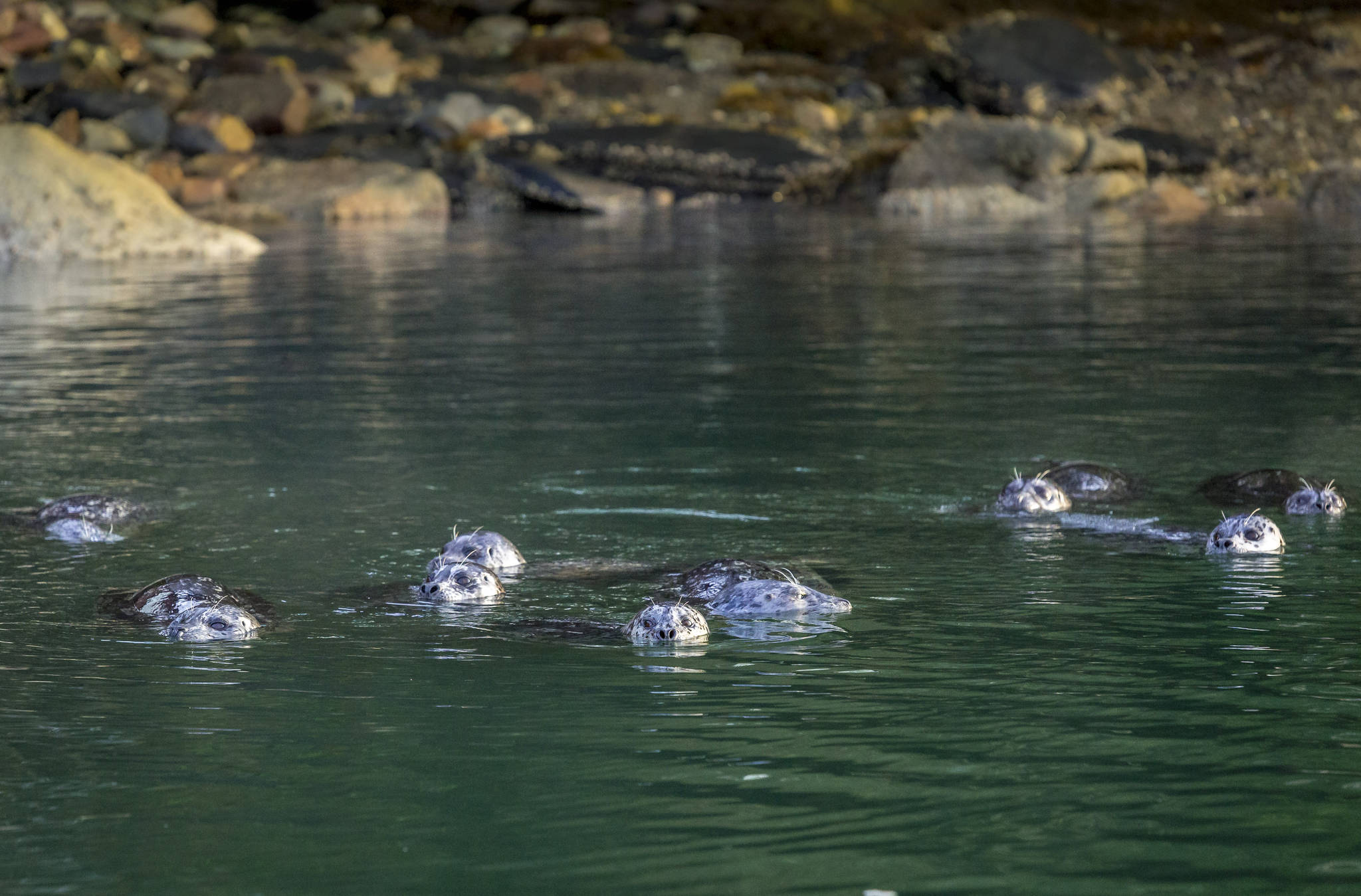
Focus on the eyes! I couldn’t pass up this bob of seals hanging at Auke Bay. I was able to take advantage of the great light at days end; that fifteen minutes before sunset and with a nice side light. This is much easier than capturing the golden hour; 15 minutes after sunrise- you have to get up early! Homework: what three things could have been done to this photo to make it better?
Be patient! Give the situation time to develop — it pays to spend time with your subject so let the moment happen. Happy Shooting!
• Heather (Burford) Holt is a fourth-generation Juneauite who offers photo workshops designed to improve camera skills while capturing photos in the Alaska wilderness. She can be reached at flyingakcaptured@gmail.com, or visit her website at www.flyingalaskacaptured.net/. “Focal Point” is meant to provide inspiration, education and opportunity for all with an interest in photography. It appears monthly in the Juneau Empire.
