According to the legend, the father of Icarus built wings of feathers held together with wax, so that father and son could escape from the island of Crete. Despite his father’s warnings, Icarus flew too close to the sun, which melted the wax, and Icarus fell into the sea and drowned. Icarus’ demise notwithstanding, when used properly, wings are a tried and true way to fly, although they are not the only way.
Birds use wings to fly through the air (and sometimes water), the size and shape of the wings having much to do with the effectiveness of their muscle-powered flight. Airborne mammals include bats, which also use self-powered, flapping flight and “flying” squirrels, which merely glide, slowing their descent by spreading a skin membrane between their legs. In some parts of the world, there are also “flying” (gliding) snakes and frogs. “Flying” fish glide, emerging from the water with stiff pectoral fins that are spread to provide lift.
Lots of insects fly using muscle power. Bumblebees are strong fliers; monarch butterflies migrate for hundreds of miles on delicate wings; dragonflies can control each of their four membranous wings independently. Some very small insects don’t use wings at all; they have enough surface area that they can just float along with a wispy breeze.
In the plant kingdom, many species disperse their seeds by wings of various shapes. Maple seeds have a single asymmetrical, stiff wing that twirls the seed as it is caught by a breeze. Spruce and hemlock seeds have narrow membranous wings around them, which increases the surface area and the potential duration of aerial movement. Some plants and most fungi make seeds or spores that are so tiny that they can float on the air without any wings at all.
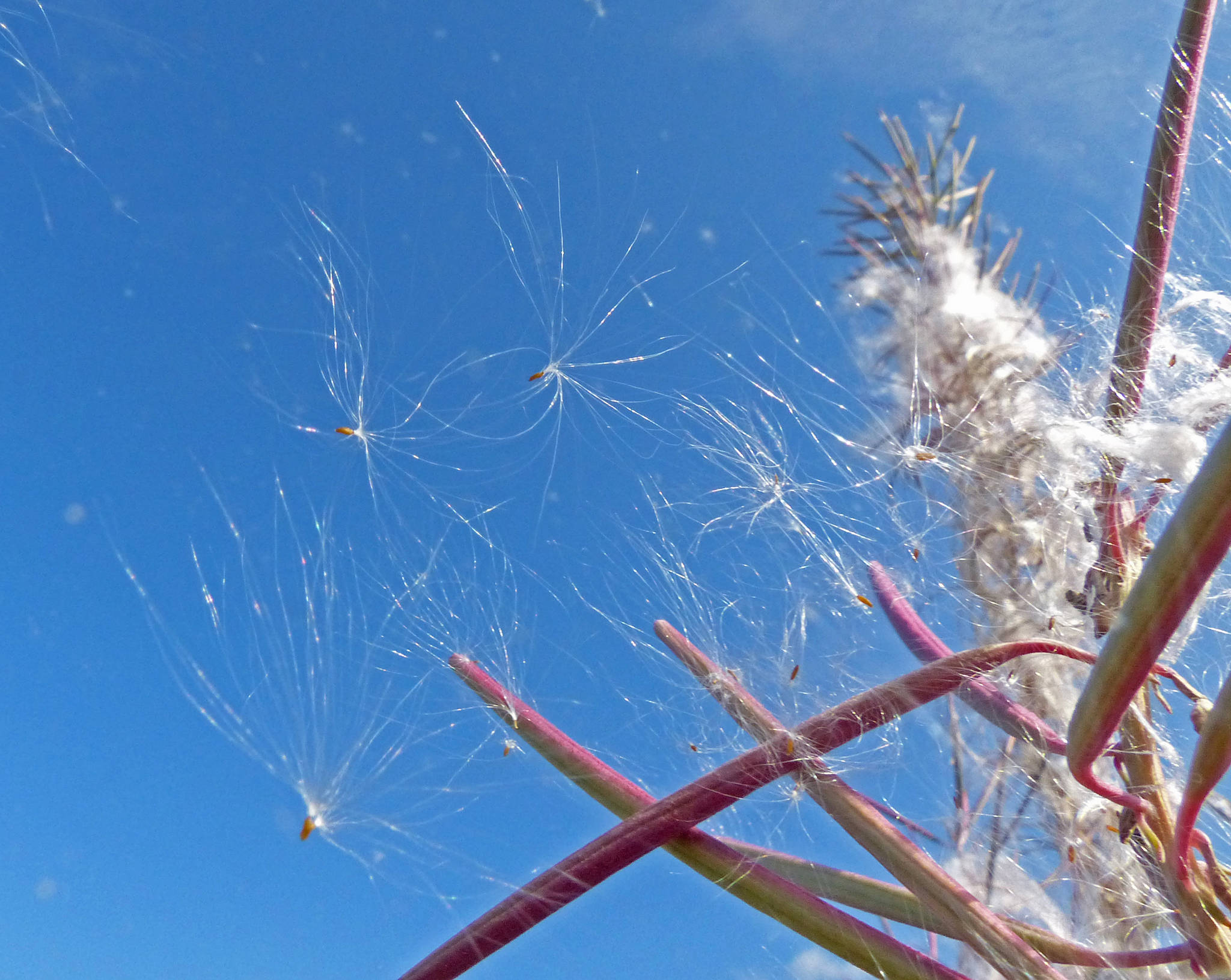
I recently learned of two other ways that organisms fly. Dandelions, fireweed and several kinds of asters and daisies produce seeds that are crowned with feathery tufts. For dandelions specifically, research has shown that although there are about a hundred plumes on each seed, they only provide some of the lift that keeps a seed airborne. The plumes are assisted by another mechanism. As air flows up between the plumes, a stable vortex ring (rather like an elongated doughnut) develops, just above the seed, where air flows up around the outside of the ring but downward in the middle of the ring. This creates a small low pressure area just above the seed, which slows the seed’s descent, keeping it airborne longer and thus improving the chances of dispersal. Those crowns of plumes can carry seeds for remarkable distances, which is why we can find dandelions, for instance, growing on distant sea stacks.
Baby spiders, and sometimes small adults, disperse through the air by “ballooning.” Standing on tiptoe, a spider spins long strands of silk and launches itself into the air — but only at carefully chosen moments after testing the breezes with a raised leg, and launching only when the wind is just right. It might be thought that the silk threads simply catch the breeze, but the story is more complex. Research has now shown that the spiders can detect (again using sense organs on the legs) and use the earth’s electrical field. There is a negative charge near the ground and on vegetation; the charge typically becomes less strongly negative every meter above the ground and plants. As a spider spins its silk thread, the silk acquires a negative charge from the environment, which repels it from the surrounding negative charge of the earth and vegetation. That repelling force is enough to lift the spider up, even if there is no breeze nearby. Once launched, the silk threads can catch any passing breeze and carry a spider for long distances.
How many other little tricks of flight are out there, still to be discovered?
• Mary F. Willson is a retired professor of ecology. Her essays can be found at www.onthetrailsjuneau.wordpress.com.
