Flood district protection plan faces high barrier if enough property owners protest $6,300 payments
Published 9:30 pm Friday, December 20, 2024
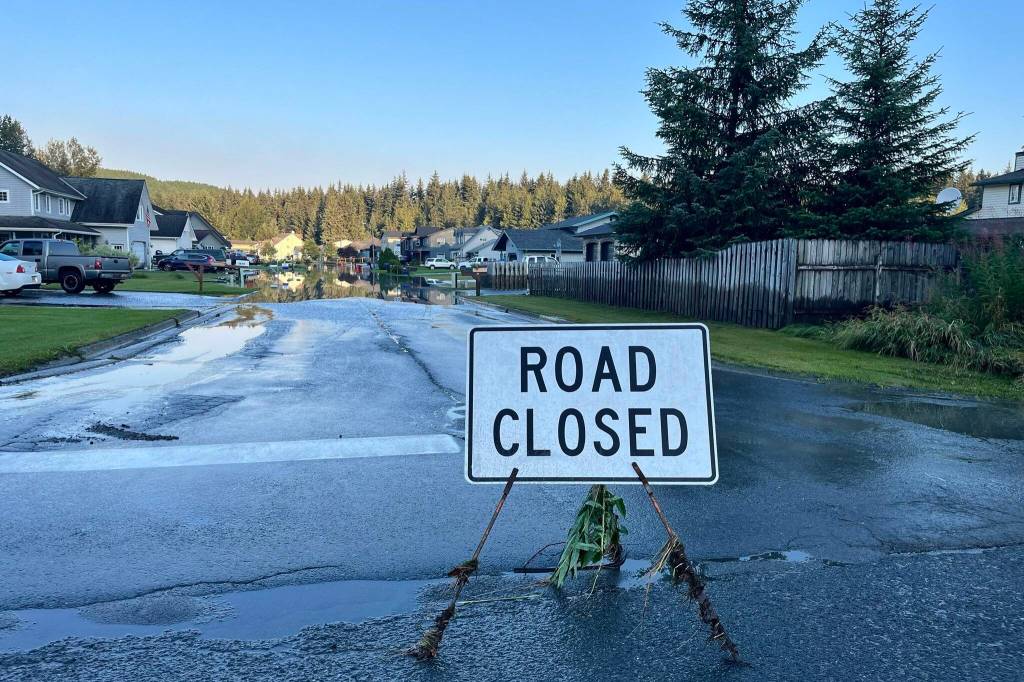
It’s not quite an election, but if most property owners formally object to paying about $6,300 apiece to install military-grade flood barriers in an area of the Mendenhall Valley vulnerable to glacial floods it appears unlikely the Juneau Assembly will move forward with the plan.
Notices were mailed to 466 property owners on Dec. 16 providing details about the proposed Local Improvement District, giving the owners six weeks to formally file a protest of inclusion. The Assembly is scheduled to vote Feb. 3 on an ordinance establishing the LID, which would clear the way to begin installing Hesco barriers provided by the U.S. Army Corps of Engineers along the most-populated side of the Mendenhall River before the summer flood season.
Eight of the nine Assembly members will need to vote in favor of the ordinance if official protests are filed by owners representing more than half of the total cost involved to them — a somewhat more complex equation than just a majority of them. Also, to the chagrin of some people who are opposed, property owners not filing an objection will count as a vote in favor of the LID.
But something in the ballpark of an official majority opposition would trigger the eight-vote override requirement. Two of five Assembly members responding to an inquiry by the Empire to all members on Monday morning expressed doubt about voting for such an override if a majority of property owners are opposed.
“Yes there are still unknowns, but at this time I would be very hesitant to approve the district if >50% (of) owners object to the LID,” Christine Woll wrote in a text message.
Assembly member Ella Adkison said she’s concerned the area could face a worse situation next summer than the nearly 300 homes damaged during this year’s record flooding if the barriers aren’t installed since experts have stated there are no other practical large-scale safeguards possible by then. But “I’m fundamentally here to represent Juneauites and I’m pretty uncomfortable with going against a direct vote by them.”
“I think it’s pretty clear from other members that even if I were to vote to override we wouldn’t have eight,” she added. “I just don’t see only losing one member. I see losing four, even five members.”
Among the other Assembly members responding to the Empire’s query by midday Monday, Maureen Hall, Paul Kelly and Mayor Beth Weldon declined to commit one way or the other if the eight-vote rule becomes necessary, noting there are still numerous uncertainties and other factors to be considered in the weeks ahead before a vote occurs.
“The city can’t take on the cost of the whole project and it could set precedent for any future natural disasters,” Weldon wrote in a text message. At the same time “we also need buy in from the home owners to show to keep our political capital.”
An FAQ published Dec. 19 at the City and Borough of Juneau’s website states the total cost of the project is $7.83 million, with the original proposal calling for CBJ to pay half and property owners to pay half — or nearly $8,000 per property. However, the Assembly voted last Monday to lower the owners’ share to 40%, or $6,291.85. The amount is payable over 10 years.
In addition, four homeowners would be assessed an additional $50,000 charge for the installation of riverbank armoring to safeguard against erosion, payable over 30 years. Those property owners in particular illustrate how protests involving half the total cost to owners — rather than half of the owners — matter when it comes to enacting the eight-vote requirement since each will pay roughly nine times as much as the other property owners.
“The votes of the properties being assessed an additional $50,000 carry more weight,” City Manager Katie Koester explained Monday.
The FAQ states phase one of the plan, intended for completion by next summer, would be for a two-mile stretch from the northern portion of Marion Drive to Rivercourt Way.
“(That) was identified as the most viable alternative to provide the most protection to the highest number of flood-vulnerable residents and homeowners,” the FAQ notes.
The levee could remain in place for up to a decade while a more permanent flood remedy is implemented and officials have discussed eventually installing Hesco barriers along up to four miles of the river.
The $7.83 million projected cost “includes removing obstructions on riverfront property, stabilizing soils, installing drainage pipe and check valves in barriers, removing organics, bank armoring, permitting, accessing and filling HESCO bags, and restoring property after HESCO barriers are removed for 2 miles of riverfront,” according to the FAQ. It also includes “a $500,000 reserve fund that will be used to establish a grant program to help homeowners restore their property.”
Public testimony will be taken at the Feb. 3 meeting before the scheduled Assembly vote and prior to that a public meeting to discuss the issue is scheduled from 5:30-7:30 p.m. Friday, Jan. 3, in the Thunder Mountain Middle School auditorium.
A group of residents opposing the LID have urged local officials to consider other solutions — notably building a levee around Mendenhall Lake — which experts have stated can’t be done safely or legally before next summer since, among other things, the lake is U.S. Forest Service property and thus subject to strict environmental and development regulations.
Adkison said such a levee may be an ideal long-term solution once its impacts are properly researched and a secure design assured, but for now the Hesco barriers “are our best option for preventing loss of life and property.” If the LID fails, however, she said local officials will still try to take what protective actions by next summer they can.
“I don’t see a world where the city abandons people in the flood area,” she said. “I see sandbags happening. I see evacuation routes — probably mandatory evacuations (with) CCFR going around and making sure people are safe — and having an emergency shelter for people to go to and maybe a place where cars can be parked. I’m not sure exactly what that all will look like because they haven’t gone down that road yet. But with or without Hesco barriers I anticipate us doing all that sort of auxiliary work to be sure that we’re as ready as possible for the next flood season.”
• Contact Mark Sabbatini at mark.sabbatini@juneauempire.com or (907) 957-2306.