
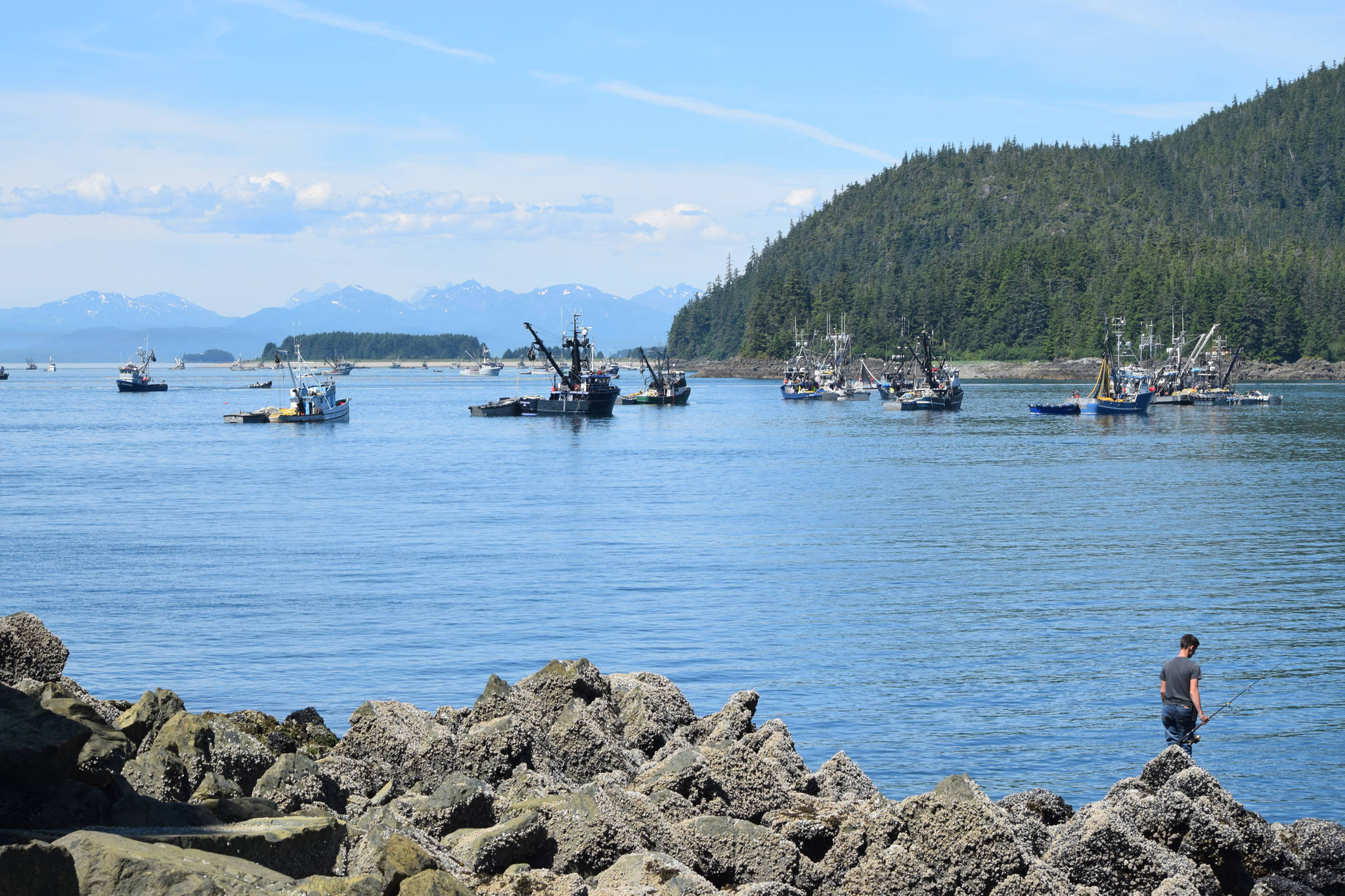
Drivers out the road might encounter a somewhat new sight on Thursdays this month: A small armada of commercial seine boats, fishing in close proximity, yards away from the Juneau road system.
In a down year for pink salmon, seiners have descended on Amalga Harbor on Thursdays in July for four planned one-day fishing openings.
“It’s quite the show,” said Douglas Island Pink and Chum Operations Manager Brock Meredith.
It’s a seine scene at Amalga Harbor today. About 79 boats came out for the nine-hour, lucrative chum fishery, Fish and Game said. Three more Thursday openings are planned for July. Story in tomorrow’s @JuneauEmpire pic.twitter.com/1DpJsderGG
— Kevin Gullufsen (@KevinGullufsen) July 5, 2018
It’s the seventh year fishery managers have allowed fishing in what’s called a Special Harvest Area around Amalga Harbor. Alaska Department of Fish and Game’s Area Managment Biologist David Harris was out on the water Thursday. He counted about 79 fishing boats netting salmon in the near-shore waters from the Shrine of National Shrine of St. Thérèse north to Amalga Harbor on Thursday.
Pink salmon harvests are down in the Juneau management area this year, Harris said, and there’re few other areas for seiners to fish right now. But hatchery-origin chum salmon, which net a higher price for fishermen than pinks, have returned in healthy number to Amalga Harbor. Seine fishermen are taking advantage. At least 15 boats waited in line to set their nets near the beach at Amalga Harbor Thursday. Chum salmon jumped out of the water at short intervals around them.
The fishery has only been able to open because Douglas Island Pink and Chum, the hatchery which produces about 97 percent of Lynn Canal’s chum salmon, recently paid off their loans to the State of Alaska. Previous to 2012, DIPAC contracted fishermen to net the salmon there in what’s called a “cost recovery” fishery. Proceeds from cost recovery would be used to fund hatchery operations and pay off DIPAC’s loan to the state, with some of the money going back to the small number of fishermen doing cost recovery.
But 2013, DIPAC paid back its principle and interest — to the tune of $42.5 million — on a state loan that helped establish the hatchery in 1976. Being out from under that loan has allowed DIPAC shift their business model from 40 percent cost recovery to 30 percent. No longer cost recovery, the fishery at Amalga Harbor is now “common property” — open to Southeast seine permit holders.
Seine openings at Amalga are limited to 9 a.m.-6 p.m. — daylight hours — because of the fishery’s close proximity to residential areas.
“We’ve avoided any sort of Sunday openings because it’s a very public viewing and that’s a high access area for the Juneau public,” Meredith said.
Harris said pink salmon fishing this year was expected to be slow. With only a two-year lifespan, the shortest of Alaska’s salmon species, pink salmon return in bulk only every two years. In the Juneau Management Area, that happens in odd years.
Since 2008, even years returns have been smaller than normal, compared to odd years, Harris. The parents of pink salmon returning this year went out in 2016. Pink salmon returns that year were so poor, Gov. Bill Walker applied for and recently received federal disaster funds to help mitigate the effects of what has been called a fishery disaster.
“This year we’re having a very, very poor pink salmon return, especially in the inside waters, north of Frederick Sound,” Harris said. “… We hope things will break out, but it doesn’t look like whatever’s holding them down has been alleviated.”
• Contact reporter Kevin Gullufsen at 523-2228 and kgullufsen@juneauempire.com. Follow him on Twitter at @KevinGullufsen.
