
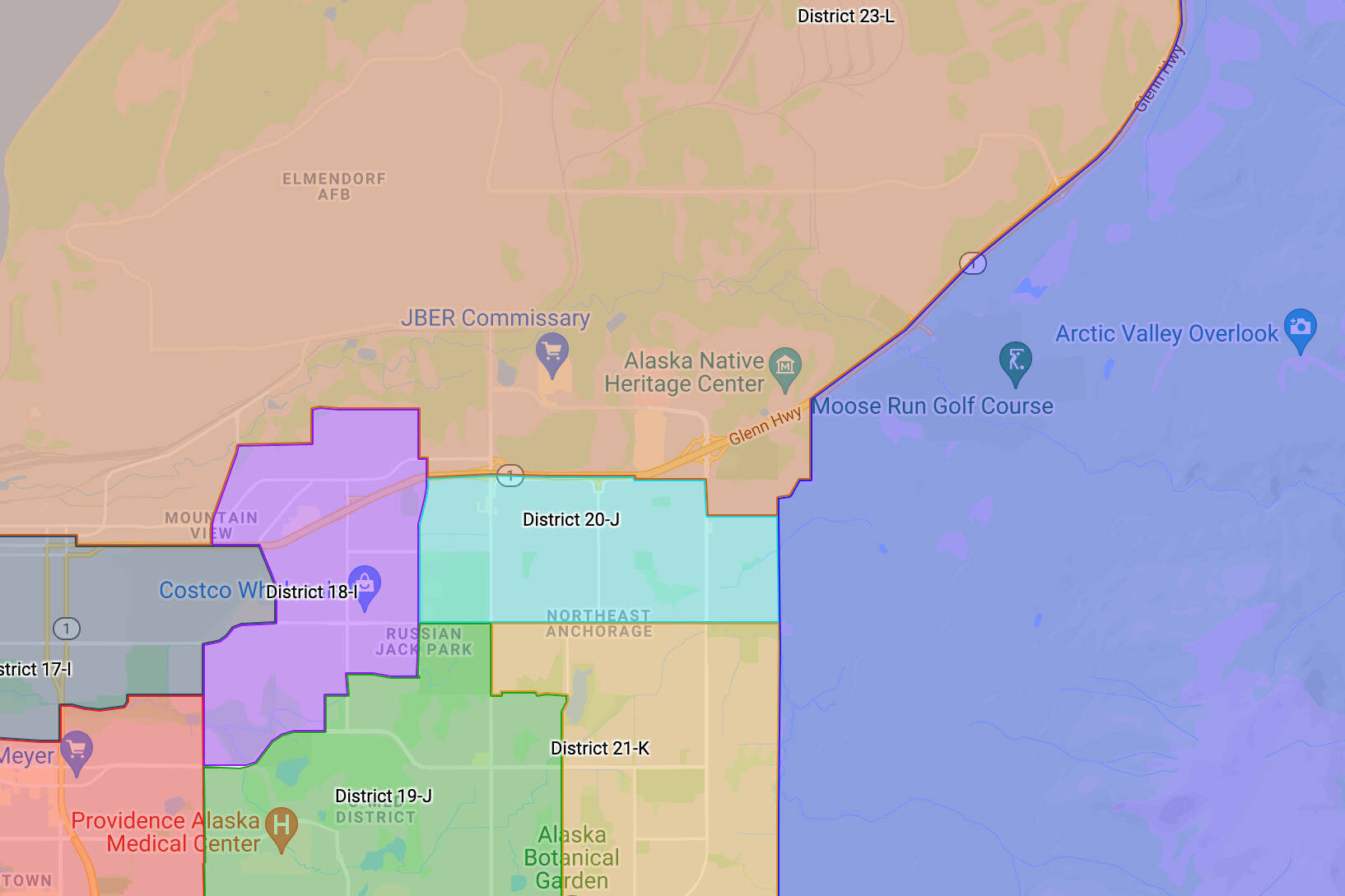
An Anchorage Superior Court heard the first arguments in a case against the Alaska Redistricting Board for proposed Senate pairings from last year’s redrawing of the state’s legislative districts.
The case combines several lawsuits against the board and on Friday the court heard arguments over the Senate pairing of an East Anchorage district with nearby Eagle River. Plaintiffs argue the pairing would dilute the votes of the East Anchorage district known as Muldoon and give Eagle River additional representation in the Senate. Lawyers for the state argue the pairing meets the constitutional requirement that the two districts be contiguous.
Eagle River is part of the Municipality of Anchorage but some of its residents, including its current senator, state Sen. Lora Reinbold, R-Eagle River, have advocated for the city to leave the municipality. When the Senate pairings were announced in November, chair of the redistricting board John Binkley defended the pairings saying the two communities were linked by social and economic ties.
But that claim is disputed by plaintiffs, led in part by Muldoon resident Felisa Wilson who filed one of the first lawsuits. Other lawsuits against the Redistricting Board combined in the court hearing are from the City of Skagway; the City of Valdez; the Matanuska-Susitna Borough and Alaska Native regional corporation Calista Corp.
In the initial complaint, lawyers for the East Anchorage plaintiffs called the Senate pairings “arbitrary” and “irrational.”
“The Board’s intentional pairing of Eagle River districts with East Anchorage Districts favored one geographical area, community of interest, and political party over another despite overwhelming testimony from both communities detailing their lack of shared interests, goals, and commonalities before the Board, and reiterated by East Anchorage witnesses from Eagle River and East Anchorage alike,” plaintiffs said.
[Years in the making, lawmakers hopeful reading bill will pass]
Friday morning the court heard expert testimony from sociologist Chase Hensel who argued the pairing would dilute the votes of residents of District 21, the East Anchorage district, by giving additional influence to Eagle River’s District 22.
“District 21 votes in a swing district,” Hensel said in his testimony. “Eagle River votes soundly Republican. The diverse voices of 21 would be completely blocked out by the bloc voting of 22.”
But lawyer for the state Matt Singer argued that the definitions of integrated communities presented by Hansel couldn’t be applied to several of Alaska’s paired districts, particularly in rural Alaska.
“It seems you’re trying to apply a standard that can’t be applied in most of Alaska,” Singer said.
Singer said it seemed the argument Hansel was making implied the requirements of the state constitution should be different in Anchorage and urban Alaska.
Members of the board have defended the decision to pair Districts 21 and 22 based on the constitutional requirement that House districts must share a border. In her affidavit to the court, board member Bethany Marcum said the requirement that communities be socially and economically integrated applies only to House districts and not to Senate districts.
“Pairing these two House districts allows commuters in Eagle River to share a senate district with a Muldoon neighborhood where they frequently stop for gas, have dinner, and where some attend church. This senate district also shares a portion of the Chugach State Park, a major public recreation amenity for these district residents,” Marcum said.
Two board members, Melanie Bahnke and Nicole Borromeo, opposed the Senate pairing, and Borromeo said in pre-trial testimony she believed the decision would expose the state to potential litigation for racial gerrymandering in violation of the Voting Rights Act. Eagle River is a predominately white community while Muldoon is more ethnically diverse, according to documents submitted by the state. Eagle River currently has only one senator, but it the board’s pairings are accepted it would give Eagle River a second seat in the Alaska State Senate.
Because of the sensitivity of the case, the trial process was expedited and much of Friday’s hearing was spent on deliberations between lawyers and Anchorage Superior Court Judge Thomas Matthews over documents and testimony that would be accepted. The legal process of discovery, where parties disclose evidence to each other, is still continuing and there was concern from plaintiffs that additional evidence would not be allowed.
Arguments will continue Monday, Jan. 24, at 9 a.m. with deliberations concerning the Matanuska-Susitna Borough pairings.
• Contact reporter Peter Segall at psegall@juneauempire.com. Follow him on Twitter at @SegallJnuEmpire.
