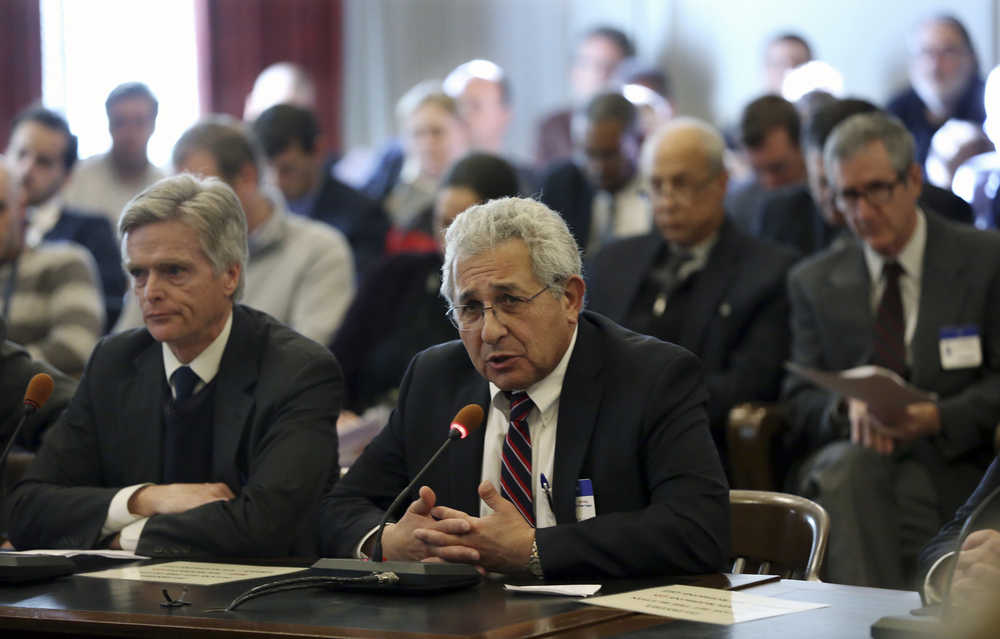
FILE - In this Dec. 15, 2016 file photo, Stephen W. Parker, left, co-owner and co-publisher of New Jersey Hills Media Group, listens as Richard Vezza, publisher of the Star-Ledger newspaper, addresses members of the New Jersey Assembly Appropriations Committee, as the committee considers among others, legislation to scrap a requirement that legal notices be published in newspapers, after a Senate budget committee greenlighted the legislation earlier in the day, in Trenton. As classified advertising, once the lifeblood of newspapers, has dried up, one constant has remained: A thick daily listing of government public notices. But legislative fights in New Jersey and elsewhere have put that tradition at risk. (AP Photo/Mel Evans, File)

FILE - In this Dec. 15, 2016 file photo, Stephen W. Parker, left, co-owner and co-publisher of New Jersey Hills Media Group, listens as Richard Vezza, publisher of the Star-Ledger newspaper, addresses members of the New Jersey Assembly Appropriations Committee, as the committee considers among others, legislation to scrap a requirement that legal notices be published in newspapers, after a Senate budget committee greenlighted the legislation earlier in the day, in Trenton. As classified advertising, once the lifeblood of newspapers, has dried up, one constant has remained: A thick daily listing of government public notices. But legislative fights in New Jersey and elsewhere have put that tradition at risk. (AP Photo/Mel Evans, File)

Fight against publishing notices in newspapers persists

TRENTON, N.J. — As classified advertising, once the lifeblood of newspapers, has dried up, one constant has remained: a thick daily listing of government public notices. But legislative fights have put that at risk.

A measure to allow government agencies in New Jersey to no longer publish their legal notices in newspapers recently stalled, but Republican Gov. Chris Christie said he will make the change a priority in 2017. And Democratic leaders in the Legislature aren’t backing down from having the debate, either.

Christie says the change would save taxpayers and residents $80 million, but the state’s newspapers dispute that math. They say that the state spends $20 million on legal notice advertising each year and that more than half is reimbursed by private business. Christie’s figures also apparently include an estimate that $60 million will be spent on public notices of pending foreclosures, a fee paid for by banks.

It’s not only an issue in New Jersey. State lawmakers nationwide have considered ending the requirement to publish notices for things like public meetings and government bids, but lobbying efforts from publishers have stopped that so far. But as the audience for printed newspapers continues to dwindle, some think it’s only a matter of time.

“I think with the state legislatures it’s just simply a matter of saving a few bucks,” said Kip Cassino, a media analyst at Borrell Associates. “It’s going to keep coming up and I think before the next decade ends, I don’t think you’re going to see the legals in newspapers anymore.”

If this month’s fight in New Jersey is any indication, though, that change won’t come easily.

Faced with legislation put on a fast track in Trenton, the state’s newspapers launched a full-court press against the measure. Most of the newspapers owned by Gannett Co., the nation’s largest newspaper chain, devoted their front pages to an editorial against the measure.

Christie called out the “billionaire” owners of the newspapers, saying that they made the attack personal against him so that they could continue “feeding like pigs at the government trough.”

Classified advertising was formerly the lifeblood of newspapers before Craigslist launched and took a huge chunk from that profitable revenue stream.

Lawmakers in states including Pennsylvania, Michigan and Alaska have debated doing away with public notices, but those measures have stalled or not passed. Arizona’s Legislature this year approved a bill allowing corporations to file their legal notices with a state regulator, but public agencies still have to publish them in newspapers.

In Massachusetts, a new law goes into effect Jan. 21, developed as a compromise to discussions about allowing government agencies to bypass newspapers, that will require newspapers to publish legal notices online as well as in print. The state’s newspapers will also be required to run a statewide website to collect all of the notices. That already happens in New Jersey, although it’s unclear whether that would continue if the measure supported by Christie passes.

“You don’t want to put the fox in charge of the hen house,” said Robert Ambrogi, of the Massachusetts Newspaper Publishers Association. “The main reason legal notices are published is to ensure government transparency and government accountability. In order to have that process done in a neutral and objective way, it needs to be managed and overseen by a third party.”

More in News

Capital City Fire/Rescue completes last season’s ice break rescue training at the float pond near Juneau International Airport. (photo courtesy of Capital City Fire/Rescue)
On thin ice: Fire department responds to season’s first rescue at Mendenhall Lake

This week’s single digit temperatures have prompted dangerous ice ventures.

Brenda Schwartz-Yeager gestures to her artwork on display at Annie Kaill’s Gallery Gifts and Framing during the 2025 Gallery Walk on Friday, Dec. 5. (Mari Kanagy / Juneau Empire)
Alaska artist splashes nautical charts with sea life

Gallery Walk draws crowds to downtown studios and shops.

A totem pole, one of 13 on downtown’s Totem Pole Trail in Juneau, Alaska, Nov. 27, 2024. (Christopher S. Miller/The New York Times)
Downtown Juneau experiences its first significant city-level snow fall of the season as pictured on Saturday, Dec. 6, 2025. (Mari Kanagy / Juneau Empire)
Sub-zero temperatures to follow record snowfall in Juneau

The National Weather Service warns of dangerous wind chills as low as -15 degrees early this week.

A truck rumbles down a road at the Greens Creek mine. The mining industry offers some of Juneau’s highest paying jobs, according to Juneau Economic Development’s 2025 Economic Indicator’s Report. (Hecla Greens Creek Mine photo)
Juneau’s economic picture: Strong industries, shrinking population

JEDC’s 2025 Economic Indicators Report is out.

Map showing approximate location of a 7.0-magnitude earthquake on Saturday, Dec. 6, 2025. (Courtesy/Earthquakes Canada)
7.0-magnitude earthquake hits Yukon/Alaska border

Earthquake occurred about 55 miles from Yakutat

A commercial bowpicker is seen headed out of the Cordova harbor for a salmon fishing opener in June 2024 (Photo by Corinne Smith)
Planned fiber-optic cable will add backup for Alaska’s phone and high-speed internet network

The project is expected to bring more reliable connection to some isolated coastal communities.

Gustavus author Kim Heacox talked about the role of storytelling in communicating climate change to a group of about 100 people at <strong>Ḵ</strong>unéix<strong>̱</strong> Hídi Northern Light United Church on Wednesday, Dec. 3, 2025. (Mari Kanagy / Juneau Empire)
Author calls for climate storytelling in Juneau talk

Kim Heacox reflects on what we’ve long known and how we speak of it.

Most Read