
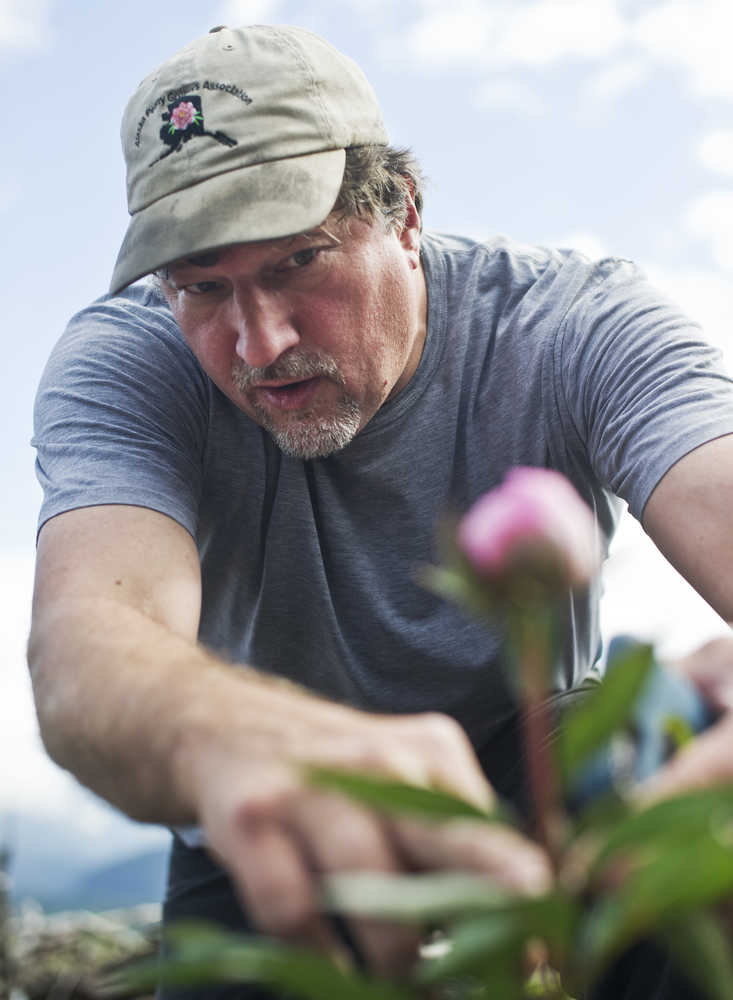
Brad Fluetsch has been growing peonies at his home in North Douglas since 1992 and they do really well. So well, people have asked to buy them.
“We’ve turned down people wanting them for their weddings. My wife doesn’t want to sell them out of the garden. They’re hers,” Fluetsch said.
Over the years, their peony garden has grown to about 75 different plants of various types, including the white Duchess de Nemour, Bowl of Cream and Henry Sass, the pink Sarah Bernhardt and the vibrant red Felix Supreme.
A few miles farther out on North Douglas Highway and a 20-minute squishy walk toward Gastineau Channel will take you to Fluetsch’s other plot of the large, fragrant flower — and these he has every intention of selling.
Fluetsch is a financial analyst and has spent time thinking about alternative ways to use land.
“So you start looking at raspberries, blueberries and other agricultural crops, and you wonder, ‘What’s the value of this?’ There’s nothing that comes close to the value of peony revenues per acre,” he said while walking around the plot last week. “And the other thing about them is, once they’re established, they’re maintenance free. You have to come out and feed them and trim them up and stuff, but they’re not demanding plants at all.”
A peony flower wholesales between $2 to $5. Depending on the type of peony, Fluetsch is projecting between $60,000 to $120,000 of revenue an acre.
Fluetsch and his wife Kathy Dye started Rainforest Peonies in August 2014. Their partners are Frank Bergstrom and Pat Belec. After logging six acres of land along the channel, Fluetsch and his partners planted 300 Sarah Bernhardt peony roots from Holland last October on a fraction of an acre. Another 600 more roots will be planted this fall.
Sarah Bernhardt is the “money standard of the peony,” Fluetsch said. Big and light pink with a peppermint smell, Sarah Bernhardts are sought-after for weddings. Peony farms are already established in other parts of the state, like Kenai, Mat-Su and Fairbanks, and Fluetsch is hoping to continue the trend in Southeast.
According to the Alaska Peony Growers Association website, Alaska peonies tend to bloom when there are no other peonies available to the market. A bloom period of late June through August and into September “makes it possible to supply these highly desirable flowers to markets when there is little direct competition.”
Even though Fluetsch’s crop already started blooming around June 20, Rainforest Peonies doesn’t plan to have their first commercial harvest until 2019. It’ll take that long for the peonies to mature and get to the right sellable standards.
“Inch-and-a-half to two-inch ball, 32-inch stem, clean leaves,” Fluetsch said. “That’s pretty much the only thing the distributors will want. They only take the very, very absolute best.”
Peonies are harvested as closed balls, before bloom, and the ball should feel soft, like a marshmallow. Fluetsch said it only takes one petal to come out for a peony to go from commercial grade to non-exportable.
“As soon as we harvest them, they’ll go onto a refrigerated container and the plan is to take them by skiff over to downtown in 150 stem boxes,” Fluetsch explained.
From there, they’ll go to the airport and flown on a midnight FedEx flight to Anchorage where they’ll be distributed down south. For the lesser quality stems, Fluetsch said he’s hoping to sell to local bed and breakfast businesses.
The peonies are planted in rows of raised beds, a mixture of dirt that was at the site and sand, covered in black plastic. By 2019, each of the original 300 plants could produce 10 stems.
“I expect to see a solid row of green with big pink balls sticking up,” Fluetsch said.
Until then, he’s been cutting the blooms off to make sure all the energy goes back to the roots.
After the planting of 600 more roots this fall, Rainforest Peonies could have up to 9,000 stems in 2020.
“If we doubled this planting area, that means we’ll have 1,800 plants and 18,000 stems,” he said.
At this point, Fluetsch is targeting 3,000 plants per acre, which is a conservative amount; other farms have upwards of double that per acre. With six acres logged, there’s still plenty of potential left. He said he wants to also start growing white peonies, which fetch more money on the market.
While a multi-year wait for peonies to become marketable may seem long, Fluetsch is a patient man.
“You plant it, you wait your five years and then you have an annuity,” he said.
And Fluetsch isn’t worried about the demand going away.
“As long as there are weddings, I have a market.”
• Contact reporter Lisa Phu at 523-2246 and lisa.phu@juneauempire.com.
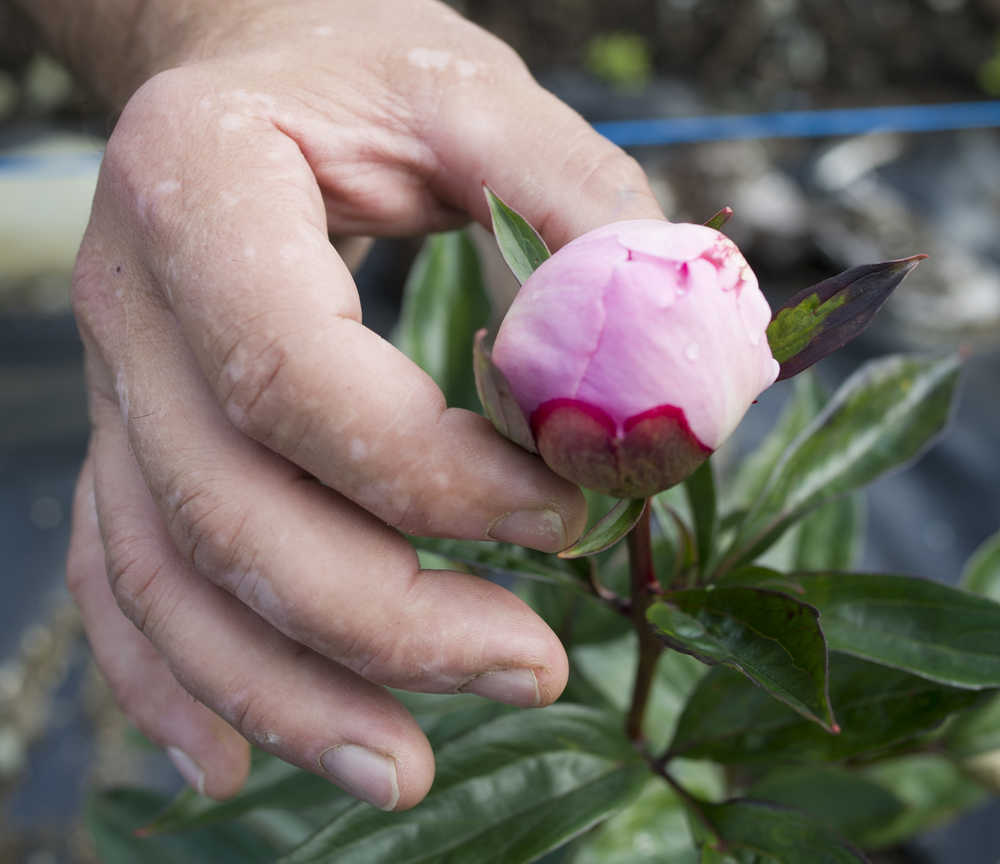
Brad Fluetsch inspects a flower on one of his 300 peony plants on his North Douglas property on Monday.
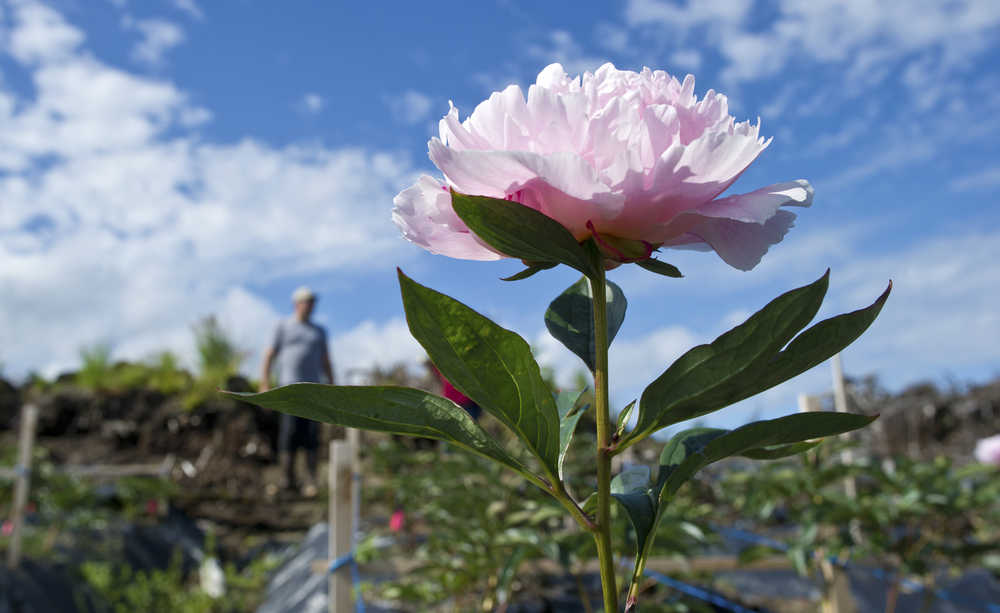
A peony flowers Monday as Brad Fluetsch talks about the health of his first 300 peony plants on his North Douglas property.
