
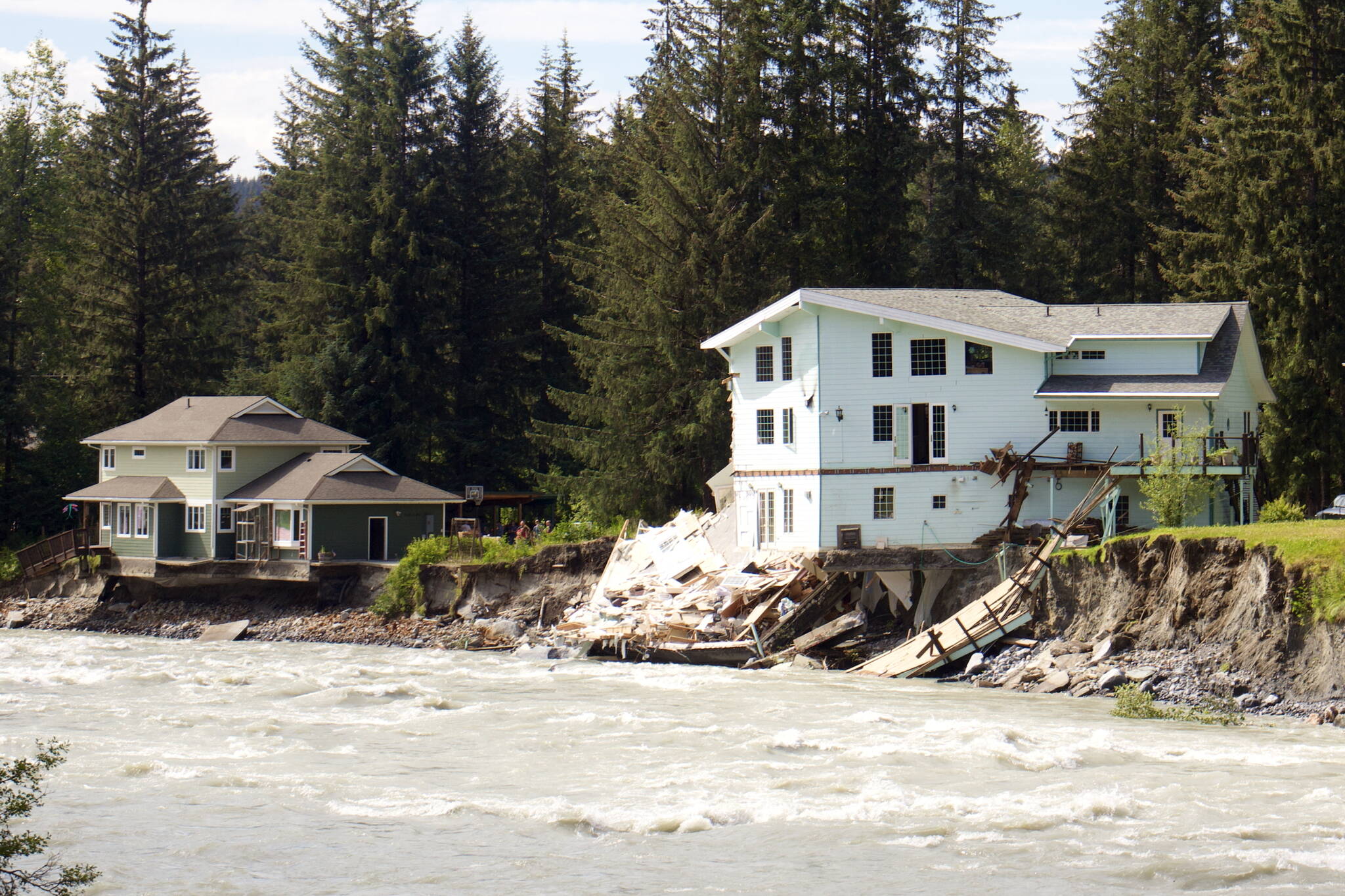
Federal Emergency Management Agency officials arrived in Juneau on Wednesday to assess damage caused by this month’s record flooding from Suicide Basin, with separate assessment teams looking at primary residences and public infrastructure, according to a spokesperson for the agency.
FEMA is working with state, local and tribal officials to determine the extent of damage, along with a range of other factors that will determine if federal disaster assistance is warranted, said Natalie Shaver, a spokesperson for the agency’s Region 10 office.
“Step one is they survey the damage,” she said. “So we’ll take a look at these teams. We’ll take a look at the extent of the damage, figure the number of people who’ve been displaced, what is the threat to public safety and health, how many homes are uninhabitable, and things like that.”
The extent of insurance coverage, business losses and damage to public infrastructure are among the other things that will be assessed, according to Shaver.
[Disaster assistance center opens at Mendenhall library for Suicide Basin flood victims]
Dozens of homes were destroyed, condemned or severely damaged by the Aug. 5 flood. Gov. Mike Dunleavy declared the incident a state disaster on Aug. 8, and people can apply for state assistance online at ready.alaska.gov/Recovery/IA or by calling (844) 445-7131 Monday through Friday from 8 a.m–4 p.m.
Guidelines published by FEMA state “residents and businesses should not wait to find out whether federal assistance will be available before beginning their cleanup and recovery.”
“They should keep repair receipts and document damages with photographs, whenever possible, for insurance purposes,” the guidelines state. “The ideal means of recovering from a disaster is always through insurance. Residents and businesses should work with their insurance companies to begin the claims process.”
The visit by FEMA officials does not guarantee a federal disaster declaration or funding, according to the guidelines. The state will use the reports to determine if the extent of damage is beyond local and state resources to repair, and verify the need for supplemental federal assistance. The assessments may also identify any unmet needs that may require immediate attention.
“The timeline for this process is event specific and is driven by what the locals and state are requesting,” Shaver wrote in an email following her interview. “The Juneau (Preliminary Damage Assessments) will take a few days for the review of damages, but the team will stay until the entire process is complete.”
The arrival of FEMA officials in Juneau occurred on the same day President Joe Biden approved a disaster declaration for portions of Alaska hit by flooding between May and June 3. Those areas include the Copper River Regional Educational Attendance Area (REAA), Kuspuk REAA, Lower Kuskokwim REAA, Lower Yukon REAA and Yukon Flats REAA.
Jeremy Zidek, a spokesperson for the Alaska Division of Homeland Security and Emergency Management, said earlier this month that because Juneau’s flooding “is kind of confined to one area and not kind of widespread,” the federal agency may be able to respond quicker than to some other large-scale disasters in the state during the past year.
“Assistance can include grants for temporary housing and home repairs, low-cost loans to cover uninsured property losses, and other programs to help individuals and business owners recover from the effects of the disaster,” a FEMA press release about Wednesday’s disaster declaration notes. “Federal funding also is available to state, tribal and eligible local governments and certain private nonprofit organizations on a cost-sharing basis for emergency work and the repair or replacement of facilities damaged by the flooding.”
Federal funding resulting from Wednesday’s declaration is also available on a cost-sharing basis for hazard mitigation measures statewide, according to the release.
• Contact Mark Sabbatini at mark.sabbatini@juneauempire.com or (907) 957-2306.
