
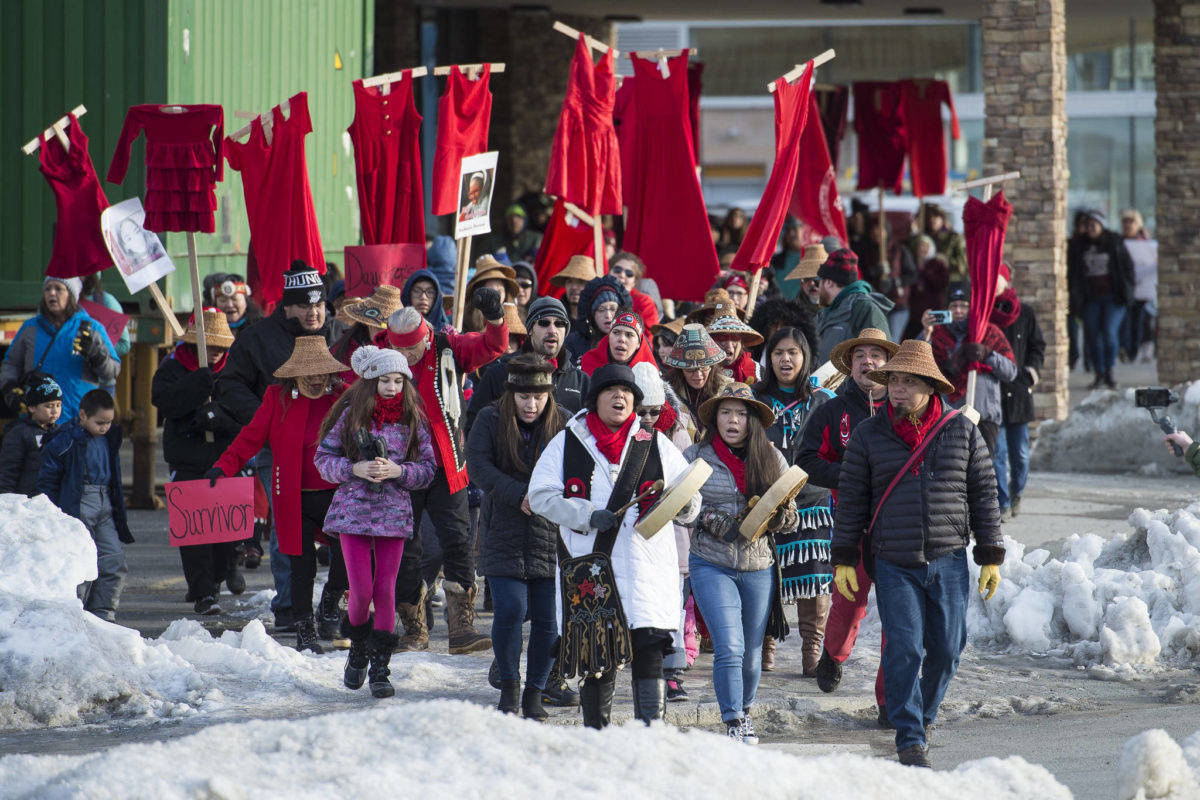
Three separate actions taken by the federal government are putting more muscle into solving cases for missing and murdered indigenous people.
On Nov. 22, U.S. Attorney General William Barr announced the Missing and Murdered Indigenous Persons (MMIP) initiative to address the crisis of violence against Native Americans. Shortly after Barr’s announcement on Nov. 26, President Donald Trump announced the creation of a task force addressing the same issue. And on Nov. 29, U.S. Sen. Lisa Murkowski, R-Alaska, threw her weight behind a new version of a long-stalled bill known as Savanna’s Act which would help law enforcement investigate cases of missing and murdered indigenous people.
Murkowski originally introduced the bill in 2017 with Sens. Catherine Cortez Mastro, D-Nevada, and Heidi Heitkamp, D-North Dakota. The bill passed the Senate but failed in the House. A re-worked bill is now making its way through Congress with Murkowski’s backing, The Associated Press reported.
The National Institute of Justice estimates that 84% of Native American women and 81% of Native Americans will experience violence sometime in their lives.
“American Indian and Alaska Native people suffer from unacceptable and disproportionately high levels of violence, which can have lasting impacts on families and communities,” Barr said in a press release. “Native American women face particularly high rates of violence, with at least half suffering sexual or intimate-partner violence in their lifetime.”
The MMIP initiative will allow local law enforcement agencies to call on the FBI for assistance is missing persons or murder cases involving indigenous victims.
Upon request, the FBI will provide expert assistance to local authorities. Additionally, the FBI will provide digital and technical service such as cellular analysis and “cyber agents,” or agents specially trained in technology, according to a press release from the U.S. Attorney’s Office for the District of Alaska.
The Attorney’s office will receive funding for the creation of MMIP coordinators who will work with federal, tribal, state and local agencies on common procedures for reports of missing or murdered Alaska Natives. The release does not say how much money the District of Alaska will receive. The Associated Press reported the initiative will invest $1.5 million nationwide.
The FBI will also provide comprehensive data analysis and federally supported databases and data collection practices. The Alaska State Troopers began working with the FBI in Anchorage to analyze missing persons data in the state, the press release said.
“A goal of this project is have an accurate count of missing people and to ensure that reports accurately reflected the circumstances surrounding the disappearance of individuals reported as missing,” said Megan Peters, communications director for the Department of Public Safety.
Peters said troopers would also be working with family members of missing persons to create a DNA databases should any remains ever be found.
Peters said in an email that because the initiative was so new, Alaska State Troopers had not yet begun receiving training from the FBI on MMIP, and she could not say when that might begin.
Trump’s task force will be overseen by Barr and Secretary of the Interior David Bernhardt and will work to develop protocols for solving missing and murder indigenous persons cases across jurisdictions.
“The Task Force will facilitate better coordination and collaboration with tribal communities, resulting in long term strategies to address complex issues,” a press release from the Department of the Interior said.
Sen. Lisa Murkowski, R-Alaska, applauded the president and Barr’s actions in a press release. Together, the two initiatives are, “a signal of the urgency and importance that has been placed on this issue.”
Murkowski highlighted her own bill, announced in October, attempting to address domestic violence in Alaska Native communities.
“Between this executive order, the initiatives coming out of the Department of Justice, and my long-standing efforts — turning the tide of this crisis has truly become an ‘all-hands-on-deck’ approach,” Murkowski said.
The release from the U.S. Attorney’s office in Anchorage does not say when implantation of the initiative will begin, or when the FBI in Alaska will receive its funding.
Assistant Attorney General Maria Bahr said the Department of Law is committed to working on the issue and will have more information following discussions with the U.S. Attorney’s office.
The Attorney’s office could not immediately be reached for comment.
• Contact reporter Peter Segall at 523-2228 or psegall@juneauempire.com.
