
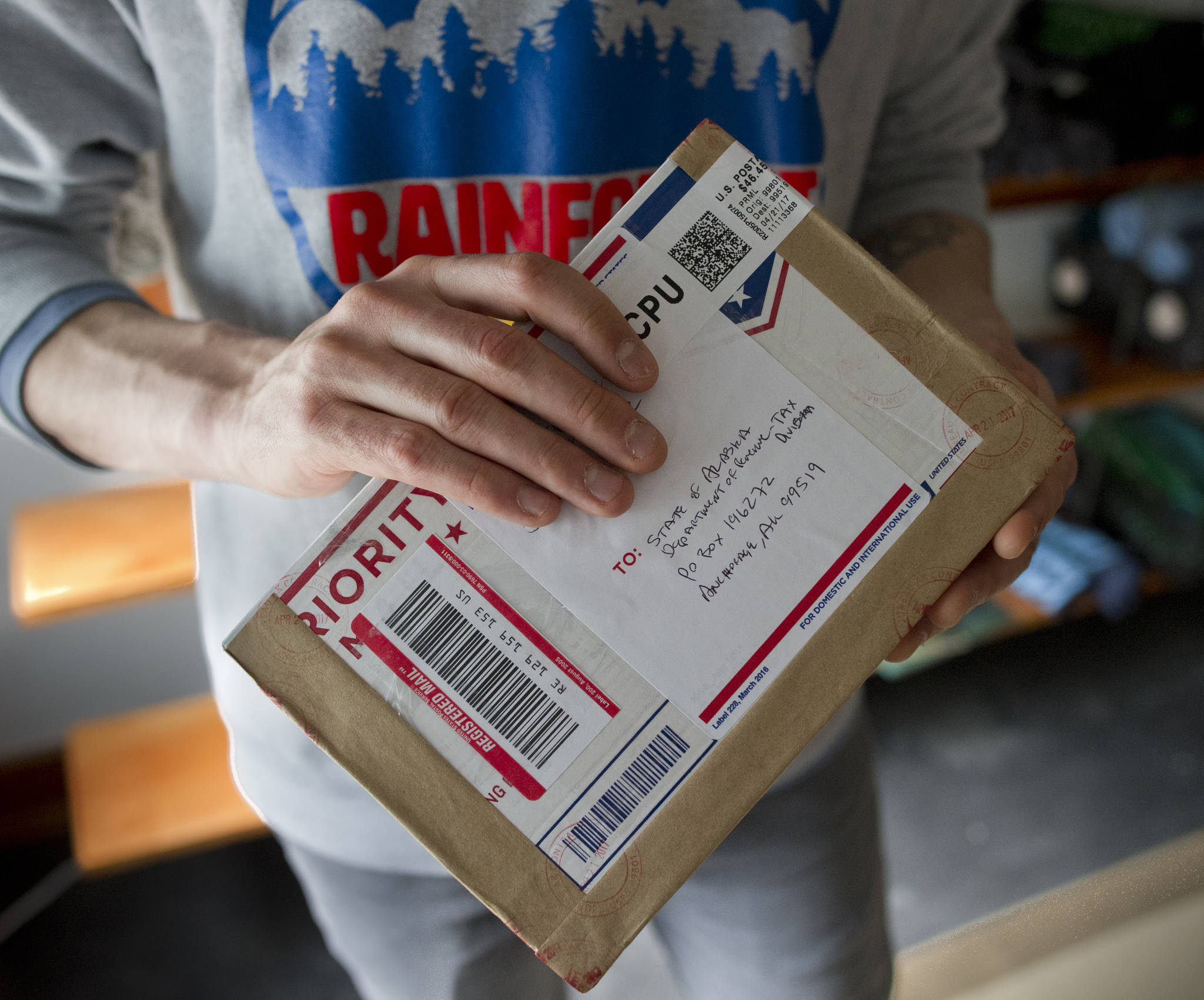
The federal government will not let Rainforest Farms pay its taxes.
Late last week, Juneau’s first legal marijuana retailer was turned away by the U.S. Postal Service when one of its owners attempted to mail his regularly scheduled state tax payment to Anchorage. That city is the only place equipped to take cash deposits, and all of Alaska’s other marijuana taxpayers are on the road system.
It’s a system the state itself created, and one that worked last month.
It doesn’t any more.
“Any proceeds from the selling of (marijuana) is considered drug proceeds under federal law, so you can’t mail that,” Postal inspector Aaron Behnen told the Empire from Anchorage.
That applies even to a business the state of Alaska has legalized.
Alaska’s tax director, when asked about the matter, said the state needs to find a way for “these legitimate businesspeople to pay their taxes.”
“We thought we had done that, and this throws a tremendous wrinkle into our processes,” Ken Alper, Alaska Department of Revenue Tax Division Director, said in an interview.
Rainforest Farms’ experience is a symptom of a larger issue. Even though eight states (Alaska, California, Colorado, Massachusetts, Maine, Nevada, Oregon and Washington) and Washington, D.C. have legalized recreational marijuana, cannabis businesses remain mostly locked out of the banking system.
Marijuana is still federally illegal, and any business that deals with it — or its proceeds — violates federal law. While the U.S. Department of Justice stated in a 2013 memo that it would not interfere with states that have legalized marijuana, that policy could change at any time.
“Until there is an act through Congress, I understand why the banks are very concerned. Just because the law is not being enforced today does not mean it won’t be enforced tomorrow,” said Kevin Anselm, Alaska’s banking regulator.
To date, none of Alaska’s four state-chartered banks or its one state-chartered credit union (others are nationally chartered and regulated) have said they are willing to accept that risk and accept marijuana businesses.
That leaves Alaska’s marijuana businesses with an old standby: cash. When they pay bills, purchase goods or distribute salaries, they have to do it in hard currency.
“It’s difficult. People like cash, but it does take a lot to move it, especially when you have to account for it properly,” said James Barrett, one of the owners of Rainforest Farms.
He estimates that he has to devote the equivalent of one workday a week to dealing with the problems associated with cash: counting it, distributing it around town, and entering receipts into his accounting software.
“It’s just a hassle; it’s just time-consuming,” he said.
It also poses security risks.
Marijuana businesses are required by state law to be secure — regulations define security systems, electronic locks, safes and other equipment. Businesses frequently go beyond those, installing strongrooms, knock-proof doors and shatterproof windows.
Erika McConnell, director of the Alaska Alcohol and Marijuana Control Office, said no marijuana worker has been harmed in Alaska, but criminals have targeted businesses.
“We are aware that there have been some break-ins, and yeah, that is a concern. I’m not aware of anyone at this point being injured,” she said.
Cary Carrigan, executive director of the Alaska Marijuana Industry Association, is worried that it’s only a matter of time before someone is hurt.
“Does somebody need to get shot or robbed or killed for somebody to pay attention to this issue?” he asked.
In February 2017, Rep. Don Young, R-Alaska, created a Congressional Cannabis Caucus with fellow Representatives from Colorado and California. This week, Young spokesman Matt Shuckerow said Tuesday, Young “will join a bipartisan group in Congress to introduce the Secure and Fair Enforcement Banking Act (SAFE Banking Act), which ensures institutions can service marijuana-related businesses without the fear of reprisal from the federal government.”
If the bill passes Congress, banks dealing with marijuana businesses will be granted “safe harbor” from a federal crackdown.
“For example, federal banking regulators would not be able to threaten or limit a bank or credit union’s Deposit Insurance, take any action or downgrade a loan made to a covered business, or force a depository institution to halt providing any kind of banking services to a marijuana-related legitimate business,” Shuckerow wrote in an email.
By phone, he added, “Banking is certainly one of his big issues. As we move forward, he wants to see these businesses operating legally … to be treated like any other business.”
In the meantime, some Alaska cannabis businesses are operating by subterfuge. Several contacted by the Empire said they use services provided by personal savings and checking accounts to access bank services for their business. Others said they have accounts under the name of their business or a parent company in order to conceal that the account is being used for a marijuana purpose.
Lacy Wilcox is the Southeast chapter president of the AMIA and said by phone that for some Alaska businesses, “it feels a lot like hiding, and we don’t want to hide.”
Rainforest Farms is the first business to remit marijuana taxes to the state from off the road system, and the problems it encounters will soon be seen by other growers. (Under Alaska’s system, growers, not retailers, pay state taxes.)
“There’s a lot more coming online, so this is something that’s important to think about,” Barrett said.
Wilcox said she and other marijuana businesses off the road system are confident that things will get better.
“We’re all rooting for each other, and I think collectively we’ll get there,” she said. “The only question is, how long is it going to take?”
Correction: The original version of this story said nine states have legalized recreational marijuana. It is eight states and Washington, D.C.
• Contact reporter James Brooks at james.k.brooks@juneauempire.com or call 419-7732.
