
State officials expect the roughly $1.25 billion in relief funds coming to Alaska to arrive in state coffers by April 24, according to Legislative Finance Director Pat Pitney.
Speaking via phone to a teleconferenced House Finance Committee meeting Wednesday morning, Pitney told lawmakers she expects the money to land in the state treasury soon.
“There are a hundred or more provisions in the CARES Act and some of the provisions come with a formula provision,” Pitney told lawmakers. “The big piece of funding, that 1.25 billion, the only guidance that exists is that funding must be related to the COVID-19 mitigation and response.”
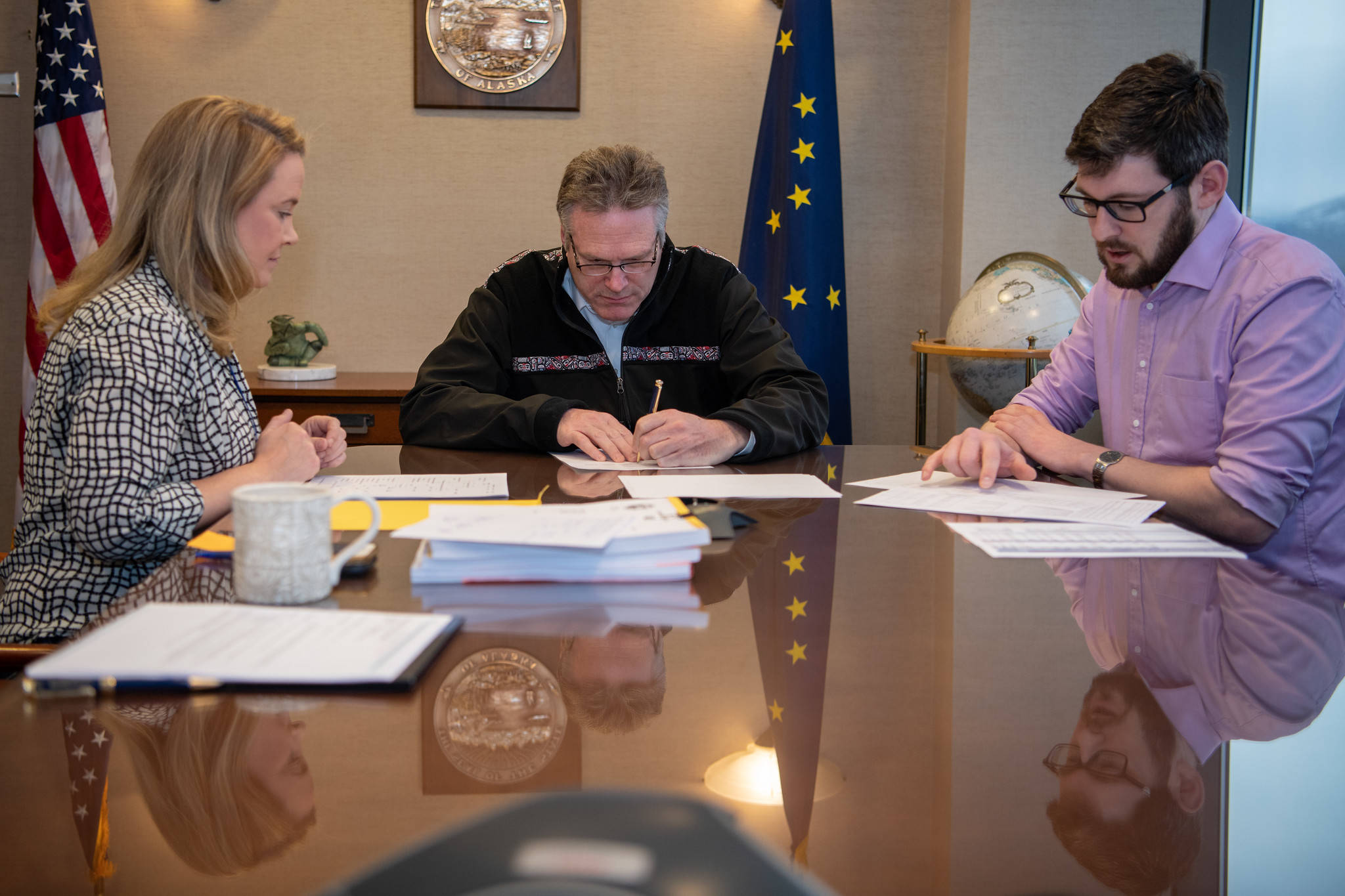
When Gov. Mike Dunleavy announced he had signed the 2021 operating budget into law, he said the “vast majority” of the items he vetoed would be covered by federal coronavirus relief money in the CARES Act.
But it’s unclear if the money will be able to be used that way nor is it clear who will be in control of allocating the money.
[Gov looks to federal funds to fill gaps in budget]
According to the text of the bill, the federal money can only be used for items that “are necessary expenditures incurred due to the public health emergency with respect to the Coronavirus Disease 2019 (COVID-19); were not accounted for in the budget most recently approved as of the date of enactment of this section for the State or government; and were incurred during the period that begins on March 1, 2020, and ends on December 30, 2020.”
Lawmakers have expressed concern the governor won’t be able to pay for state services in the way he has said he will. When the Legislature passed emergency relief funding in the mental health budget last month, they included open-ended federal receipt authority for the governor when it comes to health care funding.
However, according to a legal memo by Megan Wallace, director of Legislative Legal Affairs, that authority is limited to “the Department of Health and Social Services, Division of Public Health, in response to the public health disaster emergency.”
The governor can add to existing expenditures but can’t make any new appropriations, only the Legislature can do that. That means if new appropriations are needed, the Legislature will have to reconvene and vote for it, Wallace said.
If the governor wants to add to an existing appropriation he must make a proposal to the Legislative Budget and Audit Committee who can approve or deny the increase. But much of the federal money coming to the state will already have strings attached, according to Wallace.
“Each of those proposals will need to be specifically analyzed with respect to the federal funds attached to that purpose,” Wallace told lawmakers. “The administration would have to look at existing appropriations, look at them within the confines of that specific appropriation.”
While the $1.25 billion Coronavirus Relief Fund, which is part of the CARES Act, is more open-ended, there are still some expectations on what that money will be used for. Federal guidance for the relief fund says that 45% of that money be reserved for municipalities with populations of over 500,000, of which Alaska has none.
“There’s an expectation based on the provisions of the act that there would be assistance to local governments,” Pitney said. “But it’s really is up to the state to then manage that.”
Dunleavy spokesperson Jeff Turner said in an email “Governor Dunleavy fully intends to use CARES Act funds to meet the needs of all Alaskans. The intention would be to utilize these funds to address the needs of municipalities, individuals, businesses, nonprofits, health care systems and any unanticipated impacts stemming from the COVID-19 pandemic.”
Both Pitney and Turner said the state was expecting further guidance from the U.S. Treasury Department in the coming days regarding how the money can be used.
Sen. Lisa Murkowski, R-Alaska, recently co-authored a letter to the Treasury asking for clarity on the matter.
“Treasury must not create an unnecessary complex burden of compliance that hinders states working with local governments,” states the letter written by Murkowski and Sen. John Barrasso, R-Wyoming. “An overly narrow definition will create unintended consequences that stymy response at the local level by tying up critical resources needed by state and local governments.”
The letter was also signed by many other Republican senators including Sen. Dan Sullivan, R-Alaska.
• Contact reporter Peter Segall at psegall@juneauempire.com. Follow him on Twitter at @SegallJnoEmpire.
