
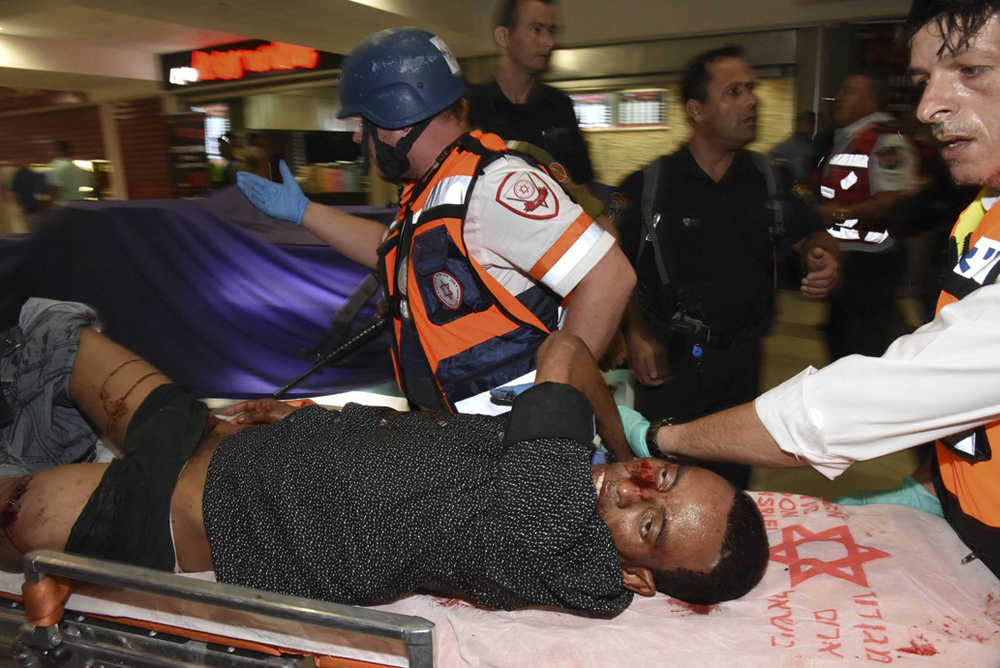
JERUSALEM — The death of an Eritrean migrant who was shot and beaten by a mob that mistakenly believed he was a Palestinian attacker set off a round of soul-searching Monday amid the jittery atmosphere sweeping Israel in a wave of unrest.
Prime Minister Benjamin Netanyahu condemned the vigilantism. Some critics accused Israel’s leaders of fostering the charged climate, while others called for the swift prosecution of the crazed mob.
“It is a disgrace to Israeli society, and those that carried out this lynching need to be found and brought to justice,” said Yaakov Amidror, Netanyahu’s former national security adviser.
“Even if it was the terrorist himself, by the way, after he was shot, after he was neutralized and lying on the floor, you need to be an animal to torment him,” he told Israel Radio.
Nine Israelis have been killed in the past month in the attacks, mostly stabbings, on city streets. At least 41 Palestinians have been killed — including 20 identified by Israeli authorities as attackers; the rest were slain in clashes with Israeli forces.
Amid the seemingly random attacks, Israelis have stocked up on mace and pepper spray, and some public officials are openly carrying personal weapons and encouraging the public to do the same. Security has been increased, and especially in Jerusalem.
The violence has led to fear and sometimes outright panic.
Following an attack at Jerusalem’s bus station last week, a swarm of security forces and armed civilians ran along a central road in search of a second assailant following a false alarm. Elsewhere, an Israeli man stabbed a fellow Jew after mistaking his dark-skinned victim for an Arab. Palestinians in Jerusalem say they are afraid of being shot if perceived to be a threat.
But Sunday night’s mob scene at the bus station in the southern city of Beersheba took things to a new level.
The violence began when an Arab with a knife and gun killed a soldier, stole his weapon and opened fire, wounding nine people before being killed by police.
In the mayhem, Habtom Zerhom, an Eritrean migrant in his late 20s, ran into the station to seek cover, police said. A security guard, mistaking Zerhom for an attacker, shot him.
As the young man lay on the floor, a mob cursed him, kicked him and hit him with objects. Security camera video showed Zerhom in a pool of blood as he was rammed with a bench and kicked in the head by passers-by, while an Israeli officer and a few bystanders tried to protect him. Zerhom later died at a hospital.
“It doesn’t matter if it was a terrorist or not. It was a man lying on the ground that couldn’t move. I couldn’t sleep at night from seeing him, his blood,” Meir Saka, a passer-by who tried to protect the Eritrean, tearfully told Channel 10 TV.
An Israeli identified only by the first name Dudu told Israeli Army Radio that he regretted participating in the attack.
“If I would have known he wasn’t a terrorist, believe me, I would have protected him like I protect myself,” he said. “I didn’t sleep well at night. I feel disgusted.”
Meeting lawmakers from his Likud Party, Netanyahu condemned the vigilante violence and sent his condolences to Zerhom’s family.
“We are a law-abiding country,” he said. “No one should take the law into their own hands.”
Police said they were reviewing the security video to identify the mob. As of late Monday, no arrests had been announced.
Critics said the shooting was the result of the charged atmosphere. Jerusalem Mayor Nir Barkat, for instance, has openly called on all licensed gun owners, like himself, to carry their weapons to help back up overstretched security forces.
“The death of an asylum seeker at the hands of security guards and an angry mob is a tragic but foreseeable outgrowth of a climate in which some Israeli politicians encourage citizens to take the law into their own hands,” said Sari Bashi, director for Israel and the Palestinian areas of Human Rights Watch.
Hanan Ashrawi, a top Palestinian official, accused Israeli leaders of whipping up the public.
“They are creating a mentality of lynch mobs and of course feeding the culture of hate and racism,” she said.
Others questioned whether Zerhom’s ethnicity had been a factor. “Just because of his skin color,” said a headline in the Yediot Ahronot daily.
There are about 34,000 Eritrean migrants in Israel. They say they are fleeing persecution and conflict in their homeland, one of the world’s worst violators of human rights.
Israel says they are merely economic migrants looking for work, and it refuses to give them refugee status. But it does not deport them because of the danger they face at home.
Many Israelis fear the influx threatens their country’s Jewish character, with one right-wing lawmaker famously calling migrants a “cancer.” Africans frequently complain of racial discrimination in Israel.
“The young Eritrean man is clear testimony to foreignness. He sustained critical injuries in a war not his own. Alone,” Danny Adino Ababa, an Israeli journalist of Ethiopian origin, wrote in Yediot.
Zerhom worked at a plant nursery in southern Israel and had been in Beersheba to renew a work visa, said his employer, Sagi Malachi.
“He was a modest man, quiet, and he tried to do his job as best as he could,” Malachi told The Associated Press. “It is heart-breaking. All in all, I think that he was in the wrong place at the wrong time.”
A friend, Goitom Haile, said Zerhom had worked in various farming jobs for four years. He had saved his money and dreamed of returning to Eritrea to reunite with his family in the next few months, Haile said.
“He was a good man, like a brother,” he said.
The current unrest began last month with clashes at Jerusalem’s most sensitive holy site, a hilltop compound revered by both Jews and Muslims. The spot is known to Jews as the Temple Mount, home to the biblical Temples, and today is the location of the Al-Aqsa Mosque, Islam’s third-holiest site and an important symbol for Palestinians.
The clashes were fueled by rumors among Palestinians that Israel is trying to change a longstanding status quo that allows Jews to visit but not pray on the mount. Israel denies the allegations and has accused Palestinian leaders and social media of incitement.
Palestinians say the violence stems from anger over the Jerusalem holy site and nearly 50 years of occupation, as well as a lack of hope.
Jibril Rajoub, a top Palestinian official, praised the Palestinian attackers.
“These are individual heroic acts. I appreciate them. I salute everyone that has done this. We bow in front of them,” he told Palestine TV.
At the same time, he called for passive resistance. “Do you know what the meaning of having tens of thousands sitting in the streets without throwing a stone? We want the world to hear our voice,” Rajoub said.
___
This story has been corrected to show the transliteration of the Eritrean migrant’s first name is Habtom, not Haptom.
___
Associated Press writers Yaniv Zohar in Ein Habesor, Israel, and Mohammed Daraghmeh in Ramallah contributed to this report.
