
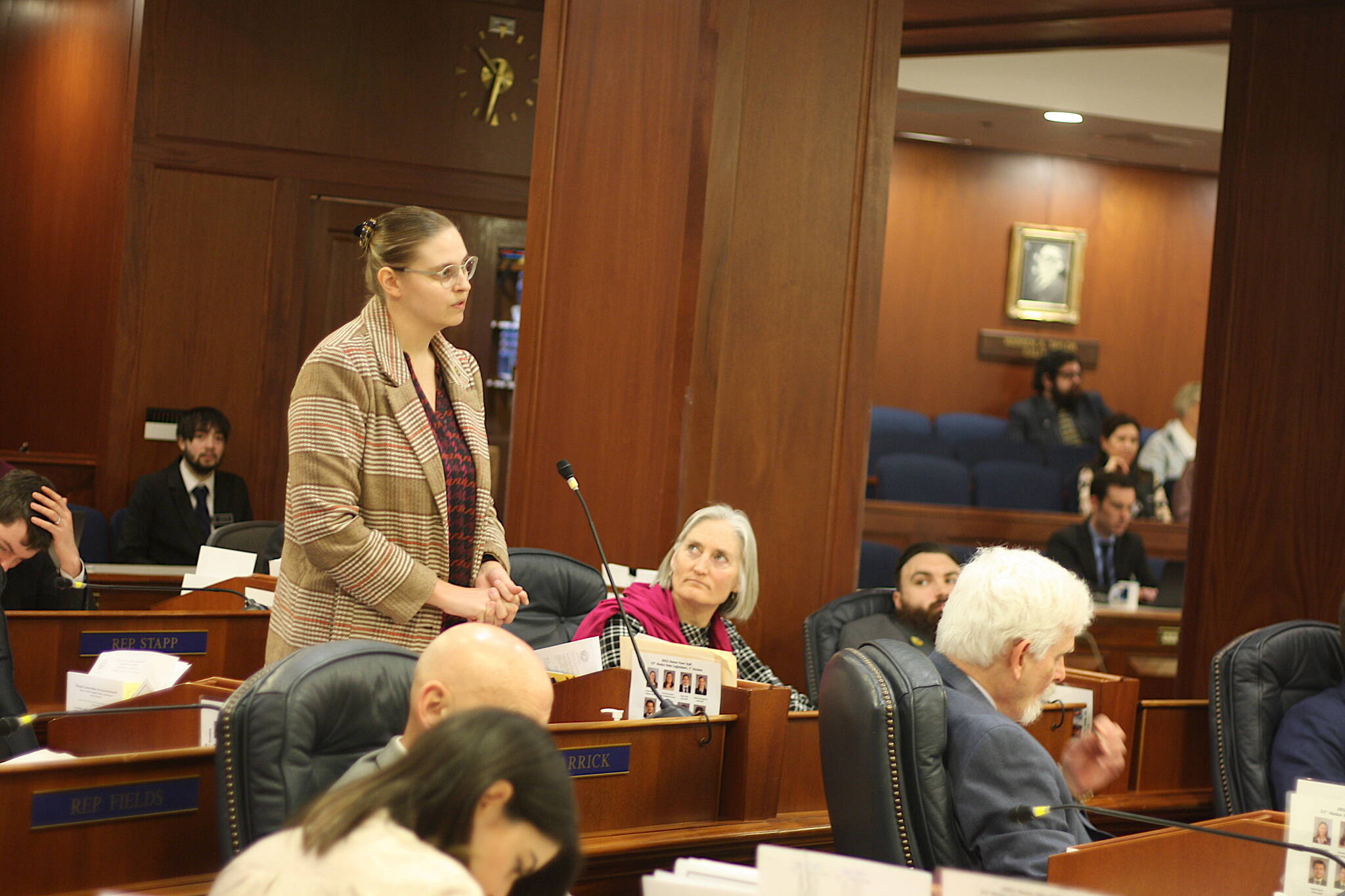
The state House majority on Thursday restored an 11% increase to education funding next year on the condition the minority provides the votes necessary to balance the budget by tapping into a reserve fund.
The action came after a chaotic Wednesday at the Capitol that saw nearly the entire minority caucus leave the building for four hours due to an education-funding standoff, with accusations like “holding our kids hostage” voiced when they returned for what turned into a de facto filibuster until the session finally adjourned for the day.
Thursday’s session started with numerous speeches by lawmakers that included a few apologies for the previous day’s behavior, but the divisions and hard feelings about the issues related to the standoff remain. The opening invocation prior to the debate by Rep. Ben Carpenter, a Nikiski Republican, cited the Psalm with the well-known reference to kids having power to defeat enemies.
“From the mouths of children and infants you have ordained praise on account of your adversaries, to silence the enemy and avenger,” he read.
The proposal restoring the education increase makes a subtle change from a proposal the House passed by a 39-1 vote Monday, where the increase was not tied to minority support for tapping the reserve fund. The one-time increase is also void if a permanent increase to the base student allocation is approved during the session.
Minority members, while not engaging in Wednesday’s stall tactics, did speak at length about their discontent with the majority’s approach.
“Right now, our education funding process sets children up for failure and their districts,” said Rep. Andi Story, a Juneau Democrat who successfully sponsored a provision in a bill increasing the BSA in a two-year phase-in thus allowing districts advance notice on what their funding will be.
Another Southeast Alaska representative on the House Education Committee, Sitka independent Rebecca Himschoot, expressed disappointment with the temporary and uncertain increase.
“I look forward to the day we can provide our districts with the funding they need in a stable and predictable way,” she said. “This is not that day.”
But majority members noted it is one of the biggest increases to education funding in the state’s history, and it’s the minority who are putting it in peril by trying to link it to other aspects of the budget and long-term fiscal plan.
“A yes vote supports Alaska,” said Rep. DeLena Johnson, a Palmer Republican who co-chairs the House Finance Committee and introduced Thursday’s conditional restoration of funds. “A yes vote funds education. A yes vote supports our children.”
The vote to approve the conditional increase was 23-17 along straight majority-minority lines, with unaffiliated Republican Rep. David Eastman of Anchorage voting with the minority.
The majority’s proposed one-time education funding increase would cost $175 million — far less than educators, Senate leaders and the House minority are seeking on an ongoing basis — and increase the projected deficit to $600 million. The majority’s plan is to cover that by tapping the Constitutional Budget Reserve, which contains roughly $2 billion, but that requires a three-fourths vote of both the House and Senate, meaning support from at least some House minority members is necessary.
The minority caucus is saying it won’t provide the votes to tap the reserve unless the education funding increase happens in a way that ensures it gets priority over the Permanent Fund dividend if there is a shortage of available funds. Practically speaking, that means PFDs that would be about $2,700 in the majority’s existing budget would be about $1,300 with a funding mechanism proposed by the minority in the event of a shortfall.
Nearly all minority members staged the walkout starting late Wednesday morning to prevent the House from voting on rescinding the funding, since a call on the House placed by House Minority Leader Calvin Schrage meant all members needed to be present. But House Speaker Cathy Tilton ruled the minority’s actions were a stalling tactic in violation of parliamentary rules and absent members were given until 3 p.m. to return when voting would resume.
The de facto filibuster continued after the minority members returned, as they introduced and reintroduced a barrage of amendments and other actions related to the education funding provision. Tempers flared, with Schrage at one point asking the House rules be officially suspended since he claimed they weren’t being followed anyway, and Tilton eventually adjourned the session for the day at 6 p.m. to allow emotions to cool down.
The House is scheduled to debate the full budget during Monday’s floor session, after leaders abandoned hope of completing work in it by Thursday so members could have a long Easter holiday weekend.
• Contact reporter Mark Sabbatini at mark.sabbatini@juneauempire.com
