
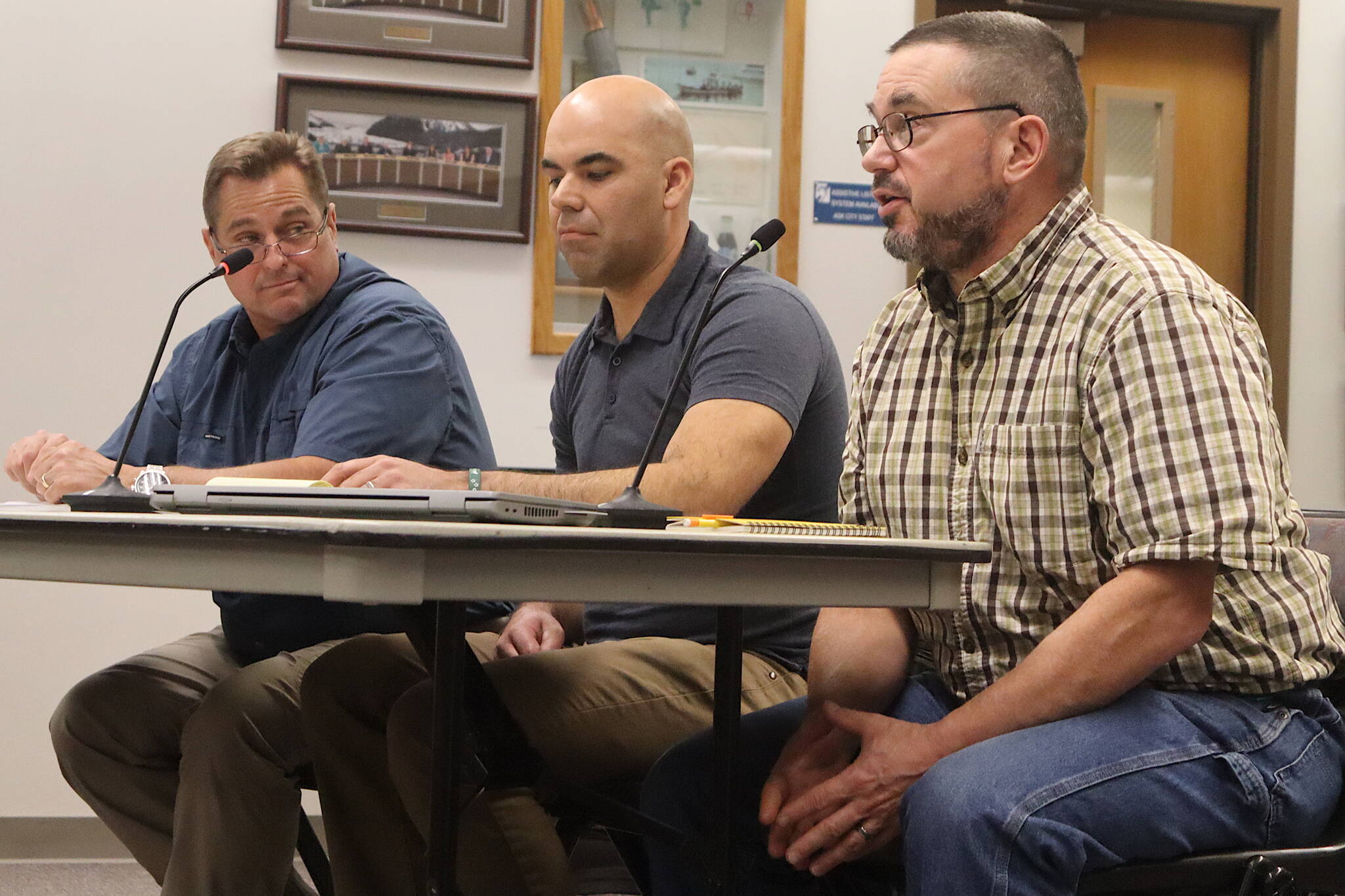
This week experts from the U.S. Army Corps of Engineers sought to address concerns about flood barriers and other prevention measures during a meeting of city leaders. Next week those experts will try to address questions from residents seeking to protect their homes.
A public meeting is scheduled Tuesday and an open house on Thursday when Corps of Engineers officials will present information and answer questions focusing on individual protection measures such as using sandbags and steps to take after a flood warning.
That focus differs from this week’s meeting that focused on military-grade flood barriers city leaders are considering to build a semipermanent levee, which local officials said they are scheduling additional meetings for. City Manager Katie Koester said one of those will be the Nov. 18 Assembly meeting where she will present proposed details for how to pay for the first phase of the barrier installation, which could include requiring payment from owners of property the barriers are placed on.
Both of next week’s Corps of Engineers meetings are in the Thunder Mountain Middle School auditorium. Tuesday’s presentation, which will be followed by a question-and-answer session, is scheduled from 6-8 p.m. The open house where people can arrive at any time to ask questions is scheduled from 4-7 p.m.
The events will not be livestreamed, but a recording of Tuesday’s meeting will be available afterward at CBJ’s website.
Glacier outburst floods known as jökulhlaups have occurred annually in Juneau since 2011, but record flooding the past two years has caused widespread damage in neighborhoods along the Mendenhall River and experts say such flooding in future years is probable.
Corps of Engineers officials, during a Juneau Assembly Committee of the Whole meeting on Monday, said researching and implementing a long-term solution is a process likely to take a decade or more.
“Even if we do it quickly, it’s still going to be a long time,” said Dan Allard, one of the Corps of Engineers experts. “Much more time than you have to protect the people down on the river.”
The Corps is providing up to 25,000 linear feet of Hesco barriers — which are three feet square at the base and four feet high — and the Assembly last month approved spending up to $2 million to install them.
However, because the barriers will largely be placed on homeowners’ properties a multitude of concerns and objections have been raised by those residents as well as Assembly members. Two flood team experts from the Corps of Engineers attending the meeting in person, and a consultant from a company specializing in the use of such barriers attending online, addressed many of those questions during presentations.
Keith Anderson, a consultant with Flood Defense Group who previously worked for Hesco for 17 years, said the barriers are used for purposes beyond flooding — such as protecting military facilities — and are able to withstand impacts ranging from trees to car bombs. If a breach occurs, he added, it is unlikely to affect adjacent barriers and repairs can be quickly made.
“There’s never been a case of one box getting damaged, resulting in a bunch of them somehow failing,” he said.
The barriers are easy to transport to sites and set up — “it’s like a soil-filled Lego,” Anderson said.
“It’s essentially just a bunch of pre-connected welded wire mesh panels to make individual boxes that are then lined with geotextile fabric,” he said. “That therefore allows you to fill it up with dirt, sand and locally available fill material.”
The effect of Juneau’s year-round wet weather on the dirt-filled barriers was raised by Assembly member Ella Adkison. Anderson said that actually can be beneficial since algae and moss that form will protect the geotextile fabric rather than degrade it. The barriers have a five-year intended design life, but in a typical climate wear starts to show after eight to ten years, he said.
A concern expressed by a resident at a previous Assembly meeting involved the removal of trees from backyards where the barriers would be placed since the roots help stabilize the riverbank. Anderson said the empty barriers can be placed with the tree in the middle before being filled — and the tree will reinforce the protection offered by the barrier.
However, an initial goal resulting from a survey of the area with the Corps of Engineers experts is putting the barriers as far from the riverbank as practically possible so they won’t be lost if erosion occurs, said John Bohan, a city engineer called upon to answer site-specific questions during Monday’s meeting.
“We may be right up against people’s homes, which may not be the most popular decision,” he said. “But if the bank’s going to go we want to have as much warning and protection as possible. We may have to come back and dismantle some sections of the barrier at times to restabilize a section of bank that we see start failing, but our first shot is going to be our best shot to get all this done correctly, and that’s why we’re really taking this seriously.”
• Contact Mark Sabbatini at mark.sabbatini@juneauempire.com or (907) 957-2306.
