
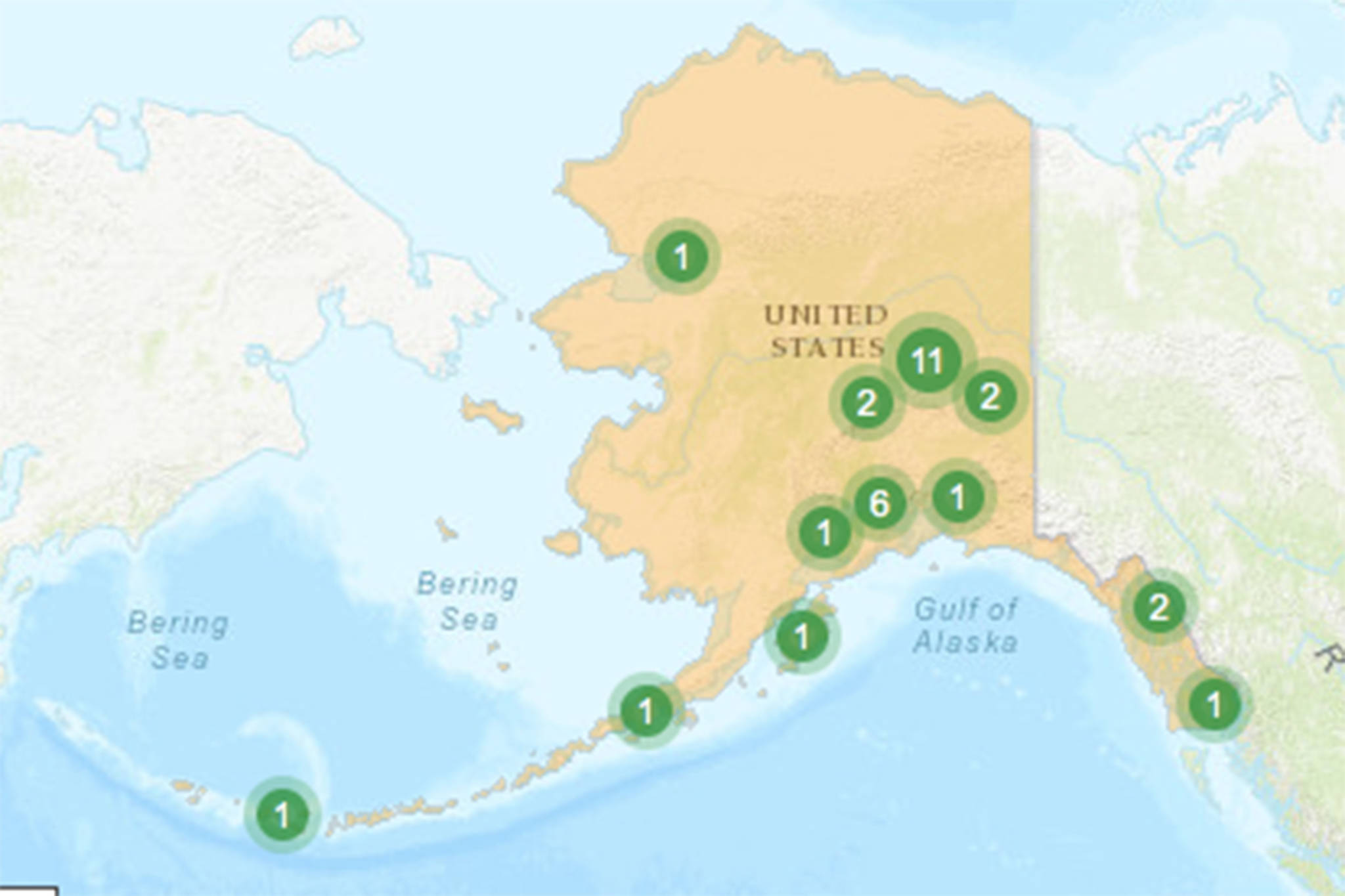
Alaska in 2018 led the nation in releasing toxic chemicals tracked by the Environmental Protection Agency, according to a new EPA report, but the Alaska Department of Environmental Conservation commissioner says the numbers aren’t what they seem on the surface.
Thirty facilities across the state released 971.9 million pounds of Toxic Release Inventory chemicals in 2018, according to the EPA’s TRI National Analysis shared Tuesday morning. That’s the most in the U.S. by volume and the 11th most per square mile.
TRI chemicals are toxic chemicals whose release must be reported to the EPA. There are currently 755 listed TRI chemicals. The annual TRI analysis tracks the management of toxic substances at the state and national levels.
DEC Commissioner Jason Brune said in a release the EPA’s numbers don’t tell the whole story of what’s happening in Alaska.
That’s because the vast majority — 970.6 million pounds, more than 99% — of Alaska’s releases are land releases connected to metal mining, and Brune argues that unearthed rocks moved to a different part of the mining site don’t have a significant impact on public health and should not be qualified as a toxic release.
“Big mines like Red Dog (near Kotzebue) move a significant amount of material as part of their daily operations, but such actions do not adversely impact human health and the environment,” Brune said in a release. “Characterizing such releases as toxic is disingenuous at best.”
However, that’s not everyone’s impression of the annual analysis.
David Chambers, founder and president of the Montana-based Center for Science in Public Participation, a nonprofit that provides assistance on mining and water quality to public interest groups and tribal governments, find TRI analysis to be fair and useful.
“I think EPA’s critique of releasing all these metals is legitimate,” Chambers said.
[House-passed bill could lead to PFAS cleanup]
He said it’s tough to characterize unearthing rocks containing toxic chemicals and moving them to another location as anything other than a release that creates the potential for harmful materials to enter the environment.
“If you let them loose they can be a real problem,” Chambers said. “That’s basically what mining does to these metallic elements.”
With this year’s report, the EPA published a new guide with the 2018 TRI National Analysis to help explain metal mining data. The EPA was unable to respond to a request for comment in time for the publication of this article.
The guide notes that because large mines relocate millions of tons of excavated waste rock, the reported quantity of chemicals can be quite large, and it acknowledges TRI data is not in itself enough to determine the level if any of public exposure to toxic chemicals.
In Alaska, Red Dog Operations accounted for more than 90% — about 885.7 million pounds — of the state’s releases, according to the EPA’s figures, but it wasn’t the only mining company in the top five. The entirety of the top five releasers in Alaska were mining projects, according to the analysis. Red Dog was trailed by Hecla Greens Creek Mining Co. at about 55.6 million pounds, Fort Knox Mine at about 19.5 million pounds, Pogo Mine at about 7.9 million pounds, and Couer Alaska Inc Kensington Gold Project at about 2.3 million pounds.
In a letter shared with the Empire, Red Dog general manager Les Yesnik and Wayne Westlake President and CEO for the NANA Regional Corporation, acknowledged the presence of lead and zinc in waste, but stated the EPA report creates “confusion and misinformation.”
NANA is a regional Alaska Native corporation whose region includes 11 communities in the northwestern portion of the state and owns the land on which Red Dog Operates.
“This is a normal part of the mining process and does not indicate any health or environmental effect,” Yesnik and Westlake wrote. “Red Dog is required to report the amount of materials moved at the mine site due to the grades of zinc and lead naturally occurring in the rocks in the ground. This does not relate to any releases of materials from Red Dog to the environment.”
Chambers said lead and zinc may occur naturally, but so does cyanide. He also said that if toxic materials stayed entirely on mining sites all of the time, there would likely not be many complaints about the contents of mining waste.
“We’ve seen it demonstrated over and over again that those contaminants get off the mine site, and that’s where you get problems,” Chambers said.
He said the annual analysis can help track what chemicals and in what quantity are present at mining sites, and that information would be useful for quantifying risk to the public if the materials made their way off site.
“I think fundamentally, TRI is a good thing,” Chambers said.
• Contact reporter Ben Hohenstatt at (907)523-2243 or bhohenstatt@juneauempire.com. Follow him on Twitter at @BenHohenstatt.
