
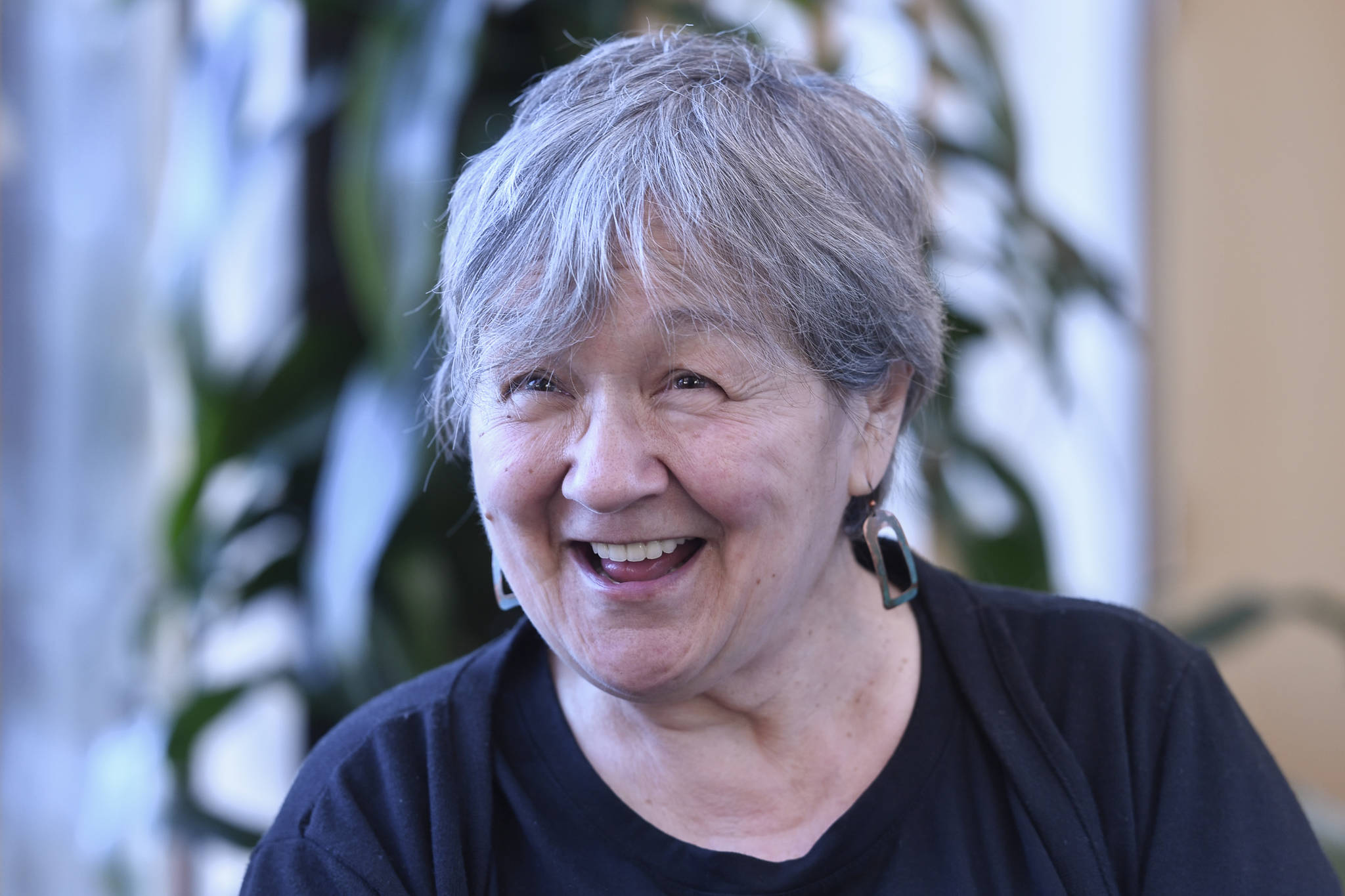
As State Writer Laureate, Ernestine Saankalaxt’ Hayes saw a lot more of Alaska.
The celebrated author of “Blonde Indian: An Alaska Native Memoir” and “The Tao of Raven” and professor of English for University of Alaska Southeast said writing workshops in parts of the state she’d never seen before were highlights from her term as state writer that’s set to soon come to an end.
“I traveled around to lots of communities in Alaska and did workshops and so on, and so my project as laureate was to workshop and try to visit communities that don’t often receive attention, are not on the main thoroughfare and so on,” Hayes said. “I’ve been to some really great places.”
“It’s been exciting,” she added. “For me it’s seemed like an extension of my Alaska Reads activities.”
Frank Soos, who preceded Hayes as Alaska State Writer Laureate, spearheaded the statewide Alaska Reads program, which encouraged Alaskans to read a book by a living Alaskan author and engage with that author. The book chosen was “Blonde Indian.”
[Author from Juneau talks about penning Elizabeth Peratrovich bio]
Hayes’ time as writer laureate has been slightly extended by a delay in naming her successor, but an announcement about a new Alaska State Laureate is anticipated at the end of the month from the Alaska State Council on the Arts.
A sabbatical is also in Hayes’ future and will allow her to pursue writing her third book.
“It took 25 to write ‘Blonde Indian” then it took 10 years to write “The Tao of Raven” but I am at an age where I don’t have another 10 or 25 years to write my next book, so I requested a sabbatical for the fall, and the main purpose is to write the third in a trilogy of an Alaska Native memoir. The working title is ‘Bury these Stories.’ It’s just a working title. I have another title in mind. Sometimes, it’s not up to me.”
Traversing the state won’t stop once she is no longer laureate, Hayes said, but the laureate program allowed her travels to take on a scope that otherwise would not have been possible.
She said trips to Seward and her first-ever visit to Seldovia, a city in the Kenai Peninsula, were particular highlights — Seward because of its place in Hayes’ family history and Seldovia because of the town’s culture.
“I went to Seward, which was touching for me, because when I was a girl, my mother was in and out of the hospital for tuberculosis, and she stayed in Seward for some time, and when I stayed in Seward, I was conscious of her presence,” Hayes said. “It was a lot like Juneau to me.”
Getting to Seldovia, which is only accessible by airplane or boat, required a lot of planning, Hayes said, but the payoff was worth it. Hayes said the visit to Seldovia may have been her single favorite aspect of her time as state writer laureate.
“It was a wonderful town,” Hayes said. “I really enjoyed it. I was so impressed by the way all the residents there were so in touch with the seasons. Everybody knew what was in season next. Everybody was talking about their favorite fishing place. I was invited to dinner. We had pickled fern stalks and pickled kelp and fresh cod fish of course. It was wonderful. All of us who live in Alaska want to live like that.”
While visiting communities, Hayes would lead two-day workshops that were formatted like ultra-abbreviated creative writing classes. The first day would include sharing remarks and writing tips with local authors during the first day and the second day featured feedback from Hayes regarding new or re-worked pieces.
“That’s what I tried to do — share technique and share tips,” Hayes said. “I think talent and sharing stories is like what they say about love and what I believe about success, which is the more you have the more we all have. The more there is the better.”
Encouraging unlikely storytellers, including the incarcerated, to find their voice is one of Hayes’ passions.
“It’s for personal reasons,” Hayes said. “I never really realized I had a story until I came here and started studying creative writing and essay writing. I was 50 when I started college here. I had a story, and I just didn’t realize it was one I could tell. We all live lives that are full of meaning and metaphor and lessons.”
Being Alaska State Writer Laureate gave Hayes numerous high-profile, public speaking opportunities, including opening remarks when U.S. Poet Laureate Tracy K. Smith came to town and a closing message at this year’s Governor’s Arts and Humanities Awards.
[PHOTOS: Governor’s Art’s and Humanities Awards 2019]
“It’s gratifying and a real opportunity when I get a chance to share a message or introduce someone or say a few words,” Hayes said. “I’d try to articulate and express what the people who invited me might hope I’m going to say or sometimes what I’m not going to say.”
Hayes is also a frequent speaker about Alaska Native issues, traditions and the complex makeup of their pre-colonial society outside of her role as Alaska State Writer Laureate.
In November, she delivered an impassioned case for referring to geographical locations by their Native names rather than the sometimes thoughtless monikers coined during colonialism.
“Is it not time to stop erasing Native people, erasing Native history, erasing Native names?” Hayes asked during that lecture on the power of Alaska Native names. “Let us not look back with admiration, but forward with hope.”
However, Hayes also used her state writer post to staunchly advocate for things on occasion.
[Poetry turns focus on environmental concerns]
“I can be sassy sometimes,” Hayes said.
For example, during February’s Governor’s’s Arts and Humanities Awards, Hayes spoke passionately about the importance of education.
“Higher education changed my life, and when we change one life we change our generations, and when we change our generation we change our future,” Hayes said. “That’s real important these days, I think.”
• Contact arts and culture reporter Ben Hohenstatt at (907)523-2243 or bhohenstatt@juneauempire.com. Follow him on Twitter at @BenHohenstatt.:
