
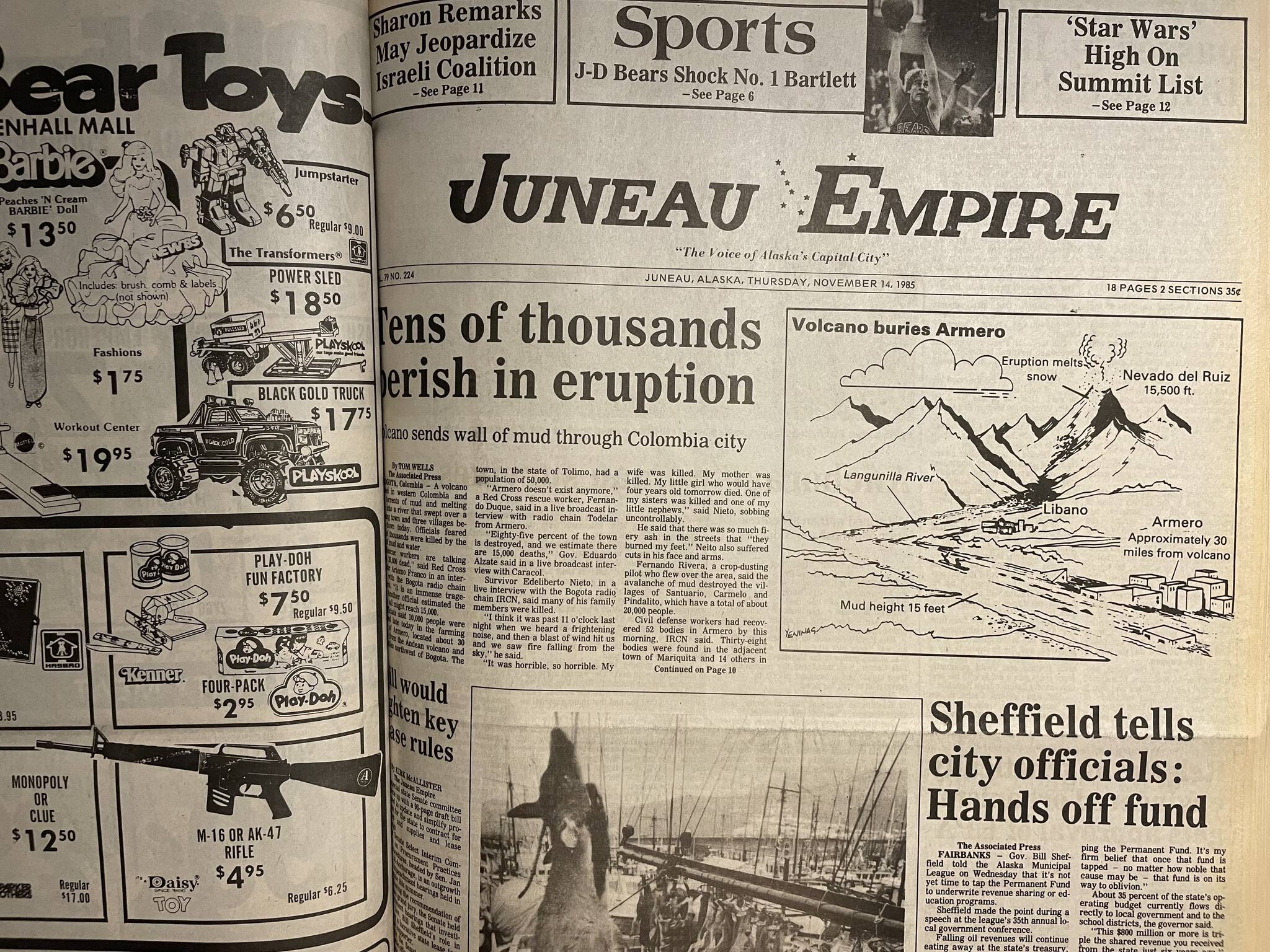
Empire Archives is a series featuring a short compilation of headline stories from archived editions of the Juneau Empire.
“Rental aid program gets good response” by Betsy Longenbaugh
Nov. 13, 1985
A Juneau housing program for low-income residents received a high turnout, filling 45 of the program’s 62 spots shortly after starting up.
The program allowed families to pay 30% of their income for rent, and the rest would be covered by the Alaska State Housing Authority. The program mandated that families be below a certain income level to qualify, and they must rent housing at fair market value.
Fair market rent for Juneau included $466 per month for an “efficiency apartment,” $555 for a one-bedroom, and $941 for a four-bedroom.
“The Sinking of the USS Juneau” by Chuck Kleeschulte
Nov. 13, 1985
Juneau historian Steve Andereggen spent three years researching the USS Juneau, a WWII military ship which sank in 1942. He presented this history at the Alaska State Museum on the afternoon of November 13, 1985.
Andereggen first came across a record of the ship in the state historical library as a service manager for the state Department of Administration. There he learned that the USS Juneau was the first military vessel to be named for an Alaskan city, but little else.
He combed through research libraries and archives in Washington D.C, and accrued thousands of dollars in phone expenses to gather information about the ship.
Andereggan’s research helped piece together the USS Juneau’s short history. It was launched in October 1941 and sunk in November 1942 in the Battle of Guadalcanal, after being struck by a Japanese submarine torpedo. Over 650 died aboard the Juneau, and only 10 survived.
Aboard the ship were five brothers of the Sullivan family and four brothers of the Roger family, all of whom died. The Navy soon after put in place a practice where brothers served not only on different ships, but in different war theaters.
“I really feel strongly that the history of the Juneau is a part of our history, all of us in Juneau today. The sinking changed naval history,” Andereggen said.
“Alaska offers to trade wolves for bears” by Dean Fosdick for the Associated Press
November 15, 1985
“Montana, bullish about trying to get rid of some of its problem grizzly bears, ran into a horse of a different color a few months back when Alaska offered to swap it timber wolves on a ‘pound-for-pound basis,’” Fosdick wrote.
Montana Department of Fish, Wildlife and Parks put out a plea to western states and Canadian provinces to adopt their problem brown bears. The bears were reportedly outgrowing their range and wreaking havoc on private land.
At the time home to about 30,000 brown bears, Alaska declined the offer as presented.
“It struck me funny that Montana, a state with a few grizzlies, was contcting us, a state with a lot of grizzlies,” said Alaska Fish and Game official Bob Hinman.
Alaska did, however, put forth an offer to trade bears for wolves. Wolves were classified as an endangered species, with a population of about 6,000 to 10,000 in Alaska in 1985. The state, however, had enacted a controversial aerial wolf control program and pushed for reopening wolf hunting to take pressure off of moose populations.
Montana did not respond to Alaska’s bear-for-wolf swap offer.
