Tribes and environmental groups sue to stop road planned for Alaska wildlife refuge
Published 7:04 am Friday, November 14, 2025
Yereth Rosen
Alaska Beacon
Three tribal governments and several environmental groups sued the Trump administration on Wednesday to try to block a land trade that would allow a road to be built through a national wildlife refuge in southwestern Alaska.
The land swap, approved by the U.S. Department of the Interior last month, would open up a section of the Izembek National Wildlife Refuge.
Supporters argue that the road is needed to connect the community of King Cove, home to about 750 people, with a legacy military airstrip that can accommodate jets. That would give King Cove’s residents access to safer medical evacuations if needed. Opponents say the proposed road — to run 18.9 miles in total, most of that within what is currently refuge land — would damage world-class bird habitat that is in the heart of the refuge.
Wednesday’s challenges came in three lawsuits filed in U.S. District Court in Anchorage. All assert that the land trade and road development pose dire threats to migratory bird populations that use Izembek’s wetlands, including species with Endangered Species Act listings, and to the wider ecosystem. All say the trade and planned road violate the Alaska National Interest Lands Conservation Act and other federal laws.
The three lawsuits have their individual characteristics as well.
One of them, filed by tribal governments in the Yukon-Kuskokwim Delta villages, focuses on threats to traditional subsistence hunters who depend on the birds that use Izembek’s wetlands. The tribal plaintiffs are the Native Village of Paimiut, Native Village of Hooper Bay and Chevak Native Village.
“Izembek’s eelgrass wetlands are a lifeline for emperor geese, black brant and other birds that feed our families and connect us to Indigenous relatives across the Pacific,” Angutekaraq Estelle Thomson, traditional council president of the Native Village of Paimiut, said in a statement. “Trading away this globally important refuge for a commercial corridor devalues our lives and our children’s future. We are joining this lawsuit because defending Izembek is inseparable from defending our subsistence rights, our food security and our ability to remain Yup’ik on our own lands.”
The Center for Biological Diversity, an environmental organization, is also a plaintiff in the case.
A second lawsuit, filed by Friends of Alaska National Wildlife Refuges, Wilderness Watch, the Alaska Wilderness League and the Sierra Club, puts a special focus on the process used to achieve the land swap and what it may mean for all wildlife refuges.
“Trading the ownership of refuge lands that Congress designated for conservation is a terrible precedent for the privatization of public lands. Building a road will have tremendous impacts on fish and wildlife habitat and could also greatly increase both disturbance and sport hunting pressure on vulnerable species,” Marilyn Sigman, president of Friends of Alaska National Wildlife Refuges, said in a statement.
The third complaint, filed by Defenders of Wildlife, puts a focus on the wider environmental impacts.
The planned road enabled by the land trade would “result in incalculable and irreversible damage” to myriad wildlife species, including marine and land mammals as well as migratory birds, that lawsuit says. The lawsuit alleges that the land deal violates both the National Wildlife Refuge System Improvement Act and the federal Wilderness Act.
“Under the Trump administration, the Interior Secretary entered into an illegal deal done in the darkness of a government shutdown: a sellout of one of our country’s largest and most pristine wildlife refuges and wilderness areas,” Jane Davenport, a senior attorney in Defenders of Wildlife’s Biodiversity Law Center, said in a statement. “Our treasured public conservation lands belong to all Americans. Defenders of Wildlife will stand up in court to hold this administration to account for recklessly and unlawfully trading them away.”
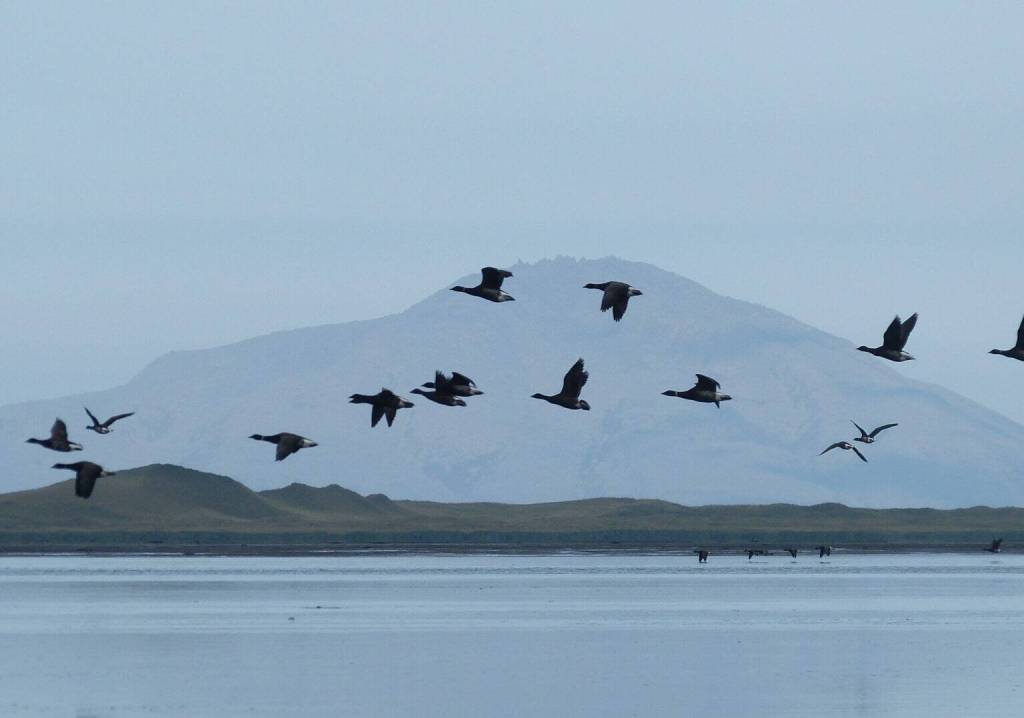
The Izembek Lagoon area, where the road is planned, holds the largest single stand of eelgrass in the world and the largest bed of seagrass along the North American Pacific Coast, according to the U.S. Fish and Wildlife Service. The entire Pacific population of black brant, a type of goose, uses the refuge’s lagoon area, feeding on the eelgrass. The refuge and its eelgrass support several other bird and mammal species; about half the world’s emperor geese use the refuge as a migratory stopover, according to biologists.
A Department of the Interior spokesperson declined to comment Wednesday on the lawsuits.
Last month, however, Interior Secretary Doug Burgum touted the land exchange and planned road as long overdue.
He spoke about the project during an event called “Alaska Day,” a gathering in Washington with Gov. Mike Dunleavy and the state’s three-member congressional delegation. The Izembek land exchange was one of the pro-development Alaska actions announced at the event.
“It just seems preposterous to me that somehow, it’s taken 40 years for us to put people first,” Burgum said at the event. “Because I know one thing as a governor of a state: You can actually do things like build 18 miles of gravel road and still take great care of wildlife.” Burgum was North Dakota’s governor before being appointed as Interior secretary.
The land trade he approved would convey a little less than 500 acres of refuge land, most of it designated wilderness, to the Native-owned King Cove Corp. The corporation would give 1,739 acres of its land to the U.S. Fish and Wildlife Service to be added to the refuge, and the federal government would also pay the corporation for the land.
The idea of a road linking King Cove to the World War II-era military runway at Cold Bay dates back decades. The legal and political battle over the proposal has also been long. Some of the plaintiffs in the new cases were plaintiffs in previous lawsuits over proposed land trades. The dispute was being considered by the 9th Circuit Court of Appeals, but that court in 2023 determined that the case was moot and dismissed it because the Biden administration was not pursuing the plan endorsed by the first Trump administration.
Yereth Rosen came to Alaska in 1987 to work for the Anchorage Times. She has been reporting on Alaska news ever since, covering stories ranging from oil spills to sled-dog races. She has reported for Reuters, for the Alaska Dispatch News, for Arctic Today and for other organizations. She covers environmental issues, energy, climate change, natural resources, economic and business news, health, science and Arctic concerns — subjects with a lot of overlap. In her free time, she likes to ski and watch her son’s hockey games.
Alaska Beacon is part of States Newsroom, the nation’s largest state-focused nonprofit news organization.