
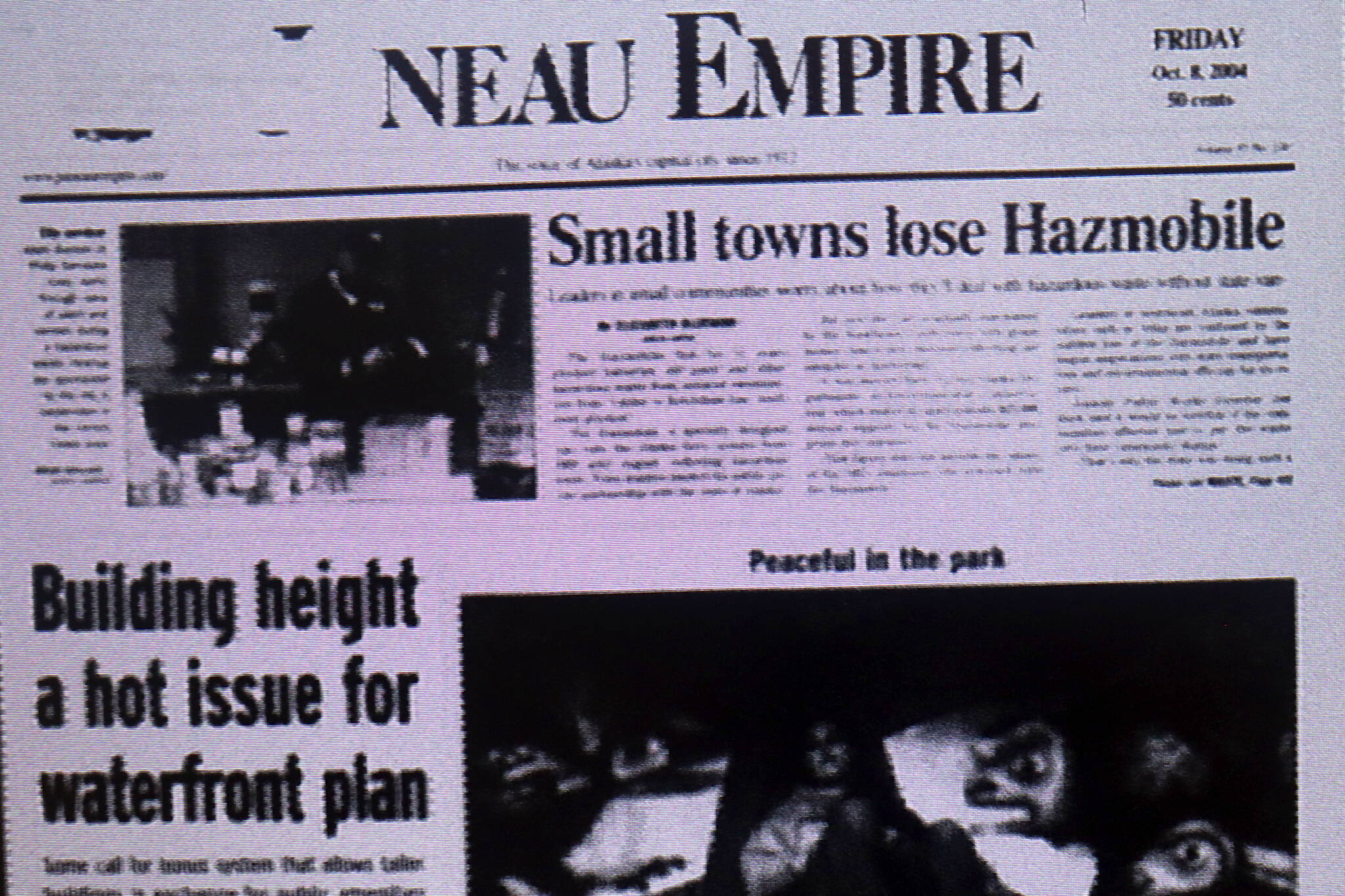
Empire Archives is a series printed every Saturday featuring a short compilation of headline stories in the Juneau Empire from archived editions in 1984, 1994 and 2004.
This week in 1984, money from half the cost of continuing work on the new areawide water system, followed by sewer and airport improvements, are the top three priorities for state funding on a preliminary list of construction projects given to planners and the Juneau City-Borough Assembly. The assembly capital improvement project committee last month completed a preliminary ranking of city construction it wants the state to help fund over the next six years. The list includes $75.5 million in state aid for construction valued at nearly $100 million. The list unveiled to members of the city’s planning commission for their comment Tuesday night emphasizes basic services, said Assemblywoman Kay Diebels. “Given the governor’s comments on infrastructure on water, sewers, road and airport improvements we tried to keep our requests to the basics, to the nuts and bolts,” said Diebels, who briefed planners.
Today the biggest two needs on a similar list, according to the Juneau Planning Commission which reviewed the projects this week, are flood protection from Suicide Basin after record flooding the past two years and a second Juneau-Douglas Crossing. Both are expected to cost hundreds of millions of dollars, with federal rather than state funds likely providing the majority if projects are approved.
Original Story: “Water system funding at top of city’s list,” by Chuck Kleesculte. 10/11/1984.
This week in 1994, the state’s blue-collar workers union has reached a tentative contract agreement with the Hickel administration, increasing the standard workweek to 40 hours. The agreement with the 1,500-member Public Employees Local 71 would increase the standard workday from 7½ hours to eight and the workweek from 37½ hours to 40. There is no pay raise in the tentative two-year deal, though the hourly employees would earn more for the extra time on the job. Of the 11 state employees unions representing some 12,000 workers, only the state troopers are required to work a 40-hour week. The 37½-hour workweek for state employees — in place since 1959 — has been a target of criticism by the private sector and lawmakers for years.
Today, according to the Alaska Department of Administration, the workweek for a permanent full-time employee is 37½ hours a week. “For health insurance and retirement benefits purposes only, 30 hours is considered full-time. Supervisory (SU) and Labor, Trades and Crafts (LTC) employees are regularly scheduled to work 40 hours per week.”
Original Story: “State, union agree,” by James MacPherson. 10/12/1994.
This week in 2004, the Hazmobile that for 11 years plucked batteries, old paint and other hazardous waste from isolated communities from Valdez to Ketchikan has itself been plucked. The Hazmobile, a specially designed van, rode the Alaska ferry system from 1993 until August, collecting hazardous waste. Town leaders lauded the public-private partnership with the state of Alaska. But now the van originally purchased by Southeast Conference with grant money has a new mission: collecting air samples in Anchorage. It was moved there by the Alaska Department of Environmental Conservation, which ended its annual $25,000 support for the Hazmobile program this summer. That figure does not include the salary of the DEC employee who traveled with the Hazmobile. Leaders in Southeast communities such as Sitka are confused by the sudden loss of the Hazmobile and have begun negotiations with state transportation and environmental officials for its return. Juneau Public Works Director Joe Buck said it would be terrible if the communities affected had to put the waste into their community dumps.
Original Story: “Small towns lose Hazmobile,” by Elizabeth Bluemink. 10/8/2004.
• Contact Mark Sabbatini at mark.sabbatini@juneauempire.com or (907) 957-2306.
