
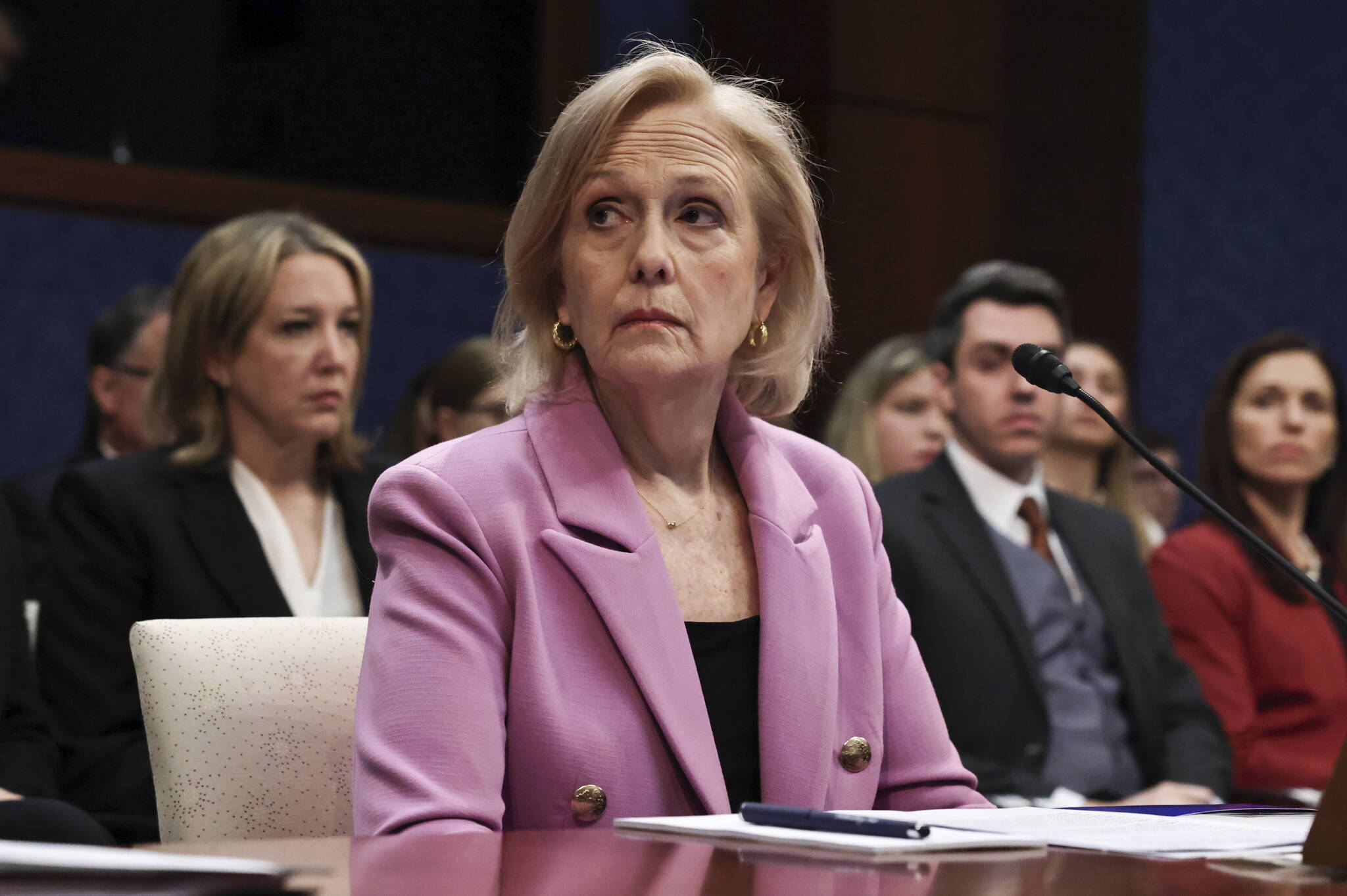
PBS CEO Paula Kerger’s phone connection was almost lost during a storm Friday as she warned how killing federal funds for public broadcasting would impact Alaska.
It was an apt metaphor as the tenuous connection made it a struggle to explain during an interview with the Empire how public broadcasting is the primary source of emergency alerts and news for many communities statewide. That’s particularly true for rural areas, although KTOO also issued a bulletin Friday noting it is “the primary point for the Emergency Alert System and Wireless Alert System in Juneau.”
President Donald Trump on Tuesday asked Congress to rescind the $1.1 billion set aside for all public broadcasters during the next two years, part of a broader attack on such media. KTOO states $1.2 million of this year’s $3.5 million operating budget comes from Corporation for Public Broadcasting grants.
Majorities in the House and Senate have to approve the request within 45 days for it to take effect. Public media officials have stated they consider passage by the Republican-led House more likely than in the Senate, where a few dissenting votes from moderates such as Lisa Murkowski (R-Alaska) — who opposes the cut — could be decisive in that narrowly divided chamber.
Alaska’s other Republican U.S. senator, Dan Sullivan, told the Homer News in a May 30 interview he’s looking for ways the federal government can continue to provide funding for public radio “without the content component” that he said “leans dramatically left.” U.S. Rep. Nick Begich (R-Alaska), the state’s lone House member, has expressed broad support for Trump’s agenda so far, but did not respond to a Northern Journal request last week about the public broadcasting cut.
Lawmakers at the state and federal level supporting cuts to public broadcasting — virtually all Republicans — say it’s about taxpayer funds supporting left-leaning programming and there are more information sources available to people everywhere compared to decades ago.
Kerger said her call to the Empire was among about half a dozen on Friday to media outlets as part of her effort to fight Trump’s request. She visited Juneau and other parts of Alaska in 2018, and as a result “I always point to Alaska as a place that is a great example of why PBS and public radio are so profoundly important.”
Consolidation or elimination of public media outlets are the inevitable outcome in Alaska and elsewhere if the cuts Trump is seeking take effect, Kerger said.
“I think it is very clear that if these cuts go through some of our stations go away that there isn’t going to be an economic base to support them,” she said. “And once stations are gone, they’re gone. It’s not like a newspaper operation that could be then propped up again. Once broadcast licenses are gone, they’re gone.”
Consolidation has already occurred elsewhere, including communities in West Texas that now all receive the same remote feed, Kerger said. She said the cuts Trump is seeking for Alaska means “there’d have to be tremendous consolidation and I think they’d be hugely limited in what they’d be able to offer the state.”
“If the money does go away some stations will look very different,” she said. “They will have to reduce some of the things that they’re doing. It may deeply impact their ability to do local journalism. Certainly for us we’ll look at having to reduce some of the content that we’re producing, not being able to serve areas that we have been in before and then parts of the country will just be unserved.”
“And the other thing is we’re the emergency backup system for the country for emergency alerts. That is compromised if you don’t have a robust broadcasting district that’s covering 99% of the country.”
Among the Alaska lawmakers supporting the end of government funding for public broadcasting is state Rep. Kevin McCabe (R-Big Lake), who in an April 3 column in the Alaska Watchman argued “a government-funded media outlet should be unbiased and represent all Americans, but NPR has actively driven away conservatives and moderates.”
He cited Uri Berliner, who resigned from NPR in April 2024 after 25 years as senior business editor, who claimed in a column a year later NPR’s audience has shifted from 37% of listeners describing themselves as liberal, 26% as conservative and 23% as middle of the road to 67-11-21, respectively.
McCabe also asserted stations elsewhere have managed to adjust to find alternatives to government funds.
“Some argue that rural stations, like KTOO in Alaska, which gets 30% of its budget from federal funds, would struggle without CPB grants,” he wrote. “But states like New York already supplement public media, and private foundations (like the Ford and MacArthur Foundations) have stepped in before. A phased reduction in federal funding would give stations time to adjust.”
However, public broadcasting officials representing 27 radio and four television stations in Alaska argue they have already been targeted for cuts for many years and had to make adjustments when reductions occurred. One such effort to “diversify the revenue stream and increase efficiencies through new station collaboration” occurred after a cut in state funding seven years ago, argued seven members of the Alaska Public Broadcast Commission in a May 15 column in the Anchorage Daily News.
“For example, Coast Alaska has linked Southeast Alaska radio stations into a cost-saving model that allows critical resources to stay at the community radio stations,” they wrote. “All stations have soldiered on with an army of thousands of volunteers and a lean professional staff providing thousands of hours of local news, weather, fishing and hunting openings and closures, plus educational and public affairs programming to their communities. They will struggle to survive without continued federal funding.”
A statement detailing more specific impacts to individual stations throughout Alaska was issued Friday by a coalition of officials representing those stations. Justin Shoman, president and CEO of KTOO, noted in the statement the loss of federal funding will have effects felt well beyond Juneau.
“This rescission package will also have an immediate impact on every Alaskan’s access to their state government by stripping funds needed to produce Gavel Alaska (formerly Gavel to Gavel), a public service of KTOO Public Media,” he wrote. “Losing this vital funding would undermine our ability to keep the public informed and engaged, diminish access to state government proceedings, and weaken the trust and transparency vital to our community’s well being.”
Managers representing rural stations said the cut sought by Trump, which accounts for up to 70% of their funding, would result in many of those stations going off the air. The statement also notes “most rural communities in Alaska can’t count on high-speed internet or cellular technology.”
“For example, Unalaska still relies on terrestrial radio for a wide range of services, especially in an emergency,” according to the statement.
The Alaska Legislature, during the final days of this year’s session, stripped $1.2 million in public radio funding intended to ensure rural stations can continue vital emergency communications from the state budget for the fiscal year that begins July 1. The cut was among hundreds of millions of dollars in late-session trims by state lawmakers due largely to another Trump administration action — an unexpectedly large revenue shortfall expected to get even worse next year due to a drop in oil prices triggered by what analysts say is driven by economic turbulence caused by global tariffs and other Trump policies.
The drop in revenue and resulting austere budget means state lawmakers are facing potential problems far greater in expense and scope than public broadcasting — with some leaders saying it’s possible there will be no money for Permanent Fund dividends next year, a first since the annual payouts began in 1982.
A proposed federal budget for next year currently pending in Congress makes severe cuts to Medicaid, for example, and state legislative leaders have said it could cost Alaska more than $1 billion if it opts to step in to prevent more than 100,000 Alaskans from losing health insurance benefits.
A further consideration is cuts sought by the Trump administration to federal agencies providing critical emergency services such as the National Weather Service and Federal Emergency Management Agency. Trump has suggested at least some responsibilities such as disaster assistance should be handled at the state level — although his cuts to agencies and staff have so far gone through a back-and-forth process at the agencies and in courts, leaving the status of many in limbo.
Although state lawmakers rejected the supplemental public broadcasting funds, Kerger said her observation as head of PBS for many years is “legislators in Alaska always understand the importance of what we do.” However, she said lawmakers and their constituents need to realize this isn’t just another of the many funding skirmishes that have occurred over the years.
“This is the most serious threat that I have seen and I’ve been in public broadcasting for 30 years,” she said. “I can go back to the Nixon era when there was a true effort to try to defund and it feels like that moment. I mean we have been batting off one challenge after another in the past. I think it is certainly appropriate for legislators to ask tough questions about ‘is this really important,’ ‘does this really matter’ if you’re making decisions about federal money. But this is different…This is going after monies that Congress already appropriated that is sitting in the coffers and that we are assuming is coming.”
“For a number of our stations that’s existential. Alaska is going to be a very tough spot if the federal funding goes away.”
• Contact Mark Sabbatini at mark.sabbatini@juneauempire.com or (907) 957-2306.
