
In September, the natural world slows down.
The days get shorter and shorter, bird song diminishes to next to nothing, marmots are hibernating and the bears soon will be. Most of the wildflowers are done blooming, although a walk above the tram in the middle of the month revealed the last few flowers of six species. And the alpine zone is where we find our best fall colors: various shades of red on dwarf dogwood, avens and lowbush blueberries, gold and russet on deer cabbage.
Nevertheless, on one day in mid-September, I enjoyed sightings of two kinds of critters that I don’t see very often.
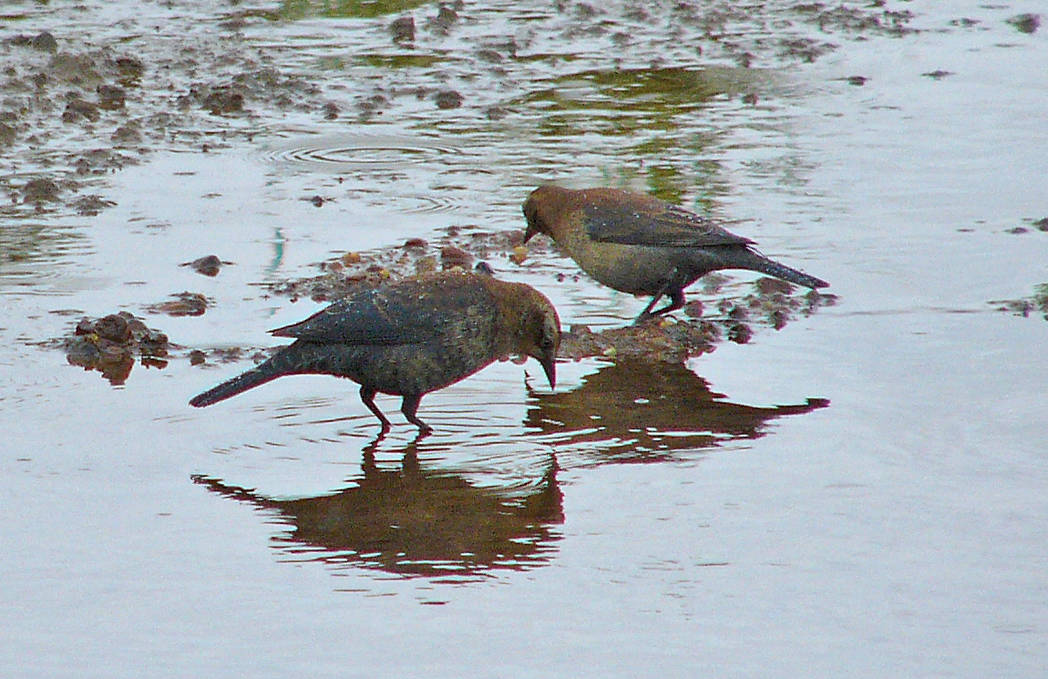
There were three rusty blackbirds on the shore of Mendenhall Lake, foraging over the wet sand and in the shallows. Rusties breed all across the boreal forest of North America and winter chiefly in the southeastern states. Even though Southeast Alaska is hardly on a direct route to the usual wintering area, I see them during the spring and fall migration seasons, sometimes by the ponds in the Dredge Lake area, occasionally elsewhere, but always in small numbers. Sadly, those numbers are likely to get even smaller: the number of rusty blackbirds has dropped dramatically in recent years, probably for several (undetermined) reasons.
Rusty blackbirds in Alaska often nest in wetlands and near ponds in dense, small black spruces, where nesting success is good, or in willow shrubs, with less success. Unlike their marsh-nesting relatives (such as red-winged blackbirds), they are usually monogamous. But similar to the other blackbirds, females do the tasks of incubating eggs and brooding young chicks. Blackbird males pitch in to help feed the chicks (but polygamous males commonly help mostly at the nest of a primary female; secondary females get less help).
In the nesting season, rusty blackbirds feed mostly on aquatic insects, including dragon and damselflies. During the rest of the year, the diet also includes seeds of many kinds and fruit. I was fascinated to learn that rusties sometimes kill and eat other birds.
The other critter I don’t see very often was Milbert’s tortoiseshell, a beautiful butterfly whose deep brown wings are banded with orange and yellow and adorned with red spots on the leading edge. All the color is on the dorsal surface, visible when the wings are spread. The ventral surface of the wings, visible on the folded wings, is more camouflaged, looking perhaps like dead leaves or bark. The one I saw was foraging on yarrow flowers — the only flower still in bloom in that area.
This butterfly overwinters as an adult, tucking into crevices in houses or trees, and emerging again in early spring. Batches of eggs are laid on nettles, which are the chief food of the caterpillars. (We could use more of them on the lower reaches of the Granite Basin trail!) Young caterpillars often forage in groups, but older ones are more solitary. They pupate in a folded leaf. When they metamorphose to the adult stage, they forage on nectar of many flowers, as well as sap and rotting fruit. In parts of North America, there may be two broods of caterpillars each year, but I doubt that there is more than one per year in Alaska. The one I saw was surely getting ready to hibernate, filling up the tanks, as it were, to last through the winter.
Addendum: As I strolled down to the beach below the pavilion near the visitor center, I stopped to watch the bear called Nicky and her little cubs. They trotted along the lowest pond on Steep Creek, where a few coho were jumping, waiting for enough water to allow them to ascend the creek. I don’t get to see Nicky very often either, so this was a happy sighting. The cubs looked pretty healthy but still very small … they will need their mom to catch some of those coho, so they can get fat enough to last the winter. But even Nicky, an expert fisher, can’t catch very many until there is enough rain to raise the water levels so the fish can get up into the stream itself. I have to hope for rain!
• Mary F. Willson is a retired professor of ecology. “On The Trails” is a weekly column and appears every Friday. Her essays can be found online at onthetrailsjuneau.wordpress.com.
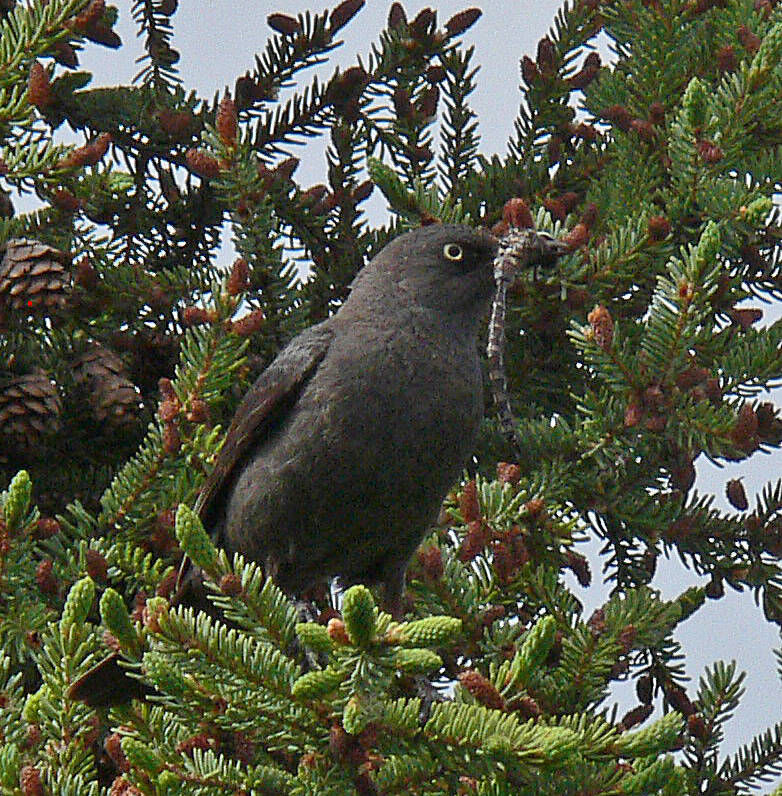
Bob Armstrong | Courtesy photo A male rusty blackbird holds the body of a dragonfly with the wings removed, perhaps ready to feed its nestlings.
