
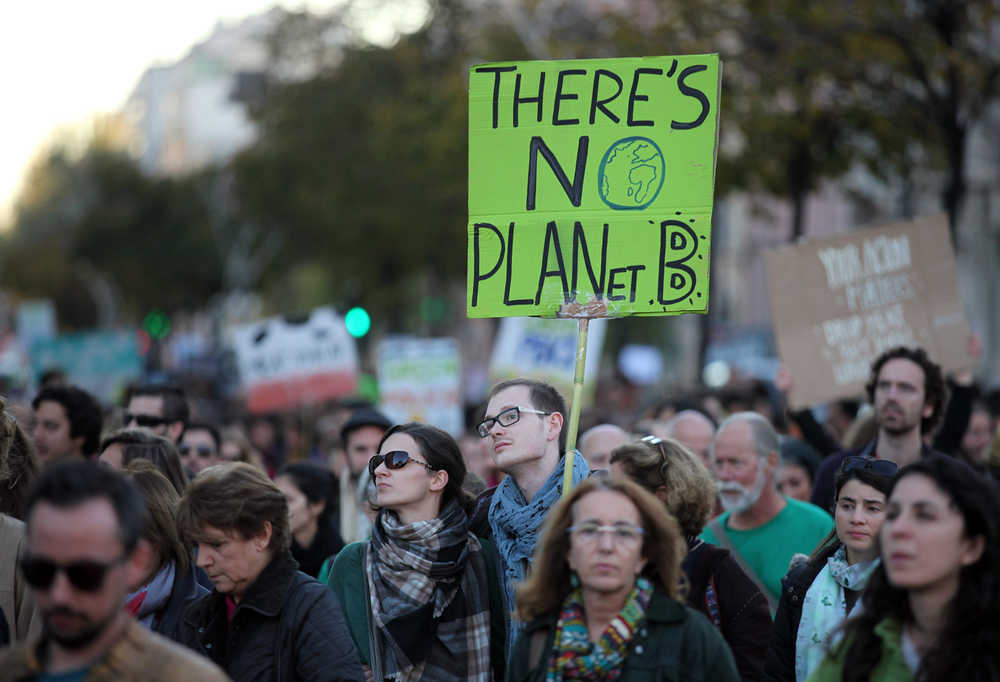
PARIS — This time, it’s a hotter, waterier, wilder Earth that world leaders are trying to save.
The last time that the nations of the world struck a binding agreement to fight global warming was 1997, in Kyoto, Japan. As leaders gather for a conference in Paris on Monday to try to do more, it’s clear things have changed dramatically over the past 18 years.
Some differences can be measured: degrees on a thermometer, trillions of tons of melting ice, a rise in sea level of a couple of inches. Epic weather disasters, including punishing droughts, killer heat waves and monster storms, have plagued Earth.
As a result, climate change is seen as a more urgent and concrete problem than it was last time.
“At the time of Kyoto, if someone talked about climate change, they were talking about something that was abstract in the future,” said Marcia McNutt, the former U.S. Geological Survey director who was picked to run the National Academies of Sciences. “Now, we’re talking about changing climate, something that’s happening now. You can point to event after event that is happening in the here and now that is a direct result of changing climate.”
Other, nonphysical changes since 1997 make many experts more optimistic than in previous climate negotiations.
For one, improved technology is pointing to the possibility of a world weaned from fossil fuels, which emit heat-trapping gases. Businesses and countries are more serious about doing something, in the face of evidence that some of science’s worst-case scenarios are coming to pass.
“I am quite stunned by how much the Earth has changed since 1997,” Princeton University’s Bill Anderegg said in an email. “In many cases (e.g. Arctic sea ice loss, forest die-off due to drought), the speed of climate change is proceeding even faster than we thought it would two decades ago.”
Some of the cold numbers on global warming since 1997:
—The West Antarctic and Greenland ice sheets have lost 5.5 trillion tons of ice, or 5 trillion metric tons, according to Andrew Shepherd at the University of Leeds, who used NASA and European satellite data.
—The five-year average surface global temperature for January to October has risen by nearly two-thirds of a degree Fahrenheit, or 0.36 degrees Celsius, between 1993-97 and 2011-15, according to the U.S. National Oceanic and Atmospheric Administration. In 1997, Earth set a record for the hottest year, but it didn’t last. Records were set in 1998, 2005, 2010 and 2014, and it is sure to happen again in 2015 when the results are in from the year, according to NOAA.
—The average glacier has lost about 39 feet, or 12 meters, of ice thickness since 1997, according to Samuel Nussbaumer at the World Glacier Monitoring Service in Switzerland.
—With 1.2 billion more people in the world, carbon dioxide emissions from the burning of fossil fuels climbed nearly 50 percent between 1997 and 2013, according to the U.S. Department of Energy. The world is spewing more than 100 million tons of carbon dioxide a day now.
—The seas have risen nearly 2 1/2 inches, or 6.2 centimeters, on average since 1997, according to calculations by the University of Colorado.
—At its low point during the summer, the Arctic sea ice is on average 820,000 square miles smaller than it was 18 years ago, according to the National Snow and Ice Data Center. That’s a loss equal in area to Texas, California, Montana, New Mexico and Arizona combined.
—The five deadliest heat waves of the past century — in Europe in 2003, Russia in 2010, India and Pakistan this year, Western Europe in 2006 and southern Asia in 1998 — have come in the past 18 years, according to the International Disaster Database run by the Centre for Research on the Epidemiology of Disaster in Belgium.
—The number of weather and climate disasters worldwide has increased 42 percent, though deaths are down 58 percent. From 1993 to 1997, the world averaged 221 weather disasters that killed 3,248 people a year. From 2010 to 2014, the yearly average of weather disasters was up to 313, while deaths dropped to 1,364, according to the disaster database.
Eighteen years ago, the discussion was far more about average temperatures, not the freakish extremes. Now, scientists and others realize it is in the more frequent extremes that people are truly experiencing climate change.
Witness the “large downpours, floods, mudslides, the deeper and longer droughts, rising sea levels from the melting ice, forest fires,” former Vice President Al Gore, who helped negotiate the 1997 agreement, told The Associated Press. “There’s a long list of events that people can see and feel viscerally right now. Every night on the television news is like a nature hike through the Book of Revelation.”
Studies have shown that man-made climate change contributed in a number of recent weather disasters. Among those that climate scientists highlight as most significant: the 2003 European heat wave that killed 70,000 people in the deadliest such disaster in a century; Hurricane Sandy, worsened by sea level rise, which caused more than $67 billion in damage and claimed 159 lives; the 2010 Russian heat wave that left more than 55,000 dead; the drought still gripping California; and Typhoon Haiyan, which killed more than 6,000 in the Philippines in 2013.
Still, “while the Earth is a lot more dangerous on one side, the technologies are a lot better than they were,” said Jeffrey Sachs, director of Columbia University’s Earth Institute. Solar and wind have come down tremendously in price, so much so that a Texas utility gives away wind-generated electricity at night.
Another big change is China.
In Kyoto, China and developing countries weren’t required to cut emissions. Global warming was seen as a problem for the U.S. and other rich nations to solve. But now China — by far the world’s No. 1 carbon polluter — has reached agreement with the U.S. to slow emissions and has become a leader in solar power.
“The negotiations are no longer defined by rich and poor,” Gore said. “There’s a range of countries in the middle, emerging economies, and thankfully some of them have stepped up to shoulder some of the responsibility.”
U.N. climate chief Christiana Figueres said there’s far less foot-dragging in negotiations: “There is not a single country that tells me they don’t want a good Paris agreement.”
Figueres said that while the Kyoto agreement dictated to individual nations how much they must cut, what comes out of Paris will be based on what the more than 150 countries say they can do. That tends to work better, she said.
It has to, Figueres said. “The urgency is much clearer now than it used to be.”
___
Follow Seth Borenstein on Twitter at http://twitter.com/borenbears . His work can be found at http://bigstory.ap.org/content/seth-borenstein
___
Online:
Paris climate conference: http://www.cop21paris.org
NOAA’s State of the Climate: http://www.ncdc.noaa.gov/sotc
International Disaster Database: http://www.emdat.be
