
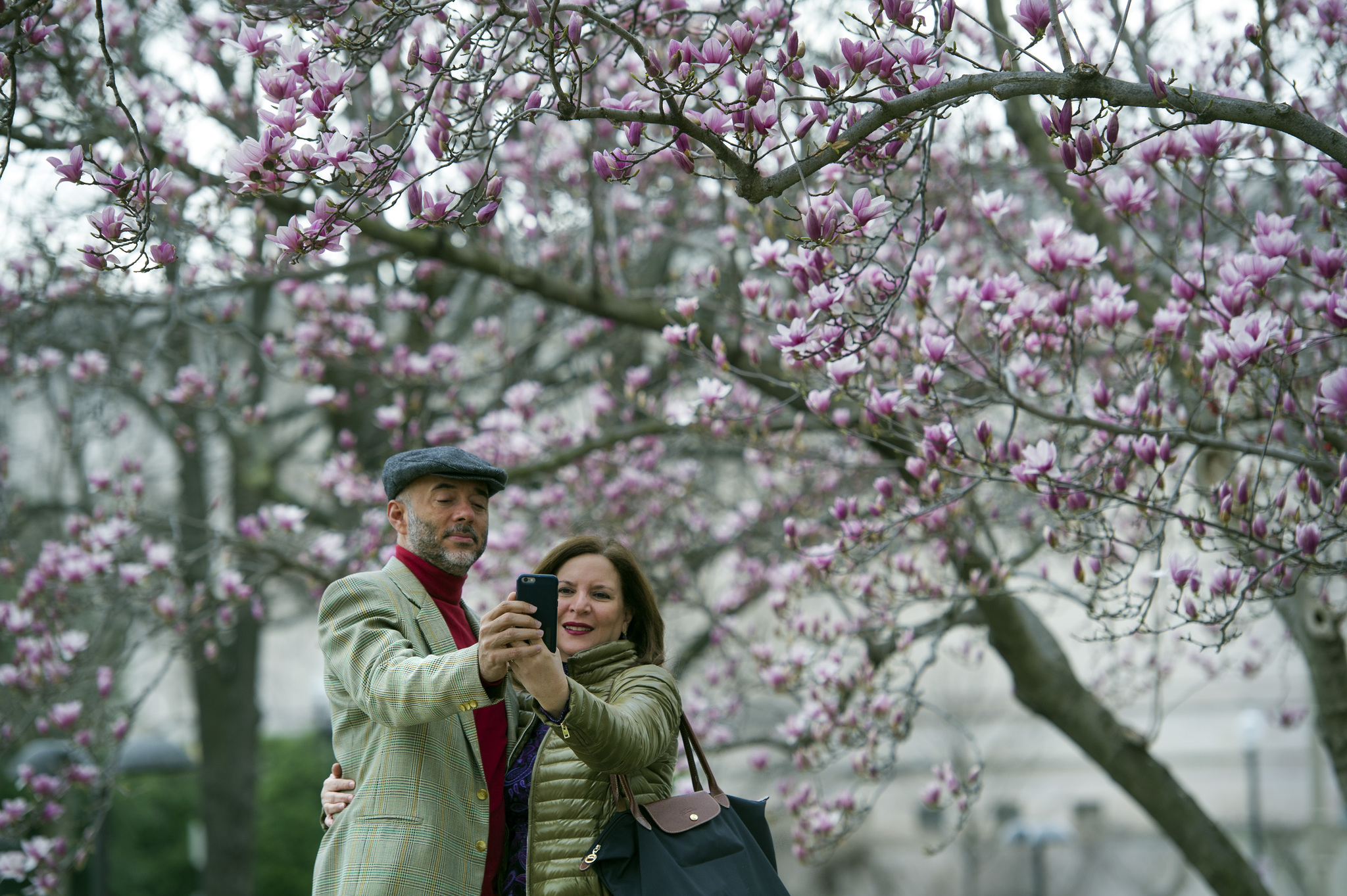
WASHINGTON — Spring has sprung early — potentially record early — in much of the United States, bringing celebrations of shorts weather mixed with unease about a climate gone askew.
Crocuses, tulips and other plants are popping up earlier than usual from Arizona to New Jersey and down to Florida. Washington is dotted with premature pink blossoming trees. Grackles, red-winged blackbirds and woodpeckers are just plain early birds this year.
The unseasonably warm weather has the natural world getting ahead of — even defying — the calendar, scientists said Tuesday.
In cities like Indianapolis, Pittsburgh and Columbus, Ohio, spring has arrived about a month earlier than the 30-year average and about 20 days earlier than in 2012, which was the earliest spring on record.
Scientists at the U.S. Geological Survey’s National Phenology Network, which studies seasonal signs, have calculated local and a national spring index based on observations of lilacs, honeysuckles and temperature records that are fed into a computer model.
The spring leaf index goes back to 1900 and 2012 has been the earliest on record. But preliminary records show this year ahead of 2012 in a good chunk of the nation.
As the world warms, spring is arriving earlier, but not everywhere. For a broad swath of the U.S., 2017 sticks out like a crocus in early February. Nashville, St. Louis, Washington, Atlanta, Pittsburgh, Columbus and Indianapolis are at least three weeks early on the spring index, but Phoenix and Los Angeles are running a bit late.
The latest early spring isn’t supposed to show up for decades based on computer simulations that model springs of the future, said Jeff Masters, meteorology director of the private Weather Underground.
“This is basically a year 2100 sort of spring that we’re seeing this year,” Masters said. “Way surprising.”
Fox butterflies are already out in Massachusetts and New York. Beetles are scurrying around Martha’s Vineyard. Crocuses and snowdrops are in full flower in suburban Boston — all exceptionally early because of warm temperatures and little snow cover, said Boston University biology professor Richard Primack.
“I am already hearing woodpeckers knocking on tree trunks” when these sounds usually occur in March or April, said Primack, editor of the journal Biological Conservation.
The northern shoveler duck is usually the next to last duck to make it to upstate New York, arriving sometime in April, but it’s already here, said Kevin McGowan, an ornithologist at the Cornell Lab of Ornithology :
These wildlife sightings stem from warm weather in February that Masters called “off-the-charts weird” that included upper 90s in Oklahoma and a first-of-its-kind February tornado in Massachusetts.
Masters and Penn State University climate scientist Michael Mann, who photographed flowers sprouting outside his central Pennsylvania house in mid-February, said this is a combination of natural weather variation and man-made warming of the climate.
Warm weather can lead to crop damage if there is a freeze in March or April after plants have already bloomed. It can also worsen droughts, which happened in 2012, Schwartz said.
Georgia Tech climate scientist Kim Cobb said what’s happening is disconcerting, no matter how nice it is for people.
“Sure we can’t wait to shed our wool coats and hats each spring, but such warm temperatures are wreaking havoc, sight unseen on key crops,” Cobb said in an email. “Here in Georgia peach buds have been robbed of necessary ‘chill hours’ this winter.”
The early spring is even changing language with some calling recent weeks “alt-spring” and “March-uary.”
Penn State meteorology professor David Titley, said it feels like being on one of the recently discovered Earth-size planets around a nearby star.
“Everything is kind of familiar (weather-wise) but different. I was walking around … in my shirt sleeves and I was almost hot. In February. That’s not supposed to happen,” said the retired admiral.
