
Gov. Mike Dunleavy said on Thursday that he would veto a standalone increase to Alaska’s per-student funding formula and said any education bill reaching his desk should be “a package.”
His statement comes as the Alaska House of Representatives prepares to consider amendments to Senate Bill 140, a comprehensive education funding bill that could be considered the kind of package Dunleavy wants. Debates are expected to begin Friday, and a final vote could take place as soon as Monday.
As currently written, the bill includes a variety of proposals, including changes to the way charter schools can be approved, more funding for correspondence school programs used by home-schoolers, money for faster Internet at rural schools, bonuses for teachers, more money for student transportation, and tax credits for companies that donate to educational institutions.
The most contentious component is a proposed permanent increase to the base student allocation, the state’s per-student funding formula. The $300 increase to the BSA is much less than the $1,413 increase requested by school districts and less than a $680 increase passed by the Senate last year.
A $300 increase would also be a year-over-year cut due to the fact that legislators and Dunleavy approved a $340 one-time increase last year.
Supporters of the $300 figure argue that it will provide budgeting stability and within two years will deliver schools more money than the one-time funding bonus did.
Some legislators have suggested that SB 140 be broken up and that lawmakers should address the BSA increase alone, but Dunleavy said that’s a nonstarter.
“It’s got to go as a package,” Dunleavy said.
If a bill containing just a BSA increase arrived on his desk, would he veto it?
“If it’s just the BSA, yes,” the governor said.
The charter school components of the bill have been under particular attack from advocates for public education.
Currently, when school districts disapprove charter schools, the state school board can approve them on appeal. The bill would allow charter schools to instead apply directly to the state board, sidestepping local officials.
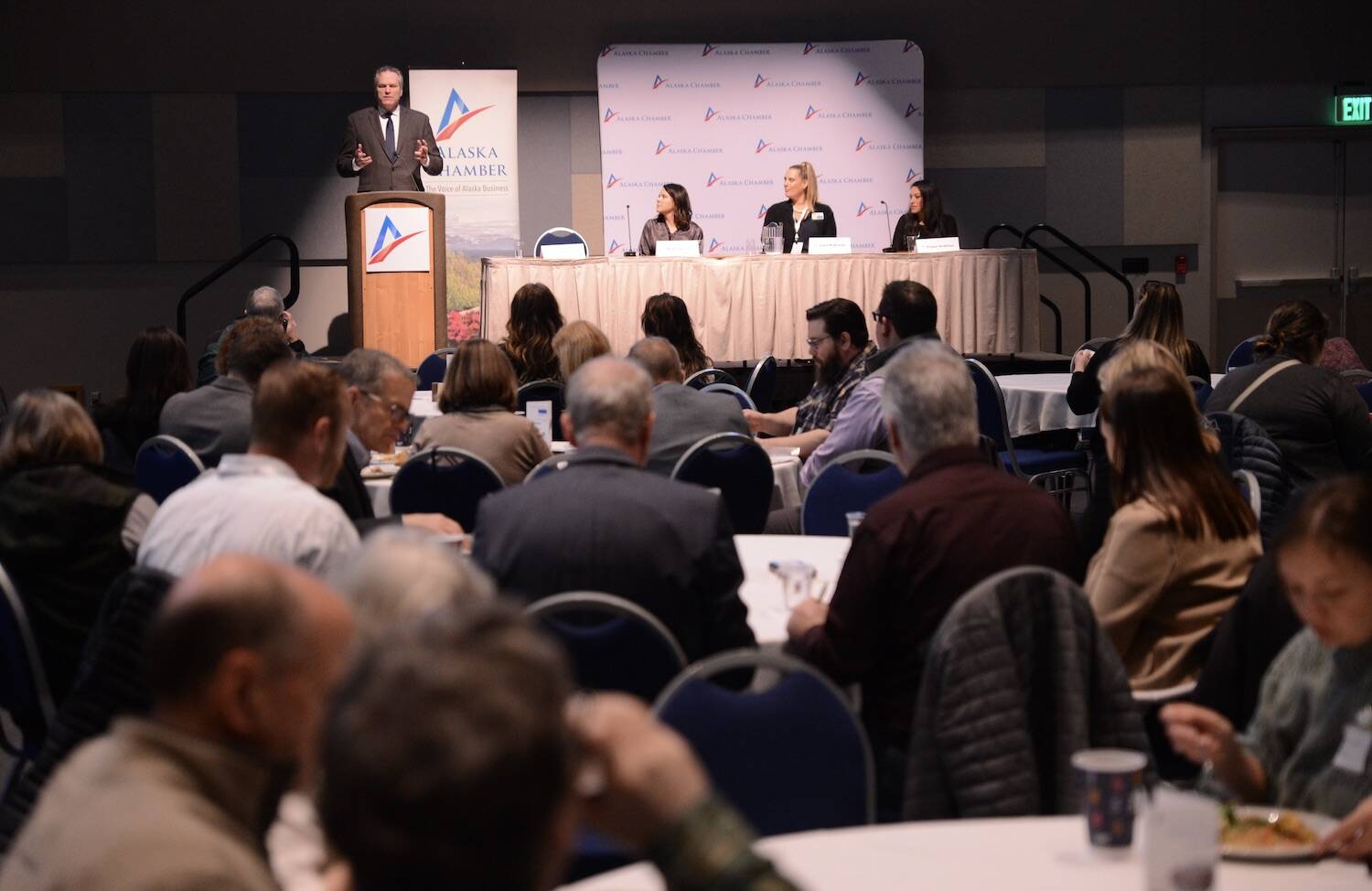
Dunleavy appeared to address those critics directly during a speech Thursday to a joint meeting of the Juneau and Alaska chambers of commerce.
During the speech, he referenced a November paper in the Journal of School Choice that found Alaska’s charter schools performed better on a national standardized test than the charter schools of any other state over a 10-year period.
The paper was published by two authors at the Harvard Program on Education Policy and Governance.
“So when people ask me … why is Dunleavy trying to do charter schools, I’m gonna go with what’s a winner,” he told the chambers.
He also spoke about the proposed teacher bonuses within the bill. Those were proposed last year in a bill introduced by Dunleavy’s office and have since been rolled into SB 140.
They offer incentives of up to $15,000 for teachers who remain in Alaska.
Dunleavy said Thursday that the proposal would amount to a three-year experiment: Does higher pay encourage teachers to stay in Alaska?
“We believe we can prove that we can keep those teachers, because we are in a highly competitive world right now for teachers,” Dunleavy said.
When all of the issues are considered, Dunleavy said after the speech, “we need all of that to improve education: including an increase in the BSA, including teacher recruitment and retention, including charter schools.”
• James Brooks is a longtime Alaska reporter, having previously worked at the Anchorage Daily News, Juneau Empire, Kodiak Mirror and Fairbanks Daily News-Miner. This article originally appeared online at alaskabeacon.com. Alaska Beacon, an affiliate of States Newsroom, is an independent, nonpartisan news organization focused on connecting Alaskans to their state government.
