
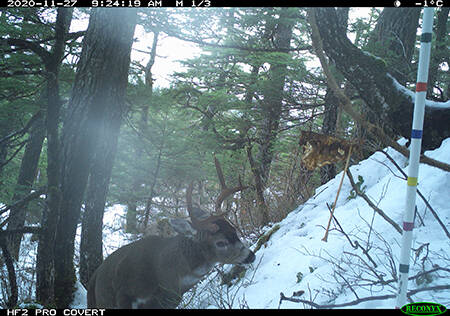
Some hunters say restricting hunts on does and younger bucks will lead to a more mature Sitka blacktail deer population on Douglas. State officials say the proposed regulations would miss their target.
Local hunter and hunting guide David Summers has submitted three proposals to the Alaska Board of Game that would change what deer can be harvested on the island, which is the most heavily hunted deer area in the City and Borough of Juneau.
Under current regulations, hunters on Douglas Island may take up to four deer per year, only one of which may be a doe. Restrictions on the mainland limits hunters to two bucks and no does.
Two of Summers’ proposals would eliminate doe harvests and restrict hunting to bucks only — one allowing up to four bucks, the other allowing two. A third proposal would require that all harvested bucks have at least one forked antler on one side.
The Alaska Board of Game is collecting public comment on the ideas through Jan. 9, along with 66 other proposed changes to hunting regulations in the Southeast.
The Board of Game will meet in Wrangell at the end of January, where they will decide which changes to adopt. The board reviews regulations for each region of the state on a three-year cycle.
Douglas Island: a road-accessible deer haven
Wildlife tends to concentrate in areas that offer the best combination of food, cover and breeding habitat. For deer, islands offer a haven from predators and often provide more habitat compared to mainland Juneau, for example.
Douglas Island is road-accessible, which sets it apart from popular hunting islands like Admiralty, Baranof and Chichagof. The island typically accounts for over 70% of deer harvested in the Juneau area, according to ADF&G.
“The primary reason that Douglas is an important area for local deer harvests is it’s an opportunity for people to hunt by road access,” Summers said. “The people who seek it out are not necessarily there for the … trophy quality animal. They’re there for the harvest of the animal to be eaten.”
That accessibility also means higher hunting pressure.
Deer populations on Douglas
Concerns about Douglas Island’s deer population heightened about a decade ago, around when wolf populations on the island peaked.
The ADF&G reports that one wolf was harvested during regulation year 2017, compared with three in RY18, four in RY19 and one again in RY20. There have been no reports of wolves harvested since then. ADF&G says that this is likely a reflection of limited abundance.
Over the past 15 years, department data shows it has taken hunters an average of 8.3 days to harvest a deer on Douglas. Over the past three years, that average is 7.6 days per deer. The department points to those averages to show that the deer populations has remained steady.
Summer believes that the days in the field where no deer are harvested are widely underreported by hunters, which skews the success rate of hunts.
“I think that is widely, widely, underreported by hunters — being in the field for a day and not harvesting an animal,” Summers said.
Carl Koch, area management biologist for ADF&G, said he trusts the hunters’ records.
“We assume people are being as truthful as their memory allows when they’re filling out reports,” Koch said. “Most of the time I think hunters care about the resource, and want to be as accurate as they can.”
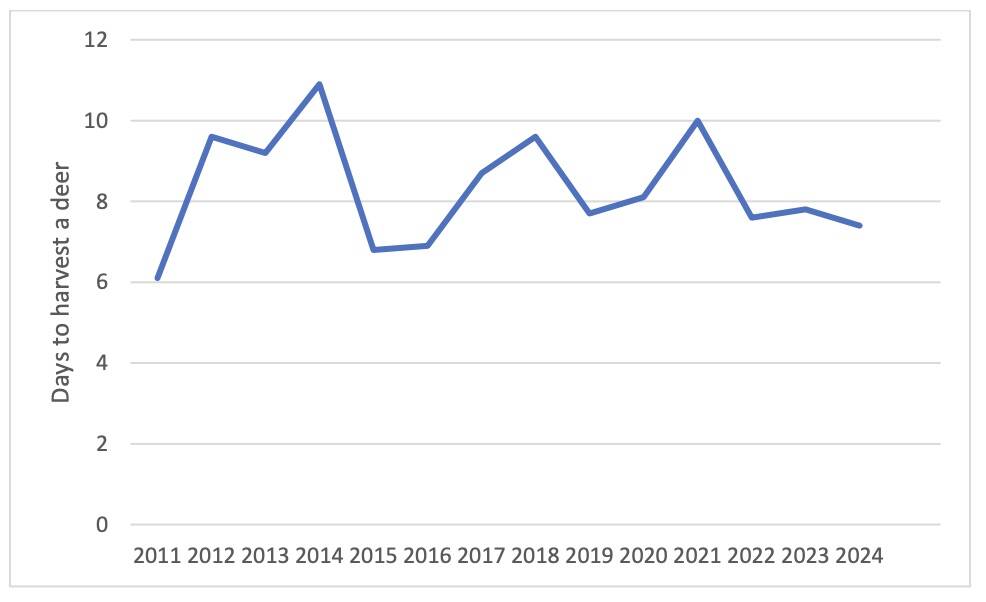
An Alaska Department of Fish and Game graph shows the average number of days it takes to harvest a single deer on Douglas Island from 2011 to 2024. (Alaska Department of Fish and Game graph)
The debate over conservation
The central debate when it comes to regulating Douglas Island’s deer hunts is whether the population needs more protection.
Summers said he submitted the three proposals — proposals 27 through 29 — as alternatives for the board to consider individually, with the goal of conservation: Increasing deer population and supporting quality herd management.
“Restricting the harvest to does only, identical to the sound policy of the adjacent mainland, will ensure the opportunity for more reproduction,” while still allowing reasonable harvest opportunity of bucks, proposals 27 and 28 state.
ADF&G’s staff comments say they are opposed to the proposals.
“There is no conservation concern for the Douglas Island deer population,” the ADFG comments state. “Douglas Island provides a good hunting opportunity for new or young hunters, and this unnecessary reduction in opportunity may negatively impact those hunters.”
According to ADF&G, the relatively-steady 7.6 day average to harvest a deer suggests the population has rebounded to a healthy level in recent years.
Summers sees the situation differently. He argues that banning harvests of does and restricting buck harvest by antler size will allow deer to reach maturity and improve the quality of the herd over time. He acknowledged that stricter regulations would mean fewer deer harvested in the short term, but said that’s the point.
“The person that objects this year, saying, ‘It’s a public resource. You reduced my opportunity to harvest it.’ That same person, the following year, is gonna post pictures on Alaska Blacktail Forum of this big buck with forks on its horns that they harvested and be proud,” Summers said. “And when the rubber meets the road, it’s gonna weigh more. It’s bigger. It has more pounds. You’re gonna put more meat in the freezer from that deer.”
But ADF&G states that antler-based regulations on deer would be unprecedented in Alaska, and difficult to enforce.
ADF&G also pointed to research that says there is no positive correlation between antler restrictions and increased deer populations for mule deer — a different subspecies than Alaska’s Sitka blacktail, but comparable, ADF&G said. The research also found that most western states that enacted antler restrictions reversed them for not having the desired effect.
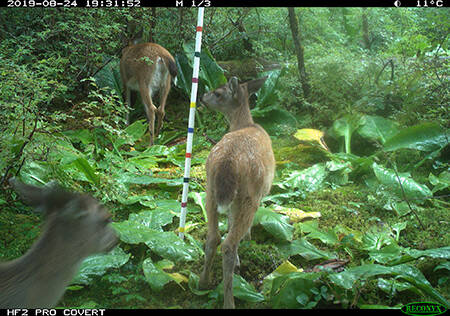
Three deer, and at least one fawn with spots, trigger the motion sensor on an Alaska Department of Fish and Game trail camera on Douglas Island in August 2019. (photo courtesy Alaska Department of Fish and Game)
The future of Douglas deer
Both sides agree on at least one point: Douglas Island’s future will matter.
The Mendenhall Wetlands already serve as a superhighway for wildlife between the mainland and Douglas Island. As the wetlands continue to experience isostatic rebound — the slow rebound of earth once compressed by massive glaciers — that pathway will become more accessible for deer and predators and deer alike, Summers noted.
Continued development could reduce winter habitat, which poses one of the biggest long-term risks to Southeast deer populations. Loss of low-elevation forest cover can make winters more lethal, regardless of hunting pressure.
“Just as wolves may have contributed to the perceived decline in population a decade ago, the board may wish to consider the consequences of habitat loss for the current population of Douglas Island deer,” ADF&G’s report states. “Development projects on North Douglas will impact the availability of suitable habitat to support a large deer population.”
For now, the Board of Game will decide whether Douglas Island deer hunting would benefit from more restrictions, or whether existing regulations already properly weigh access with conservation.
Public comments are due on Jan. 9. The Board of Game will meet in Wrangell from Jan. 23 to 26 to weigh the merits of public proposals and comments.
Correction: This story has been updated to state that the Board of Game is meeting in Wrangell from Jan. 23 to 26, not Ketchikan.
