
As Alaska’s COVID-19 case counts soar, the idea of visiting a museum might seem ludicrous.
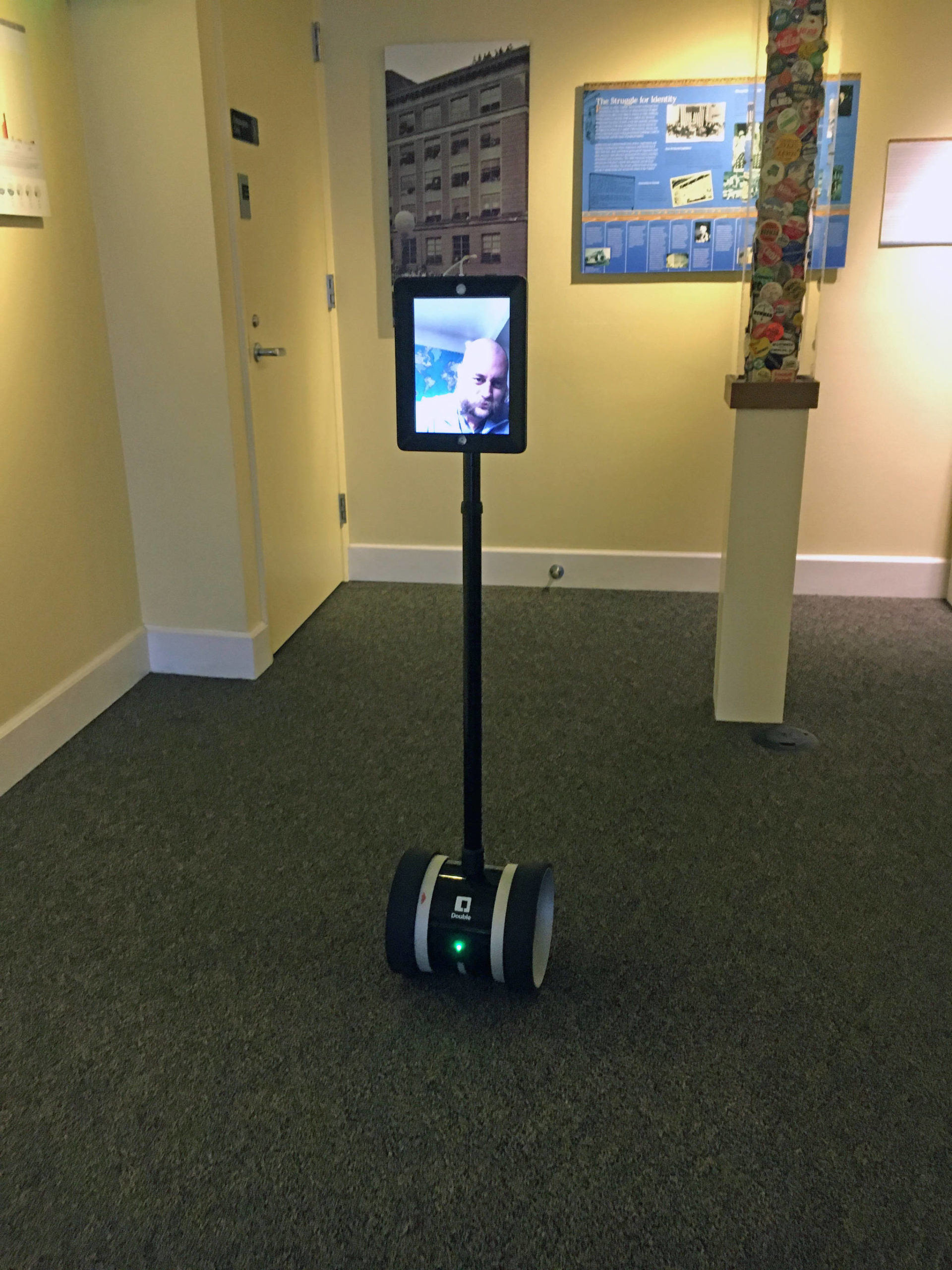
But technology is reversing that narrative, allowing those interested to see the Juneau-Douglas City Museum from the comfort of home — no matter where on Earth that home is. Robotic avatars will allow guests to the museum to roam and explore the exhibits, including the museum’s award-winning primary exhibit, “Echoes of War: Unangax̂ Internment During WWII.”
“We’ve had middle school students from Dzantik’i Heeni [Middle School]. We have a person from Delaware who found out about it and drove it through the museum,” said Elissa Borges, the museum’s curator of public programs, in a phone interview. “It doesn’t go too fast so there’s no risk of doing anything bad. It’s working really well.”
The robots, made by Double Robots, are mobile telepresence models, functionally a tablet on wheels with the ability to raise or lower its mast to get the best view, controlled by the user on the other end of an internet connection. The primary robot in use is nicknamed Shelby, after longtime volunteer Michelle Storer, said museum director Beth Weigel.
[Report: Most Alaska adults have conditions that increase risk for serious illness from COVID-19]
“UAS brought them on board to use off-site for teacher observations and evaluations,” Borges said. “It didn’t work out so well so they’ve been gathering dust for some time.”
The two models at the museum were loaned by the Juneau School District and by Virgil Fredenberg, a professor of mathematics at University of Alaska Southeast, Borges said. The project itself was the brainchild of Ray Imel, a media teacher at DHMS who had the idea to help connect kids with robotics technology and history at the same time by using robots to explore the museum.
“He (Imel) thought it would be really great to get them into the museum so people can still have access to the exhibits,” Borges said. “He thought it would be fun for kids to be involved in a community project.”
Imel worked with middle-schoolers to explore things like problem areas for the robots to drive through, places where it could have an accident, and other operational details of the project. Imel also praised Fredenberg for supporting the project.
“Back in 2017, Lee Graham at UAS had worked on another project and she said ‘I’ve got these robots and it’d be cool if kids were involved.’ Her idea was to use them in a feasibility study to see how they could be used,” Imel said in a phone interview. “We had kids, middle school students test drive them. My goal was to involve them as much as possible. How do we make this easy for people to use? That’s kind of where we’re at. It seems like it’s working pretty well at the city museum.”
Guests will get in touch with the museum, arranging a block of time to drive the robot, and staff then email the guest a link to drive the robot. Driving the robot is easily done with a laptop using arrow keys, though Borges said a touchscreen is even smoother. No special software is required, Weigel said, though Google Chrome has operated the most smoothly as a web browser.
“You can have up to five (additional guests), Borges said. “You can also share it via Zoom.”
Borges said the museum is still working out how to guide these tele-tours, telling virtual guests more about the exhibits. The setup is ideal, especially for guests for exhibits like the current showcase on the forced internment of Alaska Natives during WWII. Travel may be difficult for many reasons during this pandemic, but now anyone interested can access it no matter where they might be, without the risk.
“I think it’s exciting that someone from Australia or Delaware can go around the Juneau-Douglas museum,” Imel said. “A lot of the people who are excited about that exhibit aren’t going to make it to Juneau with travel restrictions during COVID.”
As the JDCM embraces our robotic overlords for the purpose of telling history, the Alaska State Museum and the Sealaska Heritage Institute are also looking at adopting similar measures, Weigel said.
“We’re such a small museum, this is a perfect fit,” Borges said. “What we want to expand is getting our volunteers here to be a museum guide or a docent.”
Know & (Don’t) go
The project is free, supported by donations.
To schedule an hour-long block driving the robot, contact the JDCM at 586-3572
