Does AI have a place in Tlingit language revitalization?
Published 2:30 am Friday, February 17, 2023



Whether you think artificial intelligence is the future or the destruction of mankind, AI is making global headlines as its development and investments continue to boom — and its reach isn’t as far from Juneau as you might think.
One of the most recent shake-ups in the AI industry was the November launch of Open AI’s ChatGPT, an artificial intelligence chatbot promoted as being able to interact with users in a conversational way using more than 95 natural languages.
[What is ChatGPT and why are schools blocking it?]
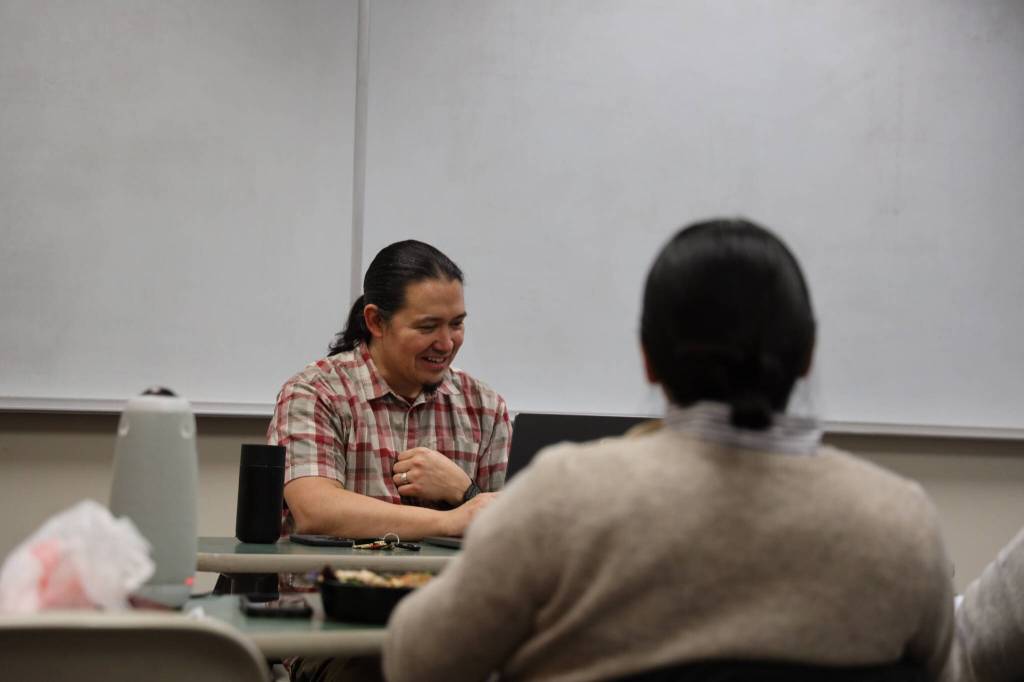
In an effort to find out if this new technology really has what it takes to converse in Lingít, the Empire asked ChatGPT to write a story in the Tlingit language and reached out to a fluent speaker and a professor of Alaska Native languages at the University of Alaska Southeast, X’unei Lance Twitchell, who decided to analyze a Lingít short story written by ChatGPT in with his Intermediate Tlingit II class Thursday evening.
The results?
“It’s total nonsense, it’s not even close,” he said, laughing with the 15 or so students who attended the class.
For the most part, he said the “story” written by the AI largely grabbed random words with perhaps a little association and put them together in a pattern that is also random. His own name was even thrown in there a few times as well, for a reason unknown to him.
“That’s a new one — I’ve never seen that one before,” he said pointing to a word on the screen with a laugh. “And, I don’t think that’s actually a word? I don’t think it is,” he said about another.
Twitchell said while the ChatGPT’s use of Lingít might not be exactly correct — or even all correct — he said still thinks AI could be a helpful tool if the technology advances to the point where it’s accurate and could assist learners of the Lingít and other Alaska Native languages as the number of speakers have dwindle dramatically over time.
I do think it could be helpful,” he said. “I think some sort of AI could give you a starting point, we could always use more tools”
According to estimates by the University of Fairbanks Alaska Native Language Center, approximately 500 Lingít speakers are scattered across different Southeast Alaska communities. However, Twitchell said that number is likely even less and estimated that around 200 speakers are actively using the language.
He said for decades Lingít speakers have talked about creating a program that could converse and understand the language, but so far nothing has been developed enough to understand the extremely complex language that is Lingít.
Efforts to grow the language continue to make major strides in Juneau through university and school programs, most recently, Juneau School District’s Tlingit Culture, Language and Literacy Program at Harborview Elementary announced it will be expanding its reach to be able to teach students up to the eighth grade level. However, Twitchell said he hopes to see growth like that continue beyond the classroom and into the community where he said it should have stayed the whole time.
[Tlingit language and culture program expands its reach]
“The biggest thing you need in language revitalization is for people to choose to use the language, and technology can’t do that — it can’t change the fabric of society, but it can give people more tools,” Twitchell said.
He said AI could be a part of that growth while respecting the sovereignty of the language and knowing that the language belongs to the Tlingit people.
“We need to put our language back out there because it was taken from us, it was prohibited, and we need those conscious efforts to put it back into society on the land,” he said. “And, we have more people learning, and people that are generally learning faster, but we are losing our high fluency elders. The goal is to create as many speakers as we can while holding on to the authenticity of the language and taking it to new places.”
• Contact reporter Clarise Larson at clarise.larson@juneauempire.com or (651)-528-1807. Follow her on Twitter at @clariselarson.