

On a Friday morning inside Floyd Dryden Middle School, a science teacher in room 94 is about to play a numbers game. The goal is to get 36 students into another building to dissect 20 fish where they will review 25 body parts with two instructors — all under 55 minutes.
Spoiler alert: It is not going to happen exactly as planned.
Seventh grade teacher Rebecca Farrell prepared for the class dissection a month in advance, she even did a dry run with students the day before.
“This is not a drill, just like we did yesterday,” Farrell shouted over the students’ mumbling.
The kids seem excited to put their lesson plan materials to use. They’re the first class of the day to dissect and they’re also Farrell’s first class in years not to use frogs. For the kids, this is a minor deviation from the syllabus, but the change was far from that for Farrell.
At the start of the school year, Farrell felt the effects of yet another budget cut. Her classroom budget dropped from $600 to $500. At the same time, her student count jumped from 60 to 134 kids. That equals $3.78 for classroom materials per student. If Farrell wanted enough frogs for even teams of three across her four classes, her entire budget for the year would be depleted.
“There’s no way to be able to give the kids that kind of rich experience on that kind of budget,” Farrell said. “And this is happening all over the district.”
Farrell said the solution to her problem came in the way most do for teachers across the district — from another teacher.
Paraeducator Ray Vidic heard about several Jack salmon the Douglas Island Pink & Chum would be willing to donate for the cause. Farrell jumped at the opportunity and Vidic stored the fish in his personal freezer until Farrell prepared a lesson plan on fish instead of frogs.
“All the parts work together efficiently to make the whole,” said guest instructor Brandon Howard. “It’s well designed. That goes for a lot of things in life in general.”
Howard was talking to the students — all dressed in lab aprons with goggles — about the intricate placement of organs in most animals’ bodies. However, his lesson could easily be applied to the inner workings of a school and the teachers who work together to make sure lessons are carried out.
Howard is an artist director for the Canvas who puts his biology degree to use with occasional volunteer work. He’s also Farrell’s son, but it’s the degree that has him visiting his mom on this particular day. Farrell said she calls on experts to help with lesson plans whenever possible.
“We don’t have a lot of time,” Howard repeated several times while cutting the salmon at his end of the long the table where most of the kids were stationed. “There’s so many of us, we won’t all fit.”
To save time and because of the large class size, only half the class gathered around Howard to watch his intricate cuts before returning to show their partners.
When the cutting begins, one student complains about losing his appetite, another jokes about the odor and across the room one student is daring his partner to lick a dead fish. But Farrell can’t hear it all or attend to it all, she has another student actually so sick he needs to leave the portable building where they are working.
It’s organized chaos at best, and when the students realize they’ve gone 15 minutes beyond their designated class time, it’s less organized and more chaos.
“I wish the public could come in and see how big our classes are, I wish our government could come in and see,” Farrell said after the portable building was free of children and only dirty lab tools remained in storage buckets. There isn’t running water in the room she’s using like there might be in a proper lab, but it’s the best she could do with what she had and it’s the only way to insure students get hands-on experience.
It’s this type of patchwork effort, where the lesson plan still happens despite what feels like too many odds stacked against her, that is part of the public awareness issue, Farrell said. Because teachers continue to find a way, people think resources aren’t an issue.
“We’re going to make it happen for their children and we want to, we gladly do it,” Farrell said. “Students are our number one natural resource and (the government is) taking money away from this natural resource every single year… but we’re working on so little and everybody is making it happen.
“I kind of sometimes think that’s why the public isn’t reacting to this, because the teacher’s make it happen.”
Farrell said in an ideal world students at Floyd Dryden would have access to a lab with running water, not buckets, and a freezer for storing dissection subjects, not a cooler on wheels. Most of all, Farrell said she would like to see smaller class sizes, but with a teacher pool that shrank from 39 to 31 from 2009 to 2015, respectively, it isn’t likely to happen.
Thankfully, this time around a group in the community was able to alleviate some of this science teacher’s worries and supplement her classroom budget.
“We’ve got the most giving community I’ve ever lived in, but how much more can our community give?” Farrell asked.
All of these concerns will have to wait for another time, because Farrell has to get ready to repeat the numbers game with three more classes of equally large sizes, and with less energy as each one passes.
• Contact reporter Paula Ann Solis at 523-2272 or at paula.solis@juneauempire.com.
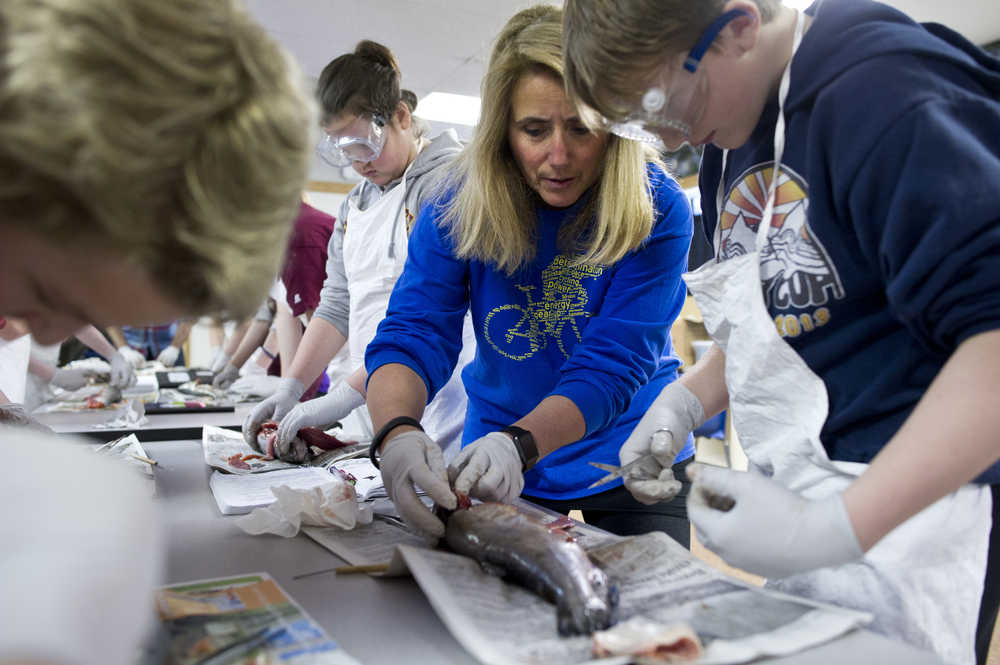
Teacher Rebecca Farrell helps Gabe Miller dissect a jack king salmon at Floyd Dryden Middle School on Friday.
