
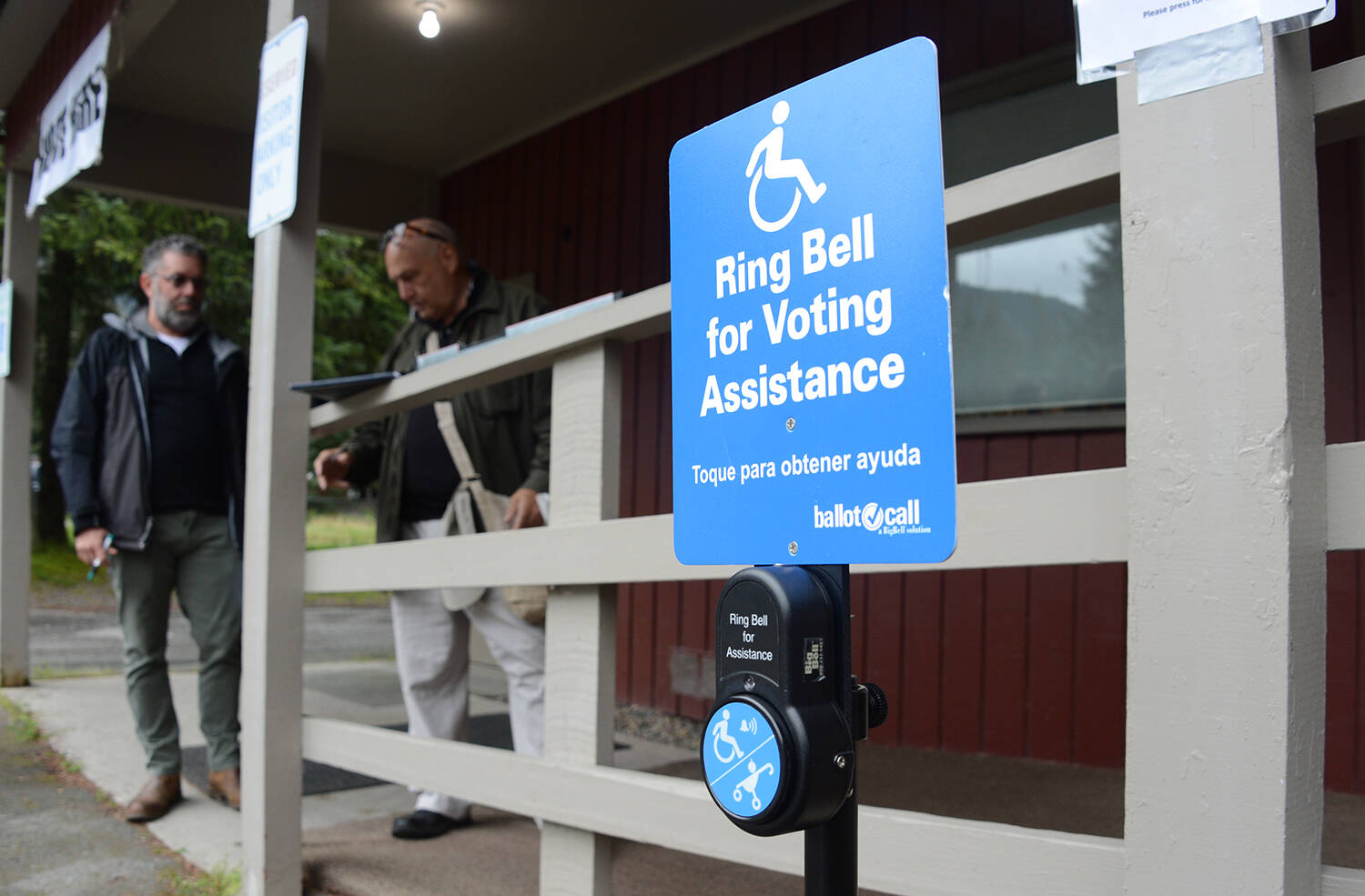
Alaska failed to accommodate people with disabilities who were trying to cast votes in various 2022 and 2023 elections, a violation of federal law, the U.S. Justice Department said on Tuesday.
The findings, described in a letter to the Alaska Division of Elections, resulted from an investigation spurred by voter complaints, the Justice Department said. The department said it has asked the division to correct the problems.
“Voting is a fundamental right for all American citizens and ensuring they have full access to the election process is a hallmark of our democracy,” Lane Tucker, U.S. attorney for the District of Alaska, said in a statement. “The U.S. Attorney’s Office will continue to collaborate with the Justice Department’s Civil Rights Division to work toward accessibility in voting for all Alaskans.”
According to the findings, certain polling places in the state lacked accessible machines that would have allowed people with disabilities to cast their votes privately, a violation of the Americans with Disabilities Act, the Justice Department said.
Physical barriers blocked access in some cases, the department said in its letter to state officials detailing the violations.
The letter cited one case in October 2023 when a voter with physical disabilities and her son, who uses a wheelchair, arrived at their polling site during the October 2023 Regional Educational Attendance Area election “to find a muddy parking lot filled with standing water and a 2-inch step to get on the ramp to the entrance,” the information letter said. “Mud, standing water, and a 2-inch step are non-compliant features that make it very difficult to maneuver a wheelchair. Once inside, the voter had trouble filling out the paperwork, but was not offered assistance. She and her son voted a paper ballot as no accessible machine was available.”
In several places, voting machines designed to be accessible to disabled people were inoperable, and at one place the accessible machine was never removed from its box, the department’s letter said.
Other cited violations concerned the division’s website, which contains important information for all voters, the department said. Its letter listed numerous violations that made the website unusable for some disabled people: “no headings; inoperable buttons; no instructions for progress links; low color contrast; pages limited to landscape; pages that do not scale properly; no language tag; inadequate error alerts; and no instructions explaining different options.” There were other lapses, the department’s letter said, including the lack of captions on language-assistance videos and lack of alternative text associated with graphics.
Polling sites identified as having accessibility problems stretched from Juneau to Fairbanks to the Kenai Peninsula, and several of them were located in Anchorage, the state’s largest city, according to a Justice Department list forwarded by the Alaska Division of Elections.
Justice Department representatives went to Alaska polling sites in recent elections to monitor compliance with the Americans for Disabilities Act and other federal laws.
The Division of Elections tries to make continuing improvements to help voters and is considering the points raised by federal officials, a spokesperson said.
“The Division is reviewing the letter and will work with the Department of Justice to understand their concerns. The Division works diligently to locate facilities in every precinct that meet accessibility requirements and continues to improve its communications,” Brian Jackson, the division’s election program manager, said by email.
Alaska is not the only state that the Justice Department has identified as discriminating against disabled voters. The department said on Tuesday that it plans to add its input to private litigation in Ohio and Alabama concerning alleged violations of voters’ rights there. Also on Tuesday, it said it has struck agreements with two Texas counties over election websites that were not fully usable by people with vision or manual disabilities. The counties have agreed to make improvements to the websites, the department said.
• Yereth Rosen came to Alaska in 1987 to work for the Anchorage Times. She has reported for Reuters, for the Alaska Dispatch News, for Arctic Today and for other organizations. She covers environmental issues, energy, climate change, natural resources, economic and business news, health, science and Arctic concerns. This story originally appeared at alaskabeacon.com. Alaska Beacon, an affiliate of States Newsroom, is an independent, nonpartisan news organization focused on connecting Alaskans to their state government.
