
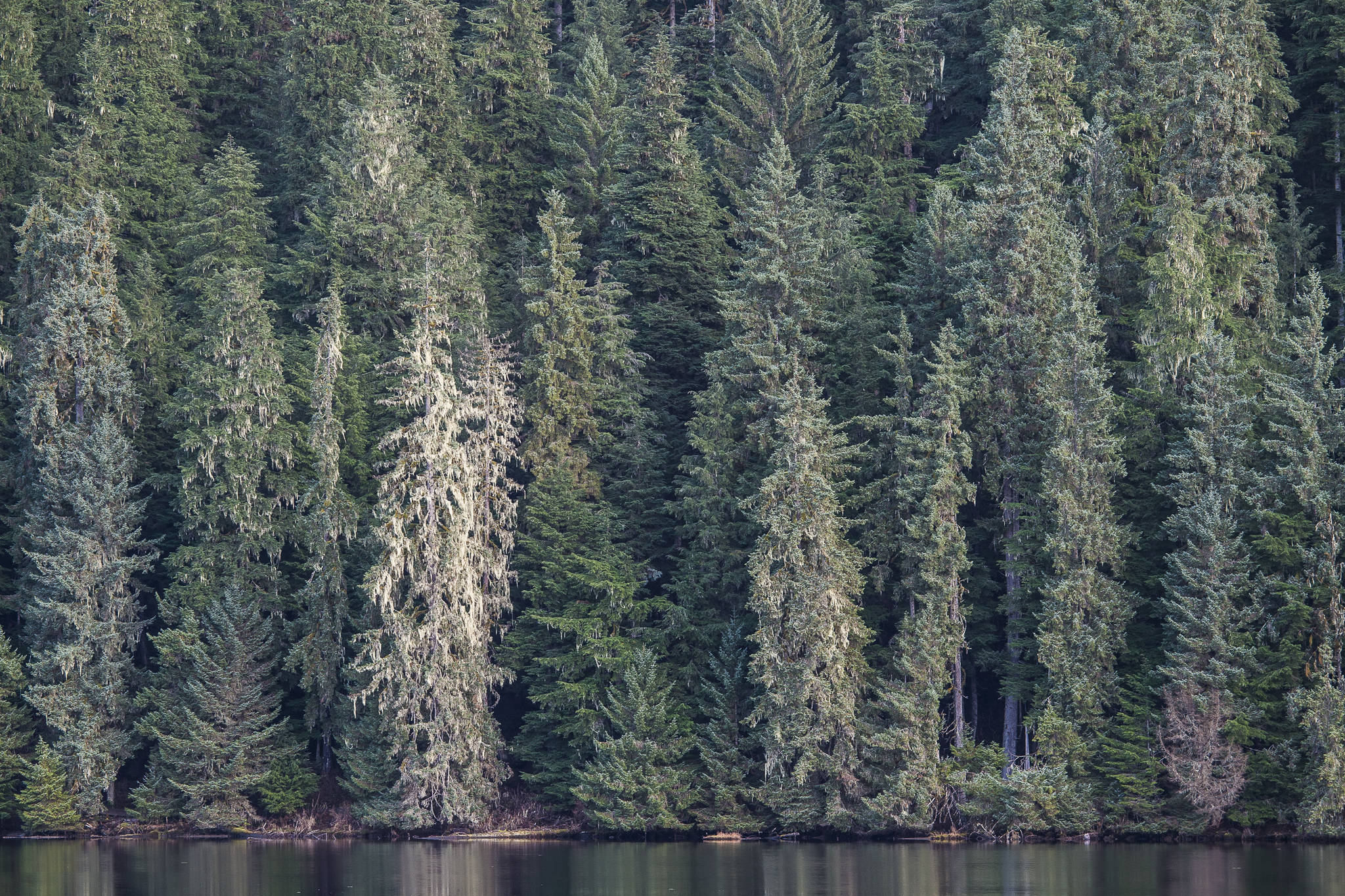
A federal court invalidated four U.S. Forest Service logging projects in Alaska’s Tongass National Forest, ending a decade-long legal struggle with environmental groups.
Timber sales included in the lawsuit were Scott Peak (on Kupreanof Island), Overlook (on Mitkof Island), Traitors Cove (on Revillagigedo Island) and Soda Nick (on Prince of Wales Island). Together the four projects would have cut 33 million board feet of timber from 1,700 acres of old-growth forest. About 14 miles of logging roads would have been constructed. Two of the four projects were scheduled to be logged in 2019.
“The court’s decision came just in time,” said Gabriel Scott, in-house counsel for Cascadia Wildlands Project, one of the plaintiffs, in a press release.
But Buck Lindekugel, a grassroots attorney for Southeast Alaska Conservation Council (SEACC), said the Nov. 28 decision against the USFS sends an alarming message to citizens.
“The reason there are all these laws, the National Environmental Policy Act, the National Forest Management Act, the Tongass Timber Reform Act, is to direct the agencies on how to manage public lands,” Lindekugel said. “When agencies take shortcuts … that results in them making mistakes and they get called on them, they’re supposed to fix them. That’s what Congress intended. That’s what the American people depend on.”
At issue in the case was how the USFS determined the impacts of the logging projects on Sitka black-tailed deer, and consequently wolves and hunters. The 9th District Court for the District of Alaska in Anchorage found that the agency’s modeling of deer winter habitat “does not accurately measure forest structure [and] was too unreliable to be used,” the court said in its decision. The court further stated that the “USFS failed to explain why it was authorizing the projects despite lower-than-recommended deer habitat capabilities.”
The recommended minimum capability is specified in the Tongass National Forest Land and Resource Management Plan as 18 deer per square mile in biogeographic provinces where deer are the primary prey of wolves, but the model used in the four sales in question put the minimum capability at just nine for one project and at similarly low levels for the other three.
Over the course of 10 years, the court gave the USFS chances to fix the analysis model in the sales that were approved prior to the updated analysis model, but the USFS did not retroactively change the analysis models.
“We recognize this case has been litigated for over a decade, however, USFS has been given multiple opportunities to correct flaws in its project analysis and has ignored this court’s guidance,” said the decision.
“They admitted they messed up,” Lindekugel said when asked about why the USFS didn’t make the recommended changes. “And they just kept stalling. And that’s just not acceptable, that kind of decision making. It shows why citizens have to remain so vigilant over bureaucrats who are making decisions, whether it’s federal or state, because they don’t always follow the law.”
Greenpeace USA and Cascadia Wildlands Project filed the suit in 2008 after some members of the two groups found two critical errors in the VolStrata deer capacity modeling system used in the analysis for planning timber sales in accordance with the Tongass National Forest Plan.
One was that the VolStrata data set, which gives an indication on how good the forest structure is at intercepting snow, was incorrect. The data set was related to the amount of timber but didn’t relate to the forest structure. The second was that the multiplier used to find carrying capacity of deer per square mile was underestimating the impacts of logging that was done in the Tongass National Forest by 30 percent.
Representation for the Forest Service argued that its application of an overestimating deer multiplier was harmless because its authorization for the sales would not change under a corrected deer multiplier, according to the decision.
But Greenpeace’s Larry Edwards said that wasn’t the case. Greenpeace used the USFS’s own 2000 study titled “Deconstructing the Timber Volume Paradigm in the Management of the Tongass National Forest” against them as evidence in the case to prove that the model used in the four sales was outdated and incorrect. The VolStrata method used in the permitting of the four sales in question did not correctly account for the carrying capacity of deer needed to support the wolf population that preys on the deer. In fact, Edwards said, many sales used this method before the Forest Service came out with a new plan in 2008, which corrected these two problems and used a different data set and a different multiplier to account for the habitat structure. These models and numbers help predict the how well the foliage conditions and forest structure will allow deer to live in an area.
The Alexander Archipelago wolves, which can only be found in Southeast Alaska, were once feared to be endangered. Numbers dropped to 89 animals in 2014, leading environmental groups to lobby for their protection under the Endangered Species Act. That idea was shot down in 2016 after the U.S. Fish and Wildlife Service determined the isolated population of wolves was not genetically distinct from mainland wolves. But population levels have stabled since then. In 2016, wildlife managers estimated that 231 wolves lived on the island. These wolves rely on the black-tailed deer for food, but subsistence hunters worried earlier this year that wolves are killing too many deer. This predator/prey/forest relationship was the equation in question in the lawsuit.
[Prince of Wales wolf hunt numbers set]
Edwards estimates very few of the sales approved between 1996 and 2008 had the appropriate carrying capacity for deer. Other timber sales he listed that incorporated the two deer model errors that were the subject of the lawsuit included: Baht (on Zarembo Island), Backline (near Wrangell), Bohemia (on Kupreanof Island), Central Prince of Wales Project (a 200 million board foot timber sale on Prince of Wales Island for Ketchikan Pulp Company) and several others.
In 2003, Greenpeace wrote to the former Tongass Forest Supervisor Forrest Cole and former Regional Forester of Alaska Beth Pendleton to go back and correct the sales that were approved under the old VolStrata model and update them, but Edwards said the letters went unanswered.
“They just buried these two problems under the rug, so eventually we filed the lawsuit,” Edwards said. “The agency’s reaction was to not acknowledge the problem, forge ahead full speed with logging, and try to quietly fix the problems later.”
Edwards said the USFS fixed the errors for recent projects, but refused to do so for earlier ones. The USFS in Juneau directed all calls related to the case to the Department of Justice, and requests by the Empire for comment as to why they did not make the recommended fixes were not returned.
“The Forest Service was handed a clear message today that it cannot fudge the science in order to give its projects an ‘easy pass’ and sell excessive amounts of timber from a planning area,” said Chris Winter, one of the plaintiff’s attorneys from Crag Law Center, in a press release. “The (Alexander Archipelago wolf) is a rare species in Alaska’s rainforest, and it’s vital that the agency follow the best science on how to protect it and how to provide for the needs of deer hunters.”
• Contact reporter Mollie Barnes at 523-2228 or mbarnes@juneauempire.com.
