
Businesses and homes in Alaska are looking to find more efficient ways to heat their buildings, and multiple Juneau organizations have identified one possible solution: wood.
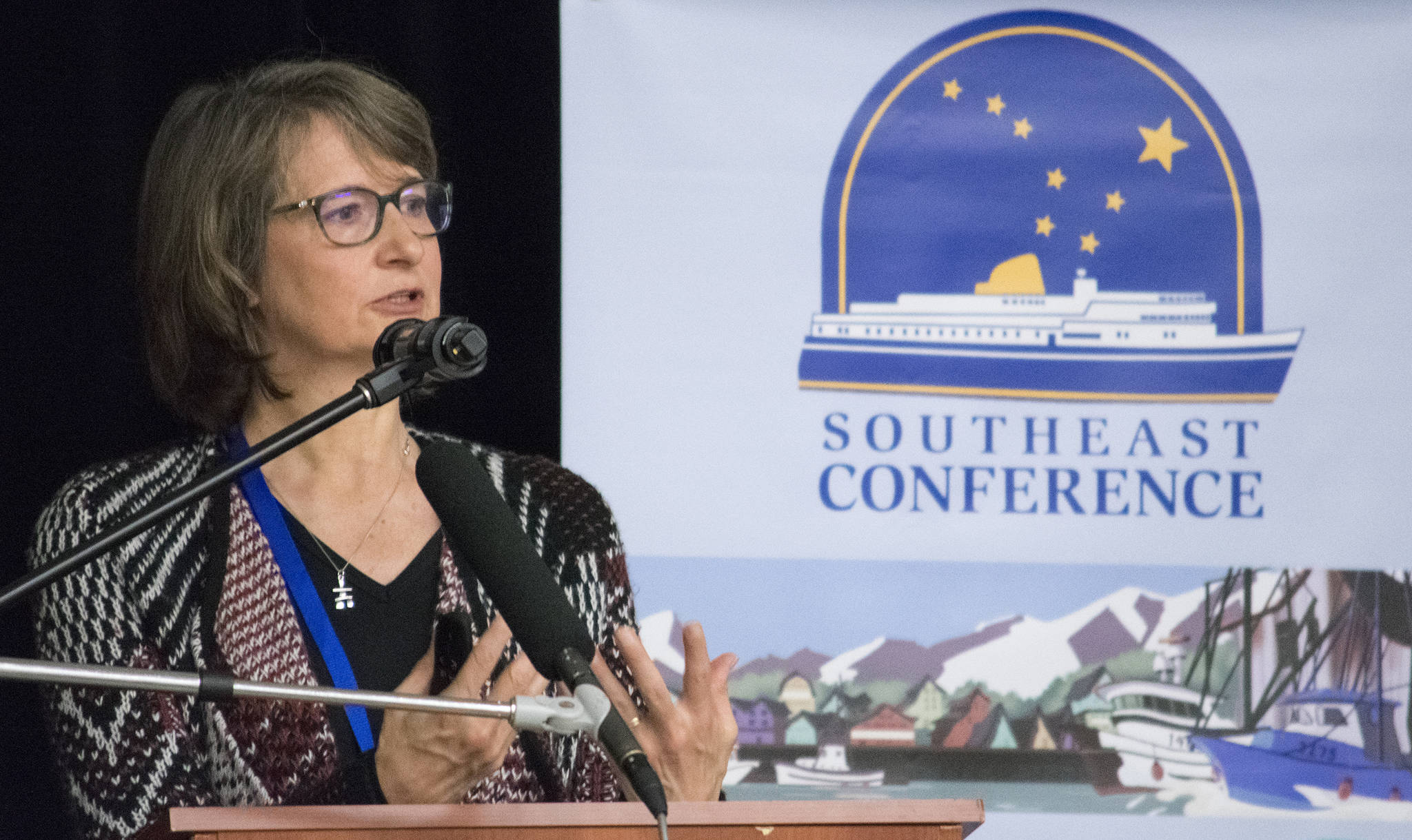
Alaska Energy Authority (AEA) Biomass Program Manager Devany Plentovich spoke at the Southeast Conference’s Mid-Session Summit on Tuesday about the future of using biomass in Juneau. Biomass represents any organisms that can be burned or somehow used to create energy (wood and crops are popular forms).
With the price of fuel oil rising in recent years, organizations are looking for other ways to heat their buildings. Two Juneau entities — Lemon Creek Correctional Center and Bartlett Regional Hospital — have expressed interest in using wood-fueled energy instead of heating oil.
“This is really early in the project development process,” Plentovich said. “One of the first steps is, we need to understand, where would the wood resource come from?”
The AEA, along with the U.S. Forest Service, is conducting a study into wood resources in Juneau. There are quite a few options for what’s called “urban wood waste,” Plentovich said.
U.S. Forest Service Renewable Energy Coordinator Bob Deering said there are thousands of tons of wood that remains mostly unused in Juneau every year. This wood comes from Alaska Electric Light &Power (AEL&P) trimming trees around power lines, construction projects and tree removal services, among other sources, Deering said.
Much of the wood that AEL&P produces every year, Vice President and Director of Energy Service Alec Mesdag said, goes to waste. A great deal of the wood is sent to the so-called “stump dump” near Mendenhall Lake that serves as a graveyard for excess wood, and some just goes to the landfill.
Though there are detractors to the idea of using biomass, Mesdag said most people agree that using it in this way is almost uniformly as a good idea.
“You’re not having to import any wood and you’re not cutting wood specifically for heating,” Mesdag said. “This is stuff that’s already being cut, it’s already being disposed of, it’s just finding a new way to make use of a waste product to offset diesel.”
Nathan Soboleff, who handles grants and business development at BRH, said the hospital is the largest user of heating oil in the city. After the Forest Service finishes its study about wood sources in Juneau, AEA is planning to do a feasibility study to see how putting in a wood-fueled system would work at Bartlett.
Previously, Soboleff spearheaded a program that replaced Sealaska Plaza’s oil-based energy system with one that runs on wood pellets. He said it would be relatively simple to install a wood-burning boiler that connects to the existing heating system, and that grants from the U.S. Department of Agriculture-Rural Development branch could make it fairly affordable to install the new boiler.
“Bartlett is a very forward-thinking organization,” Soboleff said, “and something like this, not only does it have the potential to save the community money, but it also has the ability to put Bartlett out at the forefront of sustainability and can really elevate our hospital as a center of excellence.”
At the prison, Plentovich said, the energy from wood could not only heat the facility, but would also heat the water. Deering said people he’s talked to at the prison have talked about possibly involving inmates in the process of running the heating system to give them work experience that could benefit them after they leave prison.
There are a variety of side benefits to installing these systems, Soboleff said, but the main concern for Bartlett is reducing costs. Both Soboleff and Deering said the city (which runs the hospital) could save money on both ends with not having to dispose of wasted wood while also cutting down on paying to run the hospital with heating oil.
“If we can get the wood for free, the fuel for free, delivered on site, that’s a slam dunk,” Deering said. “There’s still some cost to operating and handling, but compared to the cost of oil or electricity, there’s no comparison. It’s so much cheaper.”
• Contact reporter Alex McCarthy at 523-2271 or alex.mccarthy@juneauempire.com. Follow him on Twitter at @akmccarthy.
