
Cost-cutting legislators in the Alaska House of Representatives are advancing with a proposal to eliminate automatic salary increases for state employees until oil tops $90 per barrel.
House Bill 379 was introduced by Rep. Craig Johnson, R-Anchorage and chairman of the House Rules Committee, on the 91st day of the legislative session. It received its first hearing in the House Finance Committee on Monday morning.
“Quite frankly, it makes no sense to give out raises to state employees in this budget crisis while the private sector is looking at layoffs and scaling down,” Johnson said.
Johnson and Rep. Charisse Millett, R-Anchorage and the House Majority Leader, told members of the finance committee that the measure — expected to save $70 million to $75 million per year, according to initial estimates — is about preserving jobs.
The state can afford to keep more people on staff if they aren’t paid as much.
“I understand workforce morale, but isn’t it better to have a job than no job?” Millett asked rhetorically.
Under the state’s pay system, most employees receive 3.5 percent annual “merit increases” in their first six years. Those increases come automatically unless a supervisor pre-emptively blocks them.
Those increases are separate from step increases if an employee is promoted.
“Public employees have it easy,” said Kelsi Pulczinski, a political science major at the University of Alaska Anchorage and one of a number of Americans for Prosperity supporters who called to offer public testimony Monday.
As presented to the finance committee, the measure would not affect contracts already in place, only contracts that have not yet been ratified or are still in negotiations.
According to a report Monday by the Alaska Journal of Commerce, the state is in contract negotiations with unions representing the vast majority of the state’s 16,600 or so executive branch employees.
Jeremy Price, state director of Americans for Prosperity, called HB 379 “a great piece of legislation. Freezing automatic pay increases is the right thing to do.”
Of AFP, he added, “we are also confident that a lot of (state employees) won’t mind pitching in” to solve the state’s $4.1 billion deficit.
As reported by the Journal of Commerce, most of the state’s unions are negotiating contracts that forego annual cost-of-living adjustments. If merit increases also go away, most state employees would see no change in their salary for the next three years.
Rep. Les Gara, D-Anchorage, pointed out that the effects of HB 379 could last much longer than that. The bill calls for freezing merit increases until oil tops $90 per barrel for a full fiscal year.
The state’s recently released spring revenue forecast doesn’t see oil at that level in the next decade.
“Don’t you think you’re going to have a lot of bitter employees?” Gara asked Millett and Johnson.
Jim Duncan, executive director of the Alaska State Employees Association, said HB 379 is changing “the rules of the game after the game is over.”
ASEA had been negotiating a three-year contract with the state that provided no cost-of-living increases for the next three years — a recognition of the state’s fiscal situation.
“This has never been approached,” he said of the possibility that merit increases will go away.
Vince Beltrami, president of the Alaska AFL-CIO, referenced comments made earlier this week by Rep. Steve Thompson, R-Fairbanks and co-chairman of the House Finance Committee.
Thompson said that he didn’t believe HB 379 would move from committee and that it was simply a bargaining chip in the end-of-session budgeting process.
“That’s an insult to treat Alaska state employees as bargaining chips,” Beltrami said.
If HB 379 was intended as a bargaining chip, there are signs that it’s beginning to become more than that. Thompson asked committee members to submit amendments to the bill by 5 p.m. Thursday.
Amending a bill is one of the last steps before moving it from committee. If approved by the House Finance Committee, HB 379 would be subject to a vote of the entire House, then advance to the Senate.
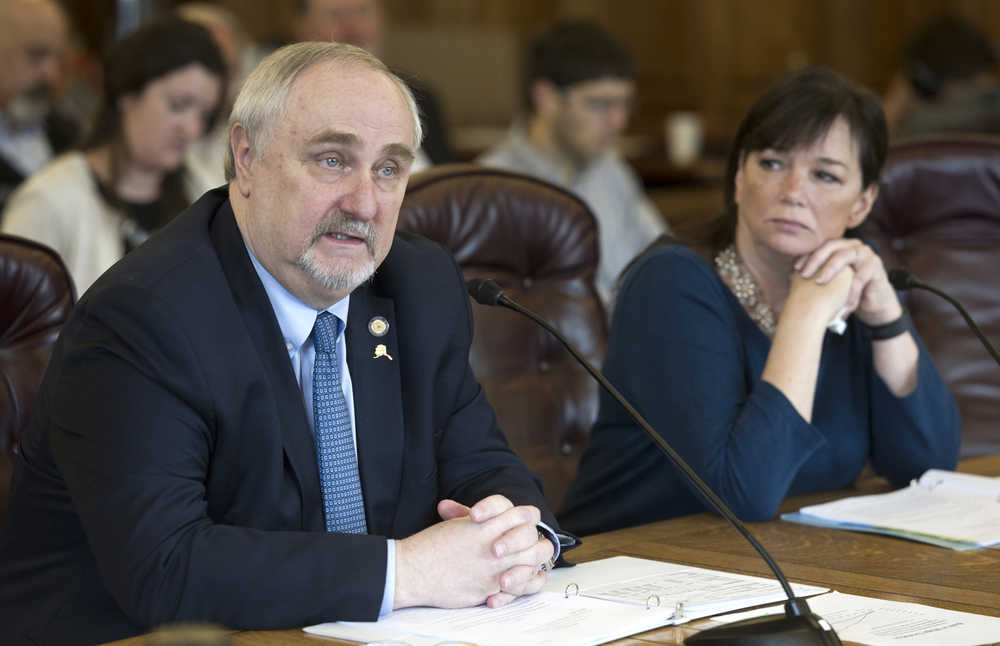
Rep. Craig Johnson, R-Anchorage, left, and House Majority Leader Rep. Charisse Millett, R-Anchorage, introduce their bill, HB 379, to the House Finance Committee at the Capitol on Thursday. The bill would eliminate pay increases for certain state employees.
