
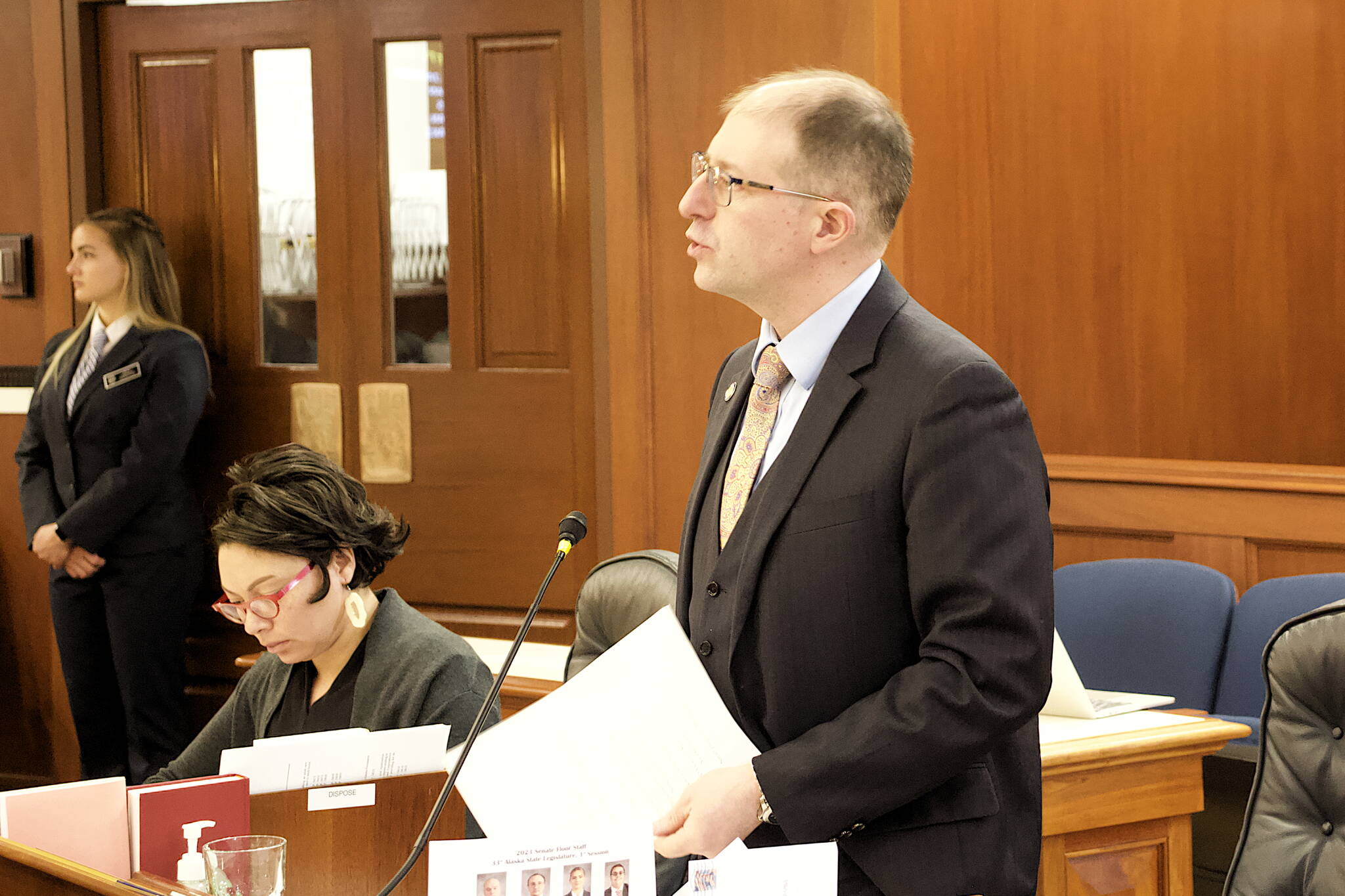
A bill by a Juneau legislator making confidential the addresses of law enforcement officers and their families, and victims of sexual assault and domestic violence, passed the state Senate unanimously on Monday.
The Senate also unanimously approved a related bill that makes peer support programs for law enforcement officers subject to confidentiality rules.
Senate Bill 12 by Sen. Jesse Kiehl, a Juneau Democrat, creates a registry where crime victims under a protective order and law enforcement officials can list an official state of Alaska post office box address for mail, which will then be forwarded to their actual address.
“The reason 41 other states have address protection programs is that for some people, people who have to uproot their lives and change everything to get away from a domestic violence abuser, from a sexual assailant or stalker, publicly listing their address puts their lives at risk, and puts the lives of their children and their families at risk,” he said during Monday’s floor session.
The bill allows forwarding to continue for up to five years beyond the expiration date of a victim’s protective order or the end of an officer’s employment.
“That allows them participate in public life, to vote without fear,” Kiehl said.
Confidential addresses are subject to a search warrant. Also, Kiehl said the bill is limited to free forwarding of first-class mail.
“This is not an Amazon package forwarding service,” he said.
There are other limitations as well, Kiehl acknowledged, responding to a question from another senator about people whose addresses might be accessible via other public records such as property documents or online activity.
“If there is a picture of your front door on Instagram no registry is going to help you if somebody wants to find you,” he said. “So there is an element of the individual protecting their own address and protecting their own privacy.”
Kiehl said he believes such exposure won’t be an issue since, while some abuse victims might retain their address and community ties, “folks who are so fearful for their lives that they pick up and restart their lives, they will need a program like this.”
There have also been conversations about allowing other people potentially exposed to risk, such as prosecutors, to be eligible for the registry, Kiehl said. But he said other states with similar registries generally aren’t that expansive, and the idea was rejected for his bill “in the interests of keeping the program limited in size and therefore limited in costs.”
A legislative fiscal analysis estimates the bill will have a $400,000 first-year startup cost, and then cost roughly the same amount annually with slow increase as postage and the number of participants rises. The analysis expects about 500 people will be enrolled in the registry and receiving 60 pieces of mail each in five years.
Support for the bill during committee hearings was expressed by a large number of officers’ and victims’ entities, including Keeley Olson, executive director of the Anchorage-based organization Sexual Trauma Prevention and Response. She said such a registry was essential while working as a victim advocate for a prosecutor’s office in Washington state.
“Combined with comprehensive safety planning and an emergency relocation plan, and done in a very particular order, the Address Confidentiality Program was a lifesaver for more than a few of my clients,” she wrote. “While the program was accessible and easy to use, I did not see the program being used in inappropriate ways, and never heard of it being a burden on state administrators.”
Also approved by the Senate on Monday was SB 103 by Forrest Dunbar, an Anchorage Democrat, which makes officer participation in peer support programs confidential, with standard exceptions such as a person considered by a provider to be a danger to themselves or others. Dunbar said it’s based on a successful program operated by the United States Marshals Service, and in Alaska 30% of first responders develop depression or post-traumatic stress disorder compared to 20% of the general population.
“Police officers and firefighters are more likely to die by suicide than in the line of duty,” he said. The bill “represents a step forward in destigmatizing mental health care for our police and firefighters in the high-stress and often traumatizing work they do.”
• Contact reporter Mark Sabbatini at mark.sabbatini@juneauempire.com
