
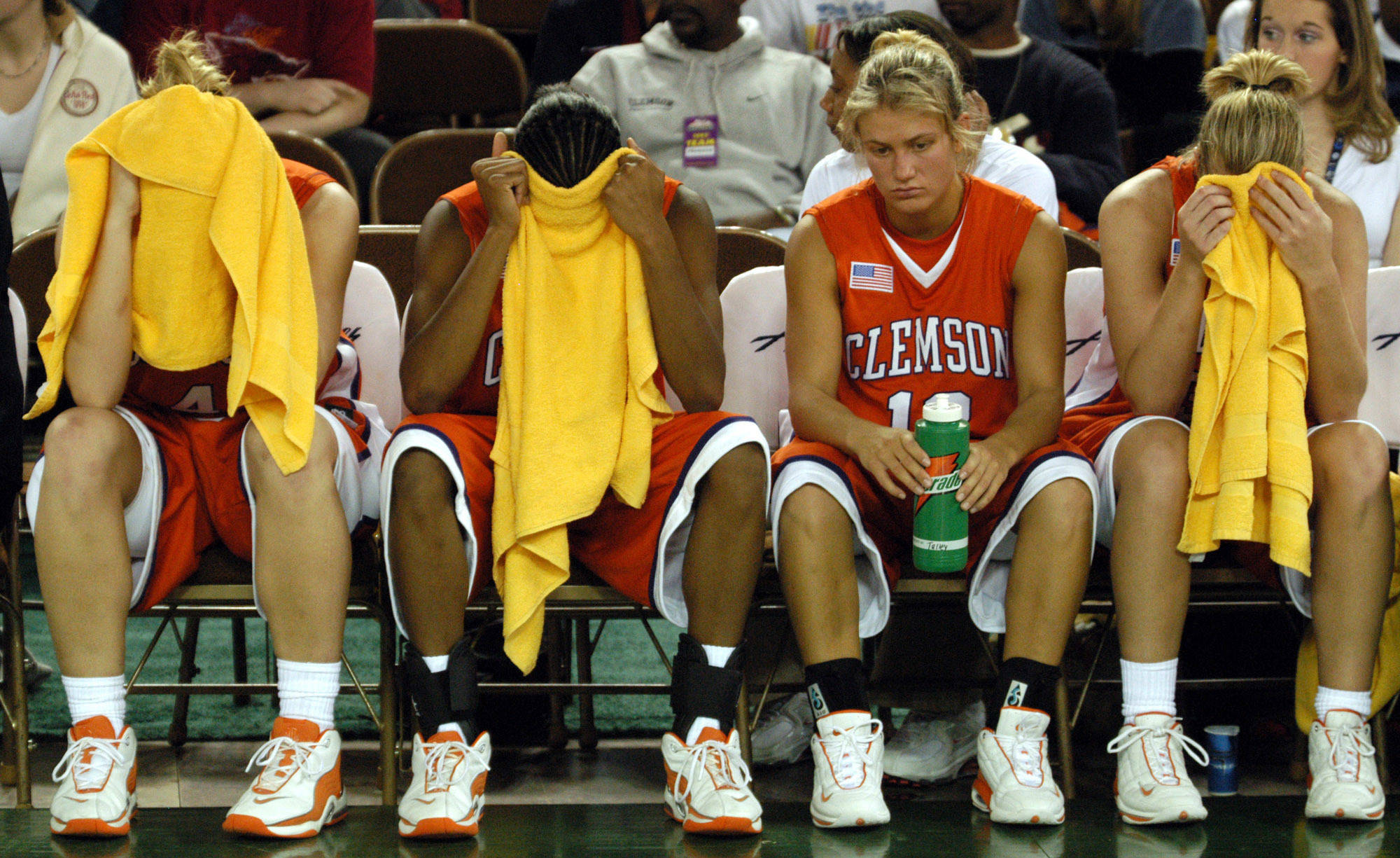
In this Nov. 26, 2003 photo, from left, Clemson’s Maggie Slosser, Lakeia Stokes, Julie Talley and Julie Aderhold sit on the bench after Clemson’s 61-58 loss to Alasaka-Anchorage in the championship game of the Great Alaska Shootout on in Anchorage, Alaska. Shootout fans over the years witnessed the best of college basketball, with Duke, North Carolina, Kentucky, Michigan State and UCLA winning titles, but the end is near. The 40th Shootout will be the last, a victim of changed rules and competition. (Michael Dinneen | The Associated Press File)

In this Nov. 26, 2003 photo, from left, Clemson’s Maggie Slosser, Lakeia Stokes, Julie Talley and Julie Aderhold sit on the bench after Clemson’s 61-58 loss to Alasaka-Anchorage in the championship game of the Great Alaska Shootout on in Anchorage, Alaska. Shootout fans over the years witnessed the best of college basketball, with Duke, North Carolina, Kentucky, Michigan State and UCLA winning titles, but the end is near. The 40th Shootout will be the last, a victim of changed rules and competition. (Michael Dinneen | The Associated Press File)

Competition, expense bring curtain down on Alaska Shootout

  • By Dan Joling
  • Tuesday, November 21, 2017 2:46pm
  • News

ANCHORAGE — Four decades ago, Alaska Anchorage head basketball coach Bob Rachal was looking to promote the program, and while rubbing shoulders with coaches from major programs at the Final Four, he found a way.

The NCAA wanted a presence in all 50 states and had created a rule to help the “geographically disadvantaged.” Colleges were allotted a fixed number of games but could use one of those allotments to play a three-game tournament in Alaska, Hawaii or Puerto Rico. Squeezing in two extra games proved irresistible and the Great Alaska Shootout was born.

“They all wanted to come up and play,” said Lee Piccard, a former Alaska Anchorage vice chancellor. “That’s how it got started.”

Shootout fans over the years witnessed the best of college basketball, with Duke, North Carolina, Kentucky, Michigan State and UCLA winning titles, but the end is near for a tournament that has lost its luster over the years. The 40th Shootout will be the last, a victim of changed rules and competition. The 2017 shootout opened Tuesday with the four-team women’s tournament. The eight-team men’s tournament starts Wednesday.

“It’s simply not financially sustainable,” said Tim McDiffett, acting athletic director, “especially given the economic times of the state of Alaska.”

Alaska’s economy, heavily dependent on the oil industry, is in recession. The NCAA has also long since relaxed rules to allow tournaments in other locations and elite teams can find bigger guaranteed appearance fees at venues that offer beaches instead of borrowed parkas.

“Some events are paying $250,000 to $300,000 to a team to get them to come to an exotic location for an event,” McDiffett said. The Great Alaska Shootout field in recent years has attracted mid-major programs and even that’s too expensive, McDiffett said.

The tournament was initially named the Sea Wolf Classic and almost didn’t happen. Rachal had floated the idea of a tournament but was fired after the 1976-77 season for NCAA rules violations. When Rachal’s replacement opened his desk, he discovered seven contracts signed with schools expecting to play in a tournament in November 1978.

Alaska Anchorage had the choice of trying to cancel contracts or to put on a tournament.

“We honored the contracts and that was the way it went,” Piccard said.

Alaska Anchorage had a year to prepare but lacked one essential: a gymnasium.

University officials sought help from the nearby Fort Richardson Army Post. The Army made its field house available, and when teams and fans showed up for the first tournament in 1978, soldiers served as parking attendants.

Community volunteers were crucial to the success of the tournament in succeeding years, Piccard said.

Families took players and coaches home for Thanksgiving dinners between games. Organizers gave visiting teams an injection of Alaska culture with demonstrations of Alaska Native dancing and dog sled rides.

“You’re 6-10, you come from New York City and you get into a dog sled,” Piccard said. “That’s the way it is.”

And then there were the games.

In 1998, Bob Huggins’ Cincinnati Bearcats defeated No. 1 Duke, the only regular-season game the Blue Devils would lose. With three seconds left, Kenyon Martin caught a three-quarter-length pass and fed a streaking Melvin Levett for the winning layup. Elton Brand, Shane Battier, William Avery, Corey Maggette and Anchorage’s own Trajan Langdon suited up for Duke.

Glenn Robinson of Purdue torched Portland for 41 points in the 1993 championship game, a single-game performance eclipsed in 2009 by Klay Thompson scoring 43 versus San Diego.

In 2001, a then-unknown 19-year-old sophomore, Dwyane Wade, academically ineligible the year before, lead Marquette to victories over Tennessee, Indiana and Gonzaga.

Syracuse made three appearances. The Orange were ranked No.1 when they lost to Arizona, 80-69, in the 1987 title game in Alaska. The Orange in 1996 were beaten by Kentucky in the first round. Syracuse finally won the tournament in 2000, defeating Missouri 84-62 for the title.

“It was a great tournament,” Syracuse coach Jim Boeheim said. “We loved going there, but it’s a long way to go, it’s tough. There are so many warm weather places now. That’s where everybody’s going.”

Piccard will be sad to see the tournament go. He has attended every game, even sparsely attended Saturday morning sessions that saw teams battling to avoid finishing eighth.

“They ought to give me a golden pillow or something,” he said with a laugh.

In this Nov. 27, 2008 photo, Seattle’s head coach Joe Callero, center, talks to the Redhawk team during a time-out at the Great Alaska Shootout NCAA basketball tournament in Anchorage, Alaska. Shootout fans over the years witnessed the best of college basketball, with Duke, North Carolina, Kentucky, Michigan State and UCLA winning titles, but the end is near. The 40th Shootout will be the last, a victim of changed rules and competition. (Al Grillo | The Associated Press File)

In this Nov. 27, 2008 photo, Seattle’s head coach Joe Callero, center, talks to the Redhawk team during a time-out at the Great Alaska Shootout NCAA basketball tournament in Anchorage, Alaska. Shootout fans over the years witnessed the best of college basketball, with Duke, North Carolina, Kentucky, Michigan State and UCLA winning titles, but the end is near. The 40th Shootout will be the last, a victim of changed rules and competition. (Al Grillo | The Associated Press File)

More in News

A Capital City Fire/Rescue truck drives in the Mendenhall Valley in 2023. (Clarise Larson / Juneau Empire file photo)
Juneau man found dead following residential fire

The cause of the fire is still under investigation.

CBJ sign reads “Woodstove burn ban in effect.” (City and Borough of Juneau photo)
Update: CBJ cancels air quality emergency in Mendenhall Valley Sunday morning

The poor air quality was caused by an air inversion, trapping pollutants at lower elevations.

A dusting of snow covers the Ptarmigan chairlift at Eaglecrest Ski Area in December 2024. (Eaglecrest Ski Area photo)
Update: Waterline break forces closure at Eaglecrest Friday, Saturday

The break is the latest hurdle in a challenging opening for Juneau’s city-run ski area this season.

Patrick Sullivan stands by an acid seep on July 15,2023. Sullivan is part of a team of scientists who tested water quality in Kobuk Valley National Park’s Salmon River and its tributaries, where permafrost thaw has caused acid rock drainage. The process is releasing metals that have turned the waters a rusty color. A chapter in the 2025 Arctic Report Card described “rusting rivers” phenomenon. (Photo by Roman Dial/Alaska Pacific University)
Ecosystem shifts, glacial flooding and ‘rusting rivers’ among Alaska impacts in Arctic report

NOAA’s 2025 report comes despite Trump administration cuts to climate science research and projects

The U.S. Capitol in Washington, D.C., on Oct. 1, 2025. (Photo by Jennifer Shutt/States Newsroom)
Moderate US House Republicans join Dems to force vote on extension of health care subsidies

WASHINGTON — Republican leaders in the U.S. House will face a floor… Continue reading

The National Weather Service Juneau issues a high wind warning forDowntown Juneau, Southern Douglas Island and Thane due to increased confidence for Taku Winds this afternoon. (National Weather Service screenshot)
Taku winds and dangerous chills forecast for Juneau

Gusts up to 60 mph and wind chills near minus 15 expected through the weekend.

Chloe Anderson for the Juneau Empire
Fallen trees are pictured by the Mendenhall river on Aug. 15, 2025. Water levels rose by a record-breaking 16.65 feet on the morning of Aug. 13 during a glacial outburst flood.
Lake tap chosen as long-term fix for glacial outburst floods

The U.S. Army Corps of Engineers and Juneau leaders agreed on the plan.

Gift card displays, such as this one in a CVS in Harlem, N.Y., have been a source of concerns for lawmakers hoping to combat gift card fraud. “Card draining,” or stealing numbers from poorly packaged cards, is one of the costliest and most common consumer scams, and states are trying to combat it with consumer alerts, arrests and warning signs on store displays. (Photo by Robbie Sequeira/Stateline)
Alaskans targeted by scammers posing as government officials, FBI warns

The FBI reports Alaskans lost over $26.2 million to internet-based scams in 2024, with $1.3 million of those losses due to government impersonation scams

A buck enters the view of an Alaska Department of Fish and Game trail camera on Douglas island in November 2020. (Alaska Department of Fish and Game courtesy photo)
Douglas deer: The island’s hunt faces calls for new rules

Board of Game is seeking public comment on regulation changes that would affect Juneau.

Most Read