
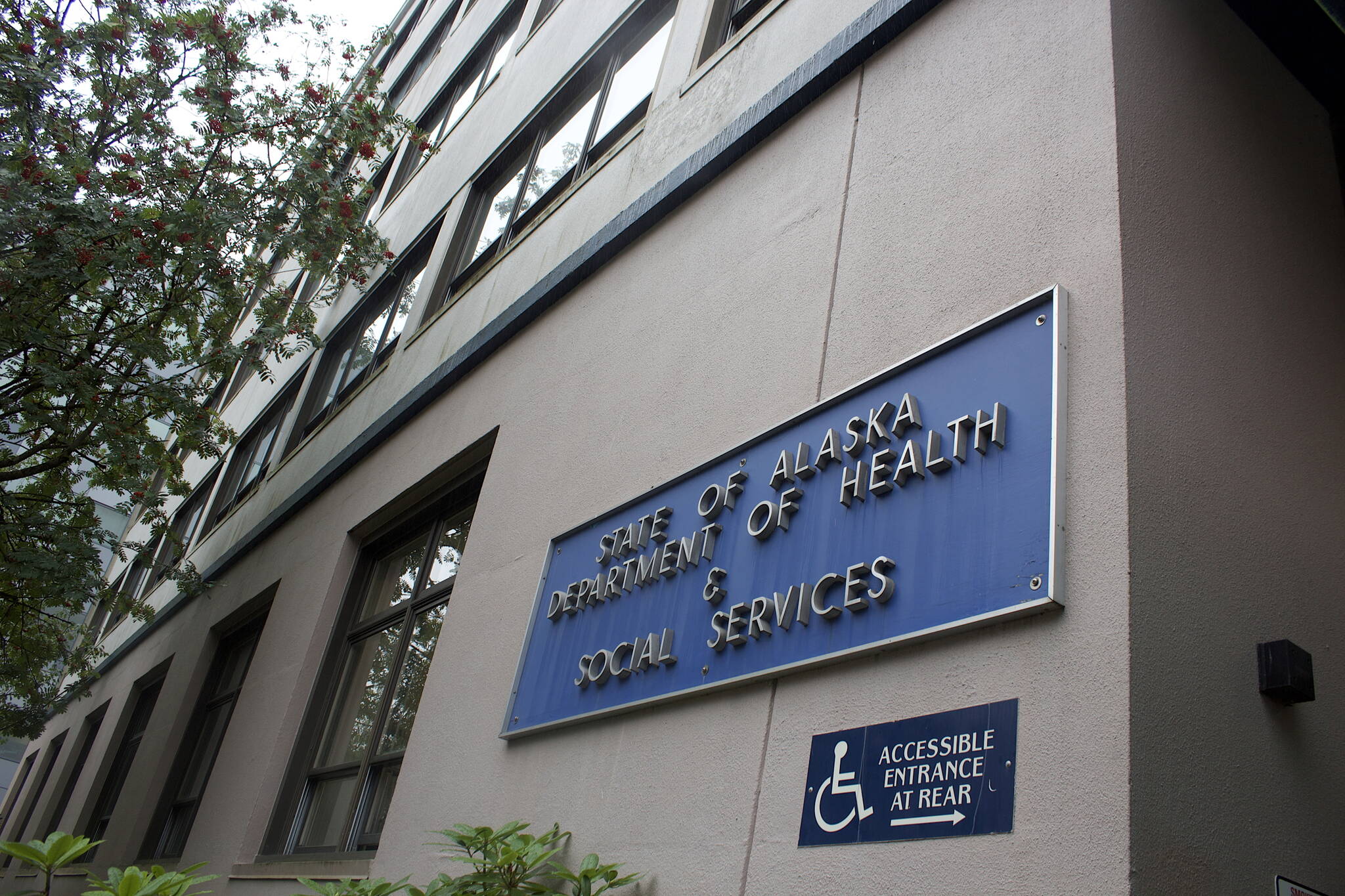
The building signs still say “State of Alaska Department of Health & Social Services” and the website dhss.alaska.gov is still active. The latter now primarily notes the agency split into two departments on July 1 and provides links to new sites, although there’s been few updates at either of them since.
But that’s not necessarily a bad thing for the commissioners of the new departments who for the past two months have been dealing with IT and payroll transitions, getting themselves and many employees up-to-date on new roles, and working on more publicly noticeable long-term changes.
”So far we’ve seen very minimal disruption,” said Kim Kovol, the first commissioner of the Department of Family and Community Services, in a Zoom interview with top officials from both departments Tuesday.
The commissioner of the new Department of Health is Adam Crum, the former DHSS commissioner, who said presiding over a narrower range of services is already proving beneficial in focusing on long-term issues.
“There’s been a lot more extensive meetings with group to implement longer-term goals,” he said. “Again we’re not even two months into it, and we have had a lot of great meetings and ideas come up.”
New building signs, stickers, opening of offices and other similarly visible indicators of the split are in the works and should appear within a few months, Crum said. Kovol said her department is meeting Monday to finalize plans for its public information process, and website and social media updates should begin occurring regularly shortly thereafter.
DHSS was the state’s largest agency before the split with about 3,250 employees and a $3.5 billion budget, two-thirds of which funded Medicaid-related services. DOH now oversees Medicaid via the divisions of Public Health, Public Assistance, Behavioral Health, Health Care Services, and Senior and Disabilities Services. DFCS oversees services including the state’s child welfare system, juvenile justice Alaska Psychiatric Institute and assisted living homes.
Crum, in an interview the week after the split became official, said “Alaska should not notice that any change has occurred.” Gov. Mike Dunleavy stated his executive order for dividing the department was an efficiency move to “improve outcomes for programs and services statewide.”
In Thursday’s interview, Crum said his comment refers to the short-term transition, an area of emphasis when the Alaska State Legislature was evaluating if they should official disapprove the executive order.
“The biggest thing, which we said during the session multiple times, is we didn’t want disruption of benefits to beneficiaries or providers, and that has been continuing throughout,” he said.
General agreement of that assertion, along with ongoing concerns about potential long-term impacts, was expressed by Mary Johnson, family and youth services director for the Central Council of the Tlingit and Haida Indian Tribes of Alaska.
“I can’t say that it’s been anything noticeable for better or worse,” she said. “I am hopeful that we’re going to see further growth in particular with the Office of Children’s Services.”
Johnson said one of her primary concerns is the fate of the Alaska Tribal Child Welfare Compact — in effect since 2017, but finally codified this month when Dunleavy allowed it to become law without his signature. The government-to-government agreement allows the state’s tribes to oversee placement of foster children and provide child welfare services with the intent of reducing what she said is a disproportionately high number of Alaska Native children in state custody.
“We were told the divide would be able to dedicate more time and efforts into programs,” Johnson said. She said Kovol is making an effort as the new commissioner to introduce herself to tribal groups and become familiar with the compact, but “it sounds like there’s a lot for her to learn and take in.”
“There is so much going on, but we don’t have time to lose momentum,” Johnson said.
Kovol, a longtime advocate for people experiencing homelessness and other social services who became a social services special assistant to the governor last year, said she has met extensively with communities in much of the state so far about the compact as well as other services provided by her department. A visit to Southeast Alaska communities is scheduled next month.
“Every community has very unique needs, and very unique constituents and clients,” she said. “So it’s really important to make sure I have that face-to-face time.”
The most notable transition issue raised in the “Final DHSS Reorganization Newsletter” published by the state Aug. 17 are IT-related. Challenges cited by Crum included “navigating the first full payroll for each department,” “transitioning emails for more than 3,000 employees to the correct department” and “continuing provider payments without interruption.”
“Issues and concerns about the transition will arise over the next few months,” he wrote in the newsletter.
About 70% of the work related to Dunleavy’s executive order is complete, according to the update. DFCS Assistant Commissioner Marian Sweet said some of her department’s unfinished work is the communications plan being finalized next week, but much of the rest involves longer-range issues.
“The rest of the stuff will probably be scatted out through the rest of the fiscal year,” she said.
The department split took two years and a legislative cycle to become official, and “the world doesn’t change in July when this becomes effective,” Crum said. He said completing some aspects of the state-level process could take a year or two, while fully transitioning to federal-level aspects could take a few years.
Kovol said the pace of transition is to ensure it occurs as Dunleavy envisioned when issuing his executive order.
“This is the right decision and the right move, and we’re seeing benefits from the reactions of communities and stakeholders,” she said.
• Contact reporter Mark Sabbatini at mark.sabbatini@juneauempire.com.
