
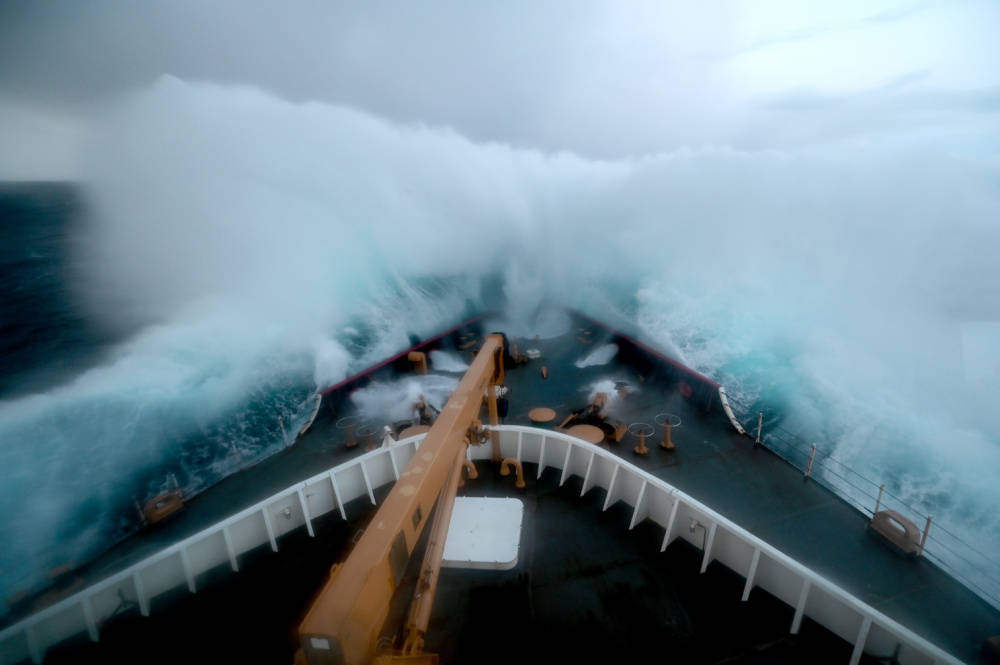
Coast Guard heavy icebreaker USCGC Polar Star got closer to Santa’s home than most as they set a record for the northernmost wintertime navigation by a U.S. vessel on Christmas Day.
“The crew achieved a notable milestone Christmas Day by traversing farther into the harsh, dark winter Arctic environment than any cutter crew in our service’s history,” said commanding officer Capt. Bill Woitrya in a news release, “Our ice pilots expertly navigated the Polar Star through sea ice up to four feet thick and, in doing so, serve as pioneers to the country’s future of Arctic explorations.”
The heavy icebreaker, the United States’ sole effective icebreaker, is on its first Arctic deployment in decades, Woitrya said in a phone interview. Pulling into Dutch Harbor Tuesday for refueling and resupply, the Polar Star will continue a mission of research, power projection and fisheries enforcement in the north.
[Heavy icebreaker retasked for Arctic deployment]
Typically, the Polar Star operates in the Southern Hemisphere supporting Antarctic operations while the medium icebreaker USCGC Healy operates in the Arctic during the summer. The Healy is currently drydocked following a major engine fire.
“This is the first time we’ve had an icebreaker north of the Arctic Circle in 40 years,” Woitrya said. “In some ways, this is the most challenging it’s been.”
The Polar Star achieved its record breaking winter latitude at 72 degrees 11 minutes north, said Petty Officer 1st Class Cynthia Oldham in a news release. This is approximately 75-80 miles north of the previous record, Woitrya said.
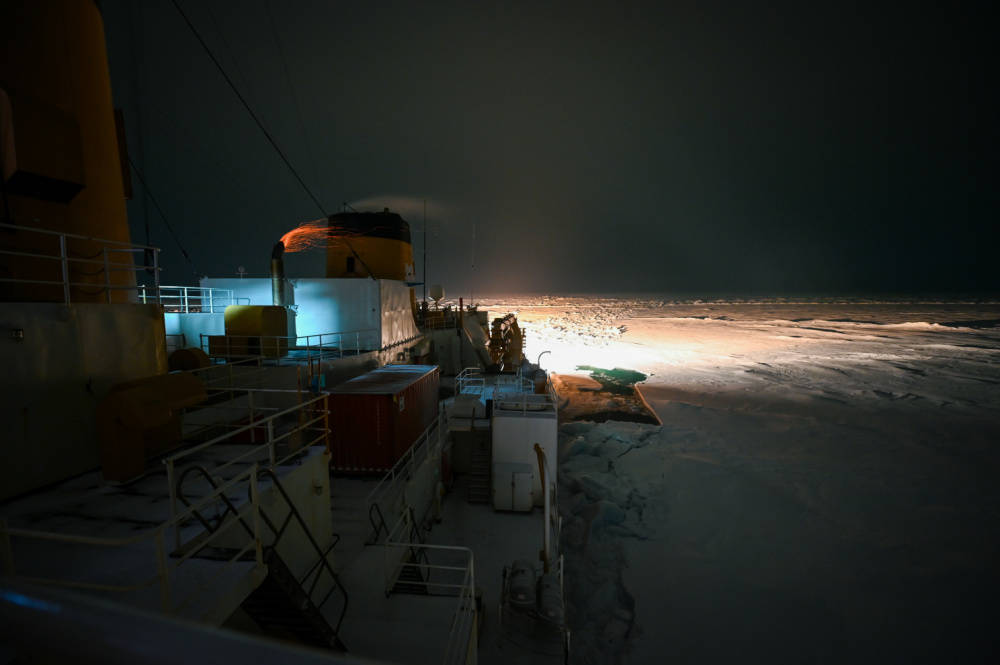
Petty Officer 1st Class Cynthia Oldham / USCG The U.S. Coast Guard Cutter Polar Star underway in the Chukchi Sea, Wednesday, Dec. 23, 2020, at about 10:30 a.m. The icebreaker is supporting an increasingly prioritized mission in the region, according the the Coast Guard.
Cold nights and thick ice
Deployed north for the first winter Arctic deployment since 1982, the ship has performed admirably under brutal conditions, Woitrya said.
“The real challenge for us this year and any year is the weather. There’s been a series of storms as we crossed the Gulf of Alaska with 20-30 foot seas,” Woitrya said. “The Polar Star is especially bad for that because of the shape of the hull. She’s built for icebreaking. In the open sea, she rolls.”
The fun doesn’t stop when they hit the ice, Woitrya said. Visibility is key for the crew of the icebreaker to avoid older and therefore thicker areas of ice and travel the route of least resistance. And in the Alaska winter, visibility can be hard to come by.
“For 23 hours a day it’s dark black, inky darkness,” Woitrya said. “It’s like driving a car if you could only see one car length ahead of you.”
[Sen. Sullivan: Coast Guard needs more Alaska Focus]
A career icebreaker officer hailing from Rochester, New York, Woitrya served as a junior officer aboard the Polar Star during his first deployment. In subsequent postings, he served aboard both of the Coast Guard’s larger icebreakers in various roles, aboard the smaller icebreakers in the Great Lakes, and with the International Ice Patrol.
“I’ve spent my entire Coast Guard career taking jobs and leading me to this point. It’s been all icebreakers for me,” Woitrya said. “As a 22-year-old I wanted to see the world and go on a grand adventure, and I certainly got that. But in the process I fell in love with the Arctic.”
Deployments in the Arctic are also made extremely difficult by virtue of their distance from resupply. While naval vessels in warmer climes are able to resupply fuel, food and other logistical requirements at sea, there is no capability to resupply a ship in the Arctic closer than the deepwater port at Dutch Harbor, Woitrya said.
“The Arctic is just an incredibly difficult environment to work in. The tyranny of distance is real,” Woitrya said. “Dutch Harbor is really the only deepwater port with the food or fuel or logistics we need.”
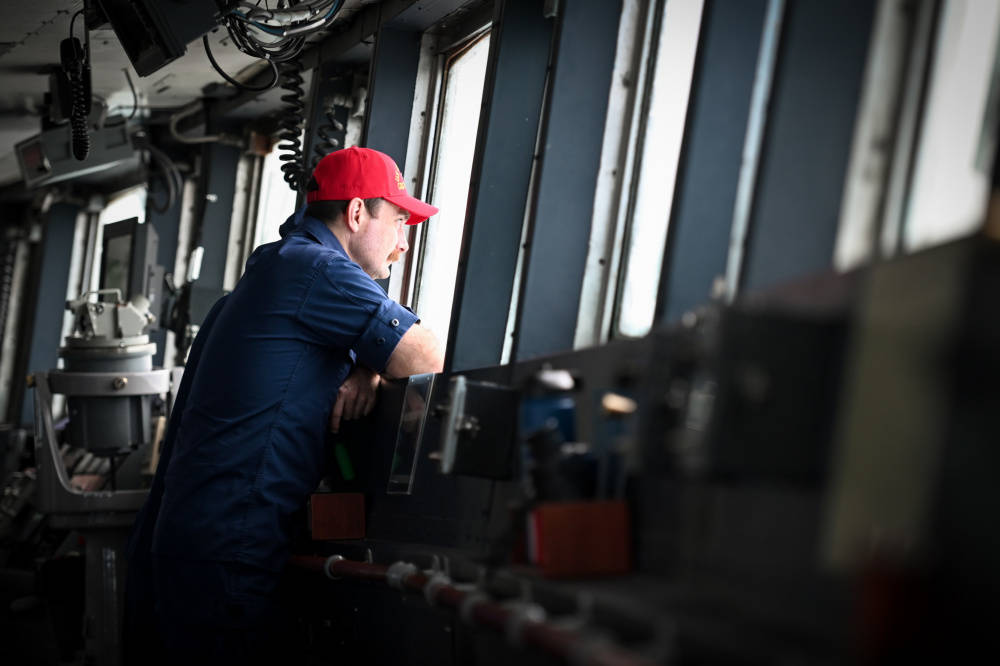
Capt. Bill Woityra, the commanding officer of the Coast Guard Cutter Polar Star looks out from the cutter’s bridge, Thursday, Dec. 17, 2020, while underway in the Bering Strait. The icebreaker is supporting an increasingly prioritized mission in the region, according the the Coast Guard. (Petty Officer 1st Class Cynthia Oldham / USCG)
Old ships, new missions
The Polar Star, commissioned in 1976, is still up to the task, Woitrya said, but she’s getting awfully long in the tooth.
“The ship is running well but it’s definitely showing its age. The crew is working around the clock to keep the ship running and they’re doing great,” Woitrya said. “These are parts that aren’t made anymore. We have only a few more boxes and when they’re out, this ship is done.”
Part of the Polar Star’s mission up north this winter is training the officers and Coast Guardsmen who will command and sail the next generation of icebreakers currently under construction: the Polar Security Cutters.
“We desperately need to invest in new icebreakers,” Woitrya said. “We have a plan to have a year round persistent presence in the arctic once we get these icebreakers online and in operation.”
[Military leaders: Partnerships key as Alaska’s strategic importance grows]
Aboard the Polar Star is an international group of personnel, including officers, sailors and midshipmen from the Royal Navy, Merchant Marine Academy, National Oceanic and Atmospheric Administration, U.S. Navy and other Coast Guard vessels, including officers from the Healy, Woitrya said. But it isn’t the ship’s largest mission.
“When we got into the Bering, we headed straight out to the maritime boundary line and patrolled there for three days. The Russian fishing fleet stayed on their side of the line,” Woitrya said. “It’s also a broader message to some foreign powers that are taking an enhanced interest in the Arctic that the U.S. is an Arctic power. We can operate here today and we’re building capacity to operate here in the future.”
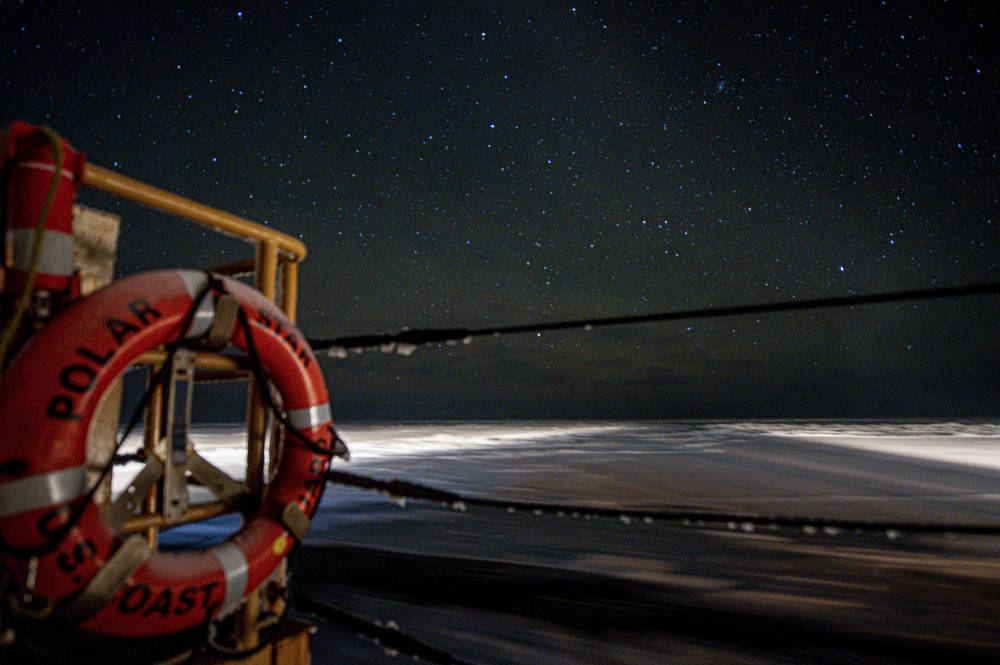
The Coast Guard Cutter Polar Star, underway in the Arctic Ocean, Monday, Dec. 21, 2020. The icebreaker is supporting an increasingly prioritized mission in the region, according the the Coast Guard. (Petty Officer 1st Class Cynthia Oldham / USCG)
Patrolling the border of the Exclusive Economic Zone, which has seen incursions from Russian fishing vessels and warships, has rapidly increased in priority for the United States in the last several years as aggression from other Arctic and non-Arctic powers has increased.
“Some of these other nations, and obviously I’m talking about Russia and China, have demonstrated that they’re interested in pushing those boundaries,” Woitrya said. “Our primary mission right now is projecting power and presence and demonstrating capability in the Arctic.”
Other operations beyond training personnel for future Arctic operations include supporting science missions from Woods Hole Oceanographic Institute that would normally have difficulty gaining access to the region in the harsh winter months and working with the Department of Defense to test the geographical effectiveness of a new constellation of communications satellites.
The Polar Star will continue its deployment in the Arctic after resupplying at Dutch Harbor.
“As we get more daylight up north, that’ll be a better opportunity for the crew to train driving in the ice,” Woitrya said. “There was no urgent mission need to really push further north.”
• Contact reporter Michael S. Lockett at (757) 621-1197 or mlockett@juneauempire.com.
