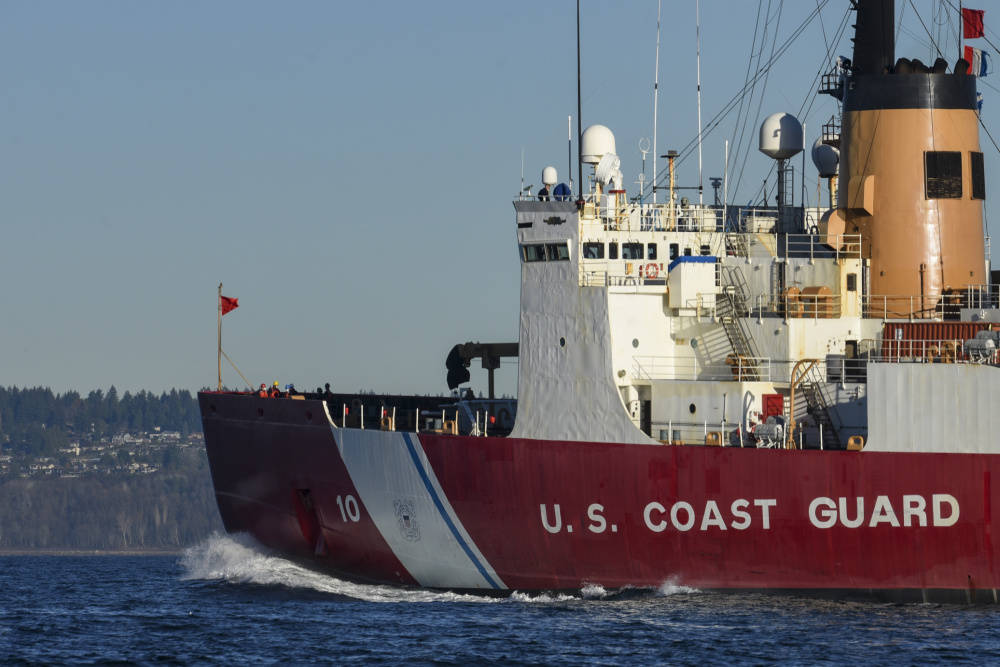
U.S. Coast Guard Cutter Polar Star (WAGB-10) transits the waters of Puget Sound near Seattle on Dec. 4, 2020. The crew is deploying on rare wintertime mission to the Arctic Circle. (U.S. Coast Guard / Petty Officer Steve Strohmaier)

U.S. Coast Guard Cutter Polar Star (WAGB-10) transits the waters of Puget Sound near Seattle on Dec. 4, 2020. The crew is deploying on rare wintertime mission to the Arctic Circle. (U.S. Coast Guard / Petty Officer Steve Strohmaier)

Coast Guard needs more focus on Alaska bases and ships, Sullivan says

Recent Russian exercises and America’s sole functional icebreaker are all cause for concern, the senator opined.

President Donald Trump’s decision to veto the annual defense budget may have lasting effects for Alaska, especially the Coast Guard.

The National Defense Authorization Act, which included more than $740 billion for military programs and construction, was combined with the Coast Guard’s annual funding authorization for the first time, a move he helped engineer, said Sen. Dan Sullivan, a Republican, in a news conference.

The NDAA included funding for construction of a second Polar Security Cutter, the Coast Guard’s new heavy icebreaker class, as well as funding for new National Security Cutters and Fast Response Cutters, some of which will be homeported in Alaska.

[Sullivan announces intent to override Trump’s defense budget veto]

But is that funding enough? Sullivan argued that more emphasis should be placed on Alaska.

“Coast Guard infrastructure, even in Kodiak, can’t currently support medium and heavy icebreakers. There’s a requirement related to how big and heavy these ships are,” Sullivan said. “The Coast Guard needs to work with us to facilitate the ability on Coast Guard bases (in Alaska) to homeport these icebreakers.”

More and bigger

Sullivan said he was working hard to ensure as much new construction as possible was sent to Alaska, which needs it to support a growing mission in the far north. The Coast Guard has only one heavy icebreaker, the Polar Star, which is currently deployed in the Arctic, a retasking from its annual mission to support McMurdo Station in Antarctica.

A second medium icebreaker, the Healy, is in the yards with an engineering casualty and is not seaworthy. Neighboring nations, including the non-Arctic China, have more and bigger icebreakers, including Russia’s recently launched nuclear-power Arktika.

“The men and women of the Coast Guard are rescuing lives every day, especially in our state. But their strategic outlook is a little myopic,” Sullivan said. “Our icebreakers need to be homeported in the Arctic. Most people don’t know they take 8-9 days to transit to the Bering Strait from Seattle.”

With Mt. Baker in the background, U.S. Coast Guard Cutter Polar Star (WAGB-10) transits Puget Sound north of Seattle on Dec. 4, 2020. The Polar Star normally departs for Antarctica, but this year the pandemic has cancelled their mission to assist with resupplying bases there. (U.S. Coast Guard / Petty Officer 2nd Class Steve Strohmaier)

With Mt. Baker in the background, U.S. Coast Guard Cutter Polar Star (WAGB-10) transits Puget Sound north of Seattle on Dec. 4, 2020. The Polar Star normally departs for Antarctica, but this year the pandemic has cancelled their mission to assist with resupplying bases there. (U.S. Coast Guard / Petty Officer 2nd Class Steve Strohmaier)

The initial homeport for the icebreakers will be in Seattle, Sullivan said, but he’s advocating for the expansion of facilities in Alaska. A survey is currently being done of Alaskan communities for port cities with the Coast Guard and non-Coast Guard infrastructure required to support the vessels.

“The heavies, once built, will be homeported in Seattle. But it makes sense to keep the other icebreakers in Alaska,” Sullivan said. “Where the hell else are you going to put them? Florida? Although I guess that’s where one of them is.”

The icebreaker in Florida is identified by The Associated Press as the Aiviq, a civilian medium icebreaker owned by Gary Chouest, a major donor to the Republican party, and forwarded by Sullivan as a candidate for leasing by the government. Sullivan also mentioned a possible icebreaker in Finland for use.

Contested waters

That mission for the nascent icebreaker fleet is only growing more important as incursion by Russian and Chinese forces and fishing fleets in American waters and exclusive economic zones.

“There was a huge discussion on what happened when our fishing fleet had these huge problems and were not made aware of this gigantic Russian navy, army and air force operation in our exclusive economic zone,” Sullivan said. “I think there’s a huge number of missions that Polar Security Cutters have with regard to protecting to economic interests, fishing interests, environmental interests, and national security interests in the United States Arctic (territory).”

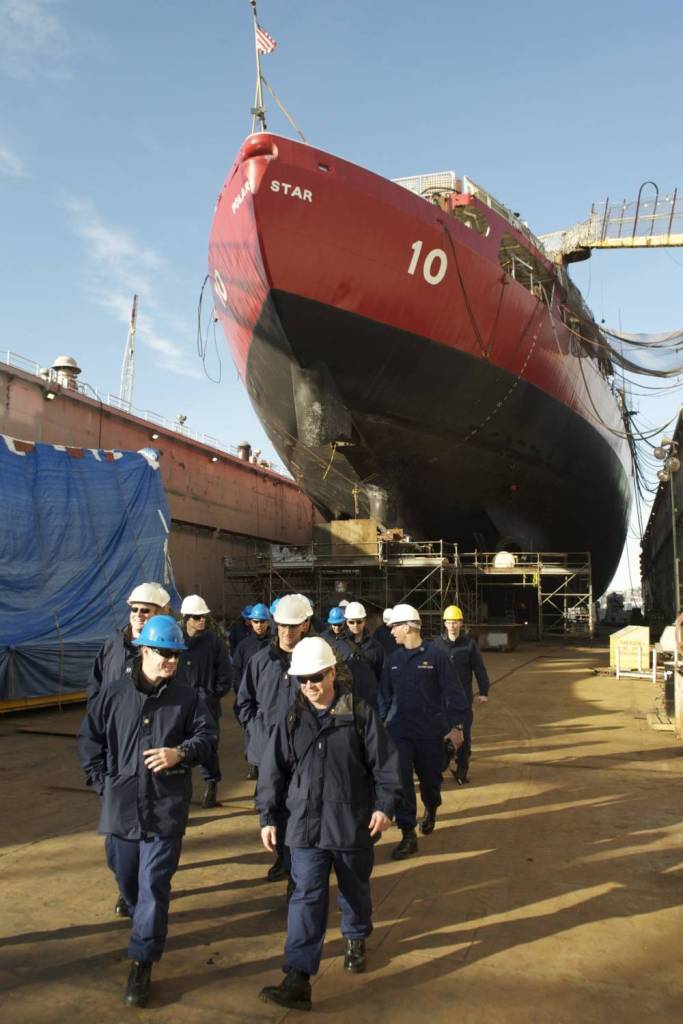
Coast Guard divers familiarize themselves with the hull of the Polar Star as part of the training for the annual Cold Water Ice Diving Course, Feb. 9, 2011. (U.S. Coast Guard / Petty Officer 3rd Class Nathan W. Bradshaw)

Coast Guard divers familiarize themselves with the hull of the Polar Star as part of the training for the annual Cold Water Ice Diving Course, Feb. 9, 2011. (U.S. Coast Guard / Petty Officer 3rd Class Nathan W. Bradshaw)

Sullivan measured leasing medium icebreakers as a stopgap measure while the PSCs come out of the yards and enter active commission.

“How do we bridge the gap, now that the Healy is down for overhaul? We’re essentially down to one icebreaker,” Sullivan said. “The big play right now is to try to execute a leasing option with two medium class icebreakers, like, within the next several weeks. There’s money in the Navy’s budget for this. And to try to get these homeported in the interim in Alaska.”

Sullivan also discussed an ongoing project to build a deepwater port near Nome, supporting operations in the high Arctic.

• Contact reporter Michael S. Lockett at 757-621-1197 or mlockett@juneauempire.com.
More in News

Local artist Johanna Griggs looks at “The Ocean Mirror,” her favorite piece from her exhibit “Landscapes of Southeast Alaska,” on display at the Juneau Arts and Culture Center. (Mari Kanagy/Juneau Empire)
Juneau painter explores local color and reflection

The exhibit display at the Juneau Arts and Culture Center through November.

Juneau International Airport stands on Shell Simmons Drive. (Clarise Larson / Juneau Empire File)
Juneau flights not yet affected by FAA restrictions

Although local departures are unaffected, connecting flights from Sea-Tac are at risk.

Choosing to shop local isn’t just convenient – it keeps money in the community, sustains the arts and turns errands into encounters with neighbors and friends. (Photo credit: Christopher S. Miller/The New York Times)
Finding the magic of the holidays close to home in Juneau

Discover how handmade treasures, live arts and hometown traditions keep Juneau’s festive spirit alive

The entrance to the Anchorage Correctional Complex is seen on Aug. 29, 2022. (Photo by Yereth Rosen/Alaska Beacon)
Alaska parole rates are among the lowest in the nation. Advocates want to know why.

At its annual public meeting, the Alaska Board of Parole offered little explanation, but advocates want to know more about their criteria and say more transparency will help reduce recidivism

“I voted” stickers are seen on display in the headquarters offices of the Alaska Division of Elections in Juneau on Tuesday, Nov. 12, 2024. (Photo by James Brooks/Alaska Beacon)
Alaska Division of Elections begins reviewing petition to repeal election reform law

Based on state law and the number of people who voted in the 2024 statewide election, repeal supporters needed to collect signatures from at least 34,099 registered voters

Members of Juneau Education Association and supporters of the union dress in green at the Board of Education Meeting on Oct. 28, 2025. (Mari Kanagy/Juneau Empire)
Teacher’s union speaks on lapsed contract as board members shuffle

Juneau Educators Association’s contract expired at the end of July.

“Tide Pools” is part of the “Landscapes of Southeast Alaska” exhibit by Johanna Griggs, presented by Juneau Arts & Humanities Council. The exhibit will open at the Juneau Arts and Culture Center on Friday, Nov. 7 2025. (courtesy Juneau Arts and Humanities Council)
November’s First Friday: Here’s what to see

Juneau Arts & Humanities Council announces community events at attend Nov. 7.

One of the houses on Telephone Hill stands vacant on Wednesday, Nov. 5. A lawsuit filed against the city Friday seeks to reverse the eviction of residents and halt demolition of homes on the hill. (Mari Kanagy/Juneau Empire)
Telephone Hill residents file lawsuit against city to stop evictions and demolition

The city says legal action is “without factual or legal support.”

Most Read