
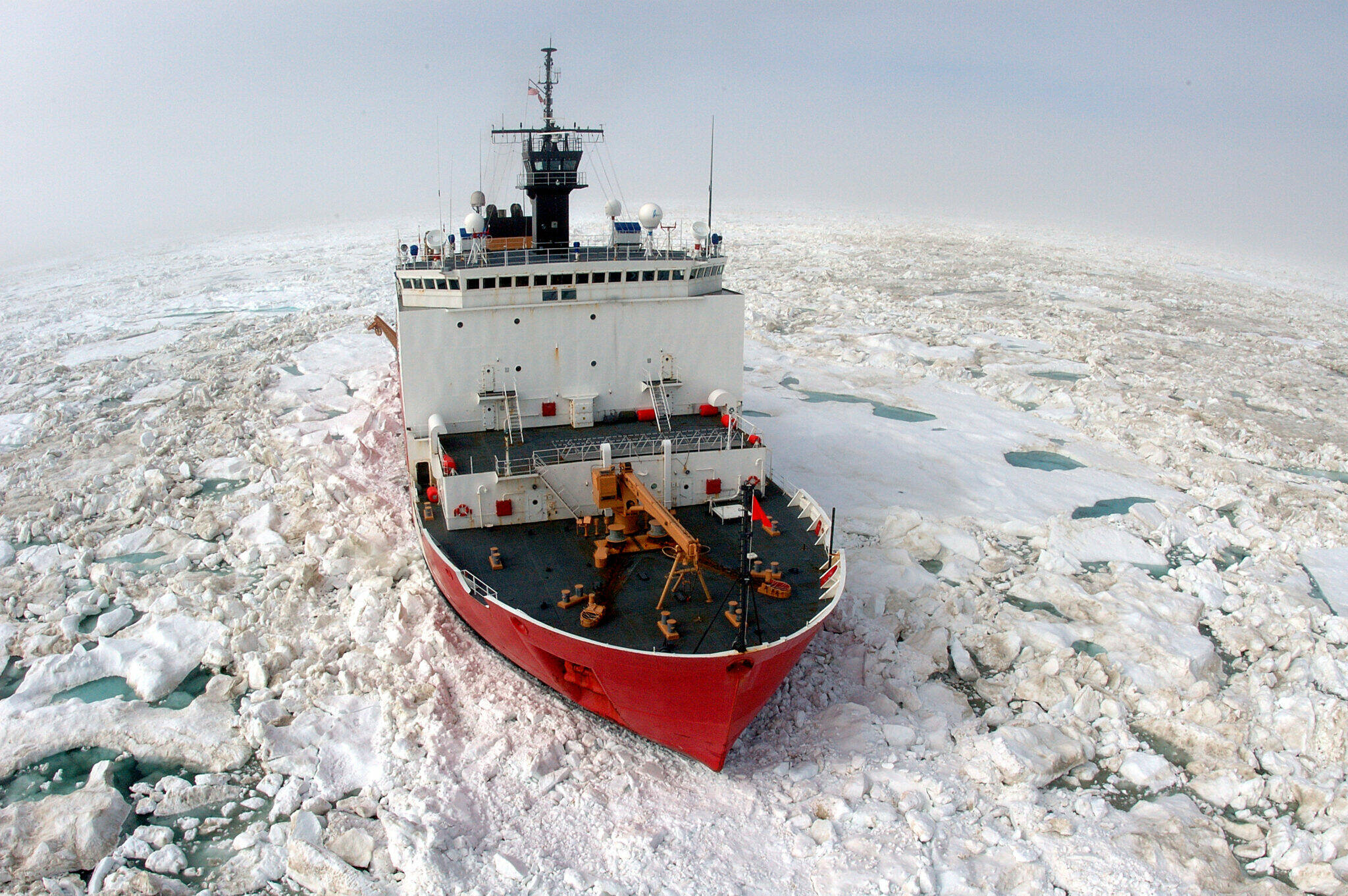
The U.S. Coast Guard cutter Healy, the largest U.S. icebreaker, is on its way to Alaska for the first of three Arctic scientific missions planned over the coming months.
The Healy departed on Wednesday from Seattle, its home port, the Coast Guard said. Its first mission will bring scientists to the Beaufort Sea to service underwater moorings, devices installed to collect information about oceanic conditions. Scientists on the mission will also survey the currents between the Bering Sea and the Canadian Beaufort Sea. Other work to be conducted includes monitoring of Arctic algal blooms, the Coast Guard said.
In its second mission, the Healy is scheduled to carry early career scientists on a cruise through the Northwest Passage to Greenland. That mission is intended to train scientists in Arctic research practices and is modeled after a similar mission conducted last year on the Sikuliaq, a research vessel owned by the National Science Foundation and operated by the University of Alaska Fairbanks.
The Healy’s third scheduled mission is to gather data for the Global Ocean Ship-Based Hydrographic Investigations Program, an international scientific program established in 2007. That work will collect high-resolution data across the Arctic basin, the Coast Guard said.
“We are excited to support three significant missions in the northern high latitudes,” Coast Guard Capt. Michele Schallip, the Healy’s commanding officer, said in a statement. “Two of these missions are part of long-standing data collection projects, aimed at enhancing our understanding of a changing Arctic. The third mission is dedicated to inspiring future principal investigators who will continue this important work.”
At a time when scientific interest in the Arctic Ocean is intensifying, the Healy “substantially enhances” U.S. Arctic research capacity, she said. “Healy’s crew have been unwavering in their efforts during our in-port maintenance period, ensuring the cutter is ready to meet the demands of these missions,” she said.
The Healy, which is designed to break through ice up to 4.5 feet thick, is one of only two operating polar-class icebreakers owned by the Coast Guard. While the Healy generally works in the Arctic during the summer and fall supporting scientific research and other purposes, the Coast Guard’s other polar icebreaker, the Polar Star, is usually assigned to the Antarctic.
The Healy’s cruises are among several scheduled for research vessels in Alaska and Arctic waters in coming months.
The Seward-based Sikuliaq, which completed some West Coast missions in the spring, has already been deployed in the Gulf of Alaska to continue long-term research there. The Sikuliaq has Alaska research cruises scheduled through September.
The Sikuliaq, which is named for the Inupiaq term meaning “young ice,” is designed to sail through relatively thin ice.
Other ships are also scheduled to conduct research cruises to collect information about fish stocks, whales, seabed features and sea ice, among other subjects, according to the Interagency Arctic Research Policy Committee.
• Yereth Rosen came to Alaska in 1987 to work for the Anchorage Times. She has reported for Reuters, for the Alaska Dispatch News, for Arctic Today and for other organizations. She covers environmental issues, energy, climate change, natural resources, economic and business news, health, science and Arctic concerns. This story originally appeared at alaskabeacon.com. Alaska Beacon, an affiliate of States Newsroom, is an independent, nonpartisan news organization focused on connecting Alaskans to their state government.
