Club mosses and the evolution of land plants
Published 10:30 pm Monday, September 28, 2020


By Mary F. Willson
For the Juneau Empire
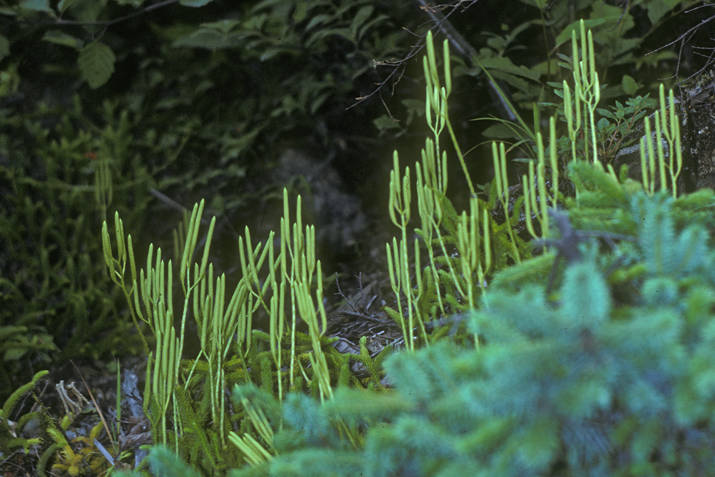
On a recent walk near Echo Cove, I noticed a lovely patch of a club moss sporting dozens of erect spore-bearing “cones.” We have several types of club moss here, but the only one I recognize (so far) is Lycopodium clavatum or running club moss. It often has long stems that are covered with short leaves, and they “run” over the ground before making erect branches that bear cones on stalks. Despite their common name, club mosses are not mosses at all; they are on a different branch of the evolutionary tree.
I knew that they originated a long time ago, although they were not the first plants to live on land. But seeing this modern specimen made me think about the evolution of early land plants and the problems that attend a change from an aquatic to a terrestrial environment.
The first land plants belonged to a group of green algae (called Charophyta), some of which became terrestrial perhaps 500 million years ago. It is not clear why they did so, although some researchers suggest that land-living allowed escape from various alga-eaters in the water. But land-living meant that these early colonists risked desiccation: both the plant and its spores had to be protected from drying. This could be done in two basic ways: avoid the problem by growing and producing spores only in wet conditions, or develop water-impervious layers around the plant and its spores. Furthermore, although they were already able to photosynthesize carbohydrates (from carbon dioxide and water), now they had to get the necessary carbon dioxide in a gaseous form, from air. Most of the early land plants were very thin, often only one cell thick, so gases could readily diffuse in and out.
The first non-algal land plants were liverworts and mosses, appearing roughly 450 million years ago. These plants grow close to the ground or other surface, seldom extending upward more than a few centimeters. Although they live on land, they need at least a film of water for reproduction: sperm have to swim to reach eggs to fertilize. They occupy two branches of the evolutionary tree that are adjacent to each other but totally separate from the branch that leads to all other living land plants.
[Wild Shots: See photos of Mother Nature in Alaska]
Around 430 million years ago, there was a new development that changed everything. It is not well understood how it happened, but some presumably moss-like land plants developed vascular tissues that conducted fluids from one part of the plant to another, so they were no longer dependent on diffusion. That made a big difference! Thus were born xylem, for conducting water mainly upward, and phloem, for conducting carbohydrates from the green leaves to the rest of the plant. This made possible the development of root systems that both anchored the plants in the ground and allowed the uptake of water from the soil. It also made possible the vertical development of woody stems that raised the leaves well above the ground surface, reaching more light and air, and eventually developing large trees.
One of the first offshoots of the major lineage called vascular plants, which now could exploit both the soil and the aerial space above ground, was a cluster of minor lineages that included the club mosses and quillworts. Among the fossils of the early forms of club moss was a tree that sometimes grew to be 100 feet tall. Unlike the trees we are familiar with, the trunk of these tall club mosses was not stiffened mainly by wood but mostly by its bark. Some researchers suggest that these trees grew for a number of years but died after reproducing once. They were once widespread on different continents but faded away by about 300 million years ago. That left the un-treelike forms to continue and they are with us yet.
Still to come were the ferns (there were now-extinct types that made seeds) and other familiar modern plants. These invented seeds by covering embryos with maternal tissue. The added tissue provided more protection from drying and often developed structures adapted for dispersal on land. In most cases, the enclosed embryo was also endowed with a packet of nutrition for seedling growth. They developed pollen grains to carry sperm cells through the air so they were not dependent on water for reproduction. Eventually, the developmental pattern of some leaves changed, producing flowers for attracting pollinators.
The world changed entirely with the arrival of an array of vascular plants with seeds and pollen. Now, there were grasslands and forests providing habitat as well as more food and more ways to get it for more kinds of animals, which embarked on their own various evolutionary trajectories.
• Mary F. Willson is a retired professor of ecology. “On The Trails” is a weekly column that appears in the Juneau Empire every Wednesday.