
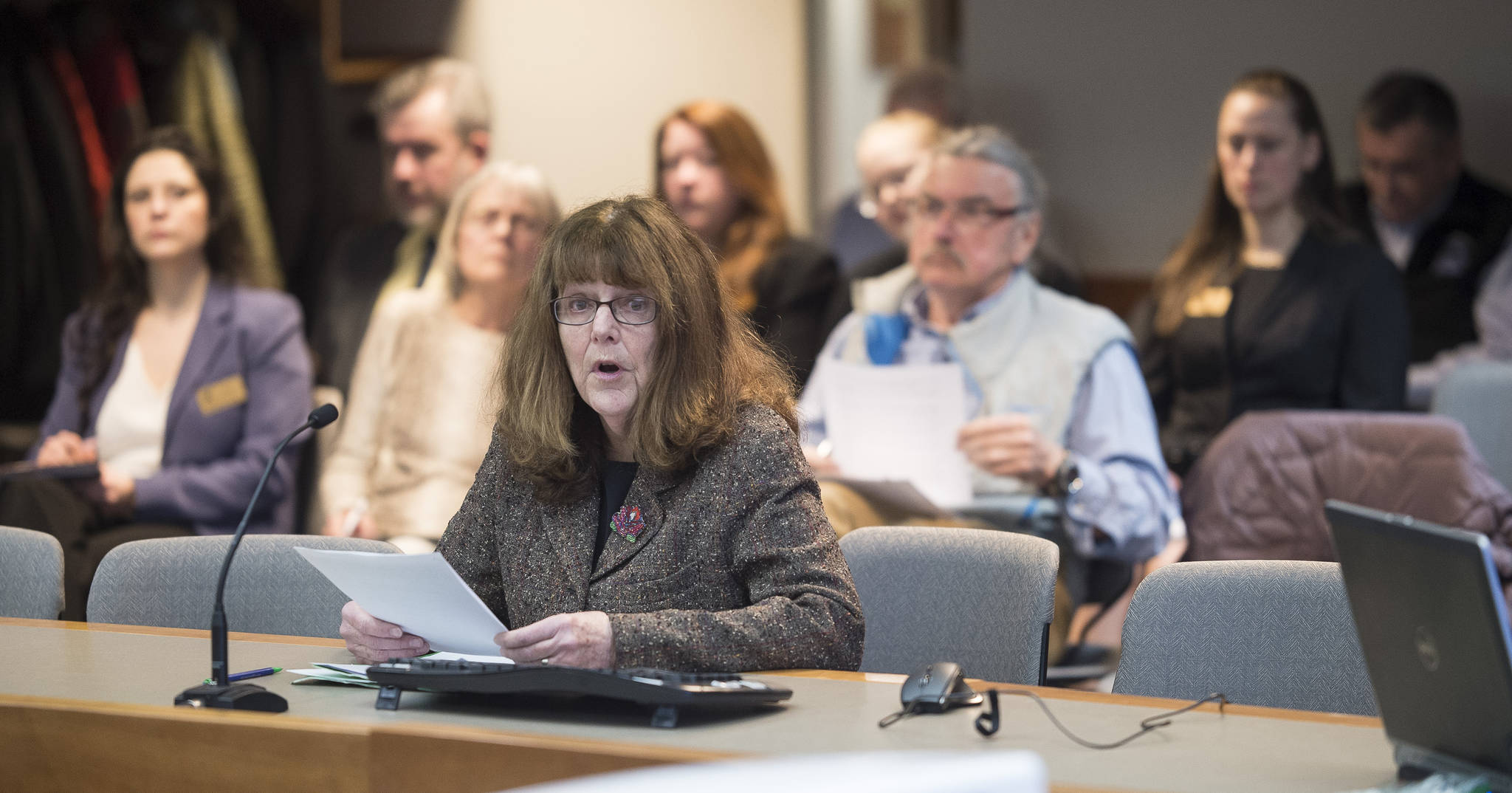
A Juneau group of climate change activists pushed the Alaska Permanent Fund Corporation Wednesday to stop investing in fossil fuel companies.
The group said it isn’t necessarily an environmental plea. The request, made at the APFC Board of Trustees meeting by a Juneau group called 350 Juneau, was couched in financial terms: the Fund’s investments in fossil fuels are a bad bet, they say, and Alaskan’s annual PFD checks might be fatter if the Corporation took those investments off the books.
Elaine Schroeder, one of 350 Juneau’s chairs, made the case that divesting from fossil fuels is in the Fund’s best interest.
Spurred by the anticipation of carbon taxes and the widescale adoption of renewable energy technologies, some of the smartest financial minds in the world are predicting a stark future for fossil fuel commodities, Schroeder said.
“Over 830 institutional investors worldwide, with an estimated value of $6 trillion, have made commitments to divest their funds from fossil fuels,” Schroeder told the board. “Many of these institutions are divesting for purely economic reasons.”
Schroeder encouraged the board to join that movement. She presented a letter signed by 400 Alaskans backing divestment.
“The fossil fuel divestment movement has been sweeping around the globe, doubling in size since 2015,” Schroeder said.
Some of those funds have moved away from investing in oil and natural gas companies as part of ethical, or “socially-responsible” investing mandates. This is the the idea that public funds should not be used to invest in companies violating certain ethical, moral or social boundaries.
Put simply, it’s the idea that we should invest in what we want to see in the world, and not contribute to what we don’t like, conservationist Rick Steiner said at a recent 350 Juneau meeting.
But other financial organizations have moved away petroleum investments for purely financial reasons.
In 2015 Norway, Europe’s biggest petroleum producer, and it’s $1 trillion sovereign wealth fund — a state-run fund similar to the APFC — made commitments to sell off their investments in mining companies and companies that depend on coal. They may soon do the same with international petroleum companies. Norway is expected to have sold off its petroleum holdings by late 2018 at the soonest, following a suggestion made in November by the Norwegian Central Bank, which manages the fund.
Paris, Washington, D.C., Copenhagen and Berlin, numerous universities and even the Rockefeller Brothers Fund, whose wealth was built on oil, have also divested from fossil fuels in one way or another.
For both ethical and financial reasons, Schroeder and 350 Juneau want Alaska to be next. Similar environmental groups have made the ethical argument to the APFC before, that some sort of socially responsible investment screening should be implemented.
But the APFC can’t consider ethical arguments and has turned those requests down. They have what’s called a “prudent investor rule,” in their mandate from the State of Alaska. This means the APFC must make its decisions based off what’s good for the Fund’s financial outcomes, not for ethical reasons.
So 350 Juneau took the tact of arguing for divestment in financial terms. It’s a fact-based argument, they say, not a workaround to implement socially-responsible investing. Their research has shown that the APFC has lost money recently on its fossil fuel investments.
Doug Woodby testified that the APFC has a chance to get out of fossil fuels ahead of an impending drop in value with anticipated carbon taxes.
“As a prudent investor, does the corporation keep apprised of the increasing global trend towards carbon pricing, such as carbon taxes and cap and trade systems, that will almost surely will make fossil fuel production more costly in the near term as well as the long run?” he asked.
It’s hard to know just how much money the APFC has tied up in fossil fuels. Parsing this out would require a significant amount of time and resources APFC doesn’t have or can’t commit, the corporation has told 350 Juneau, per Schroeder.
There was some indication by board members that they’d come back to the next APFC Board of Trustees meeting with an update of fossil fuel investments to help inform the divestment discussion, but an APFC spokesperson didn’t immediately return calls or emails for this story.
For now, 350 Juneau will have to keep waiting for news on divestment. Member Bob Schroeder, an anthropologist told the board we can’t wait too long.
“The Anthropocene, which began not that long ago, is drawing to a close as we move to a new world,” Schroeder said. “No, we may not be running out of oil, but the stone age didn’t end because we ran out of stones.”
• Contact reporter Kevin Gullufsen at 523-2228 and kgullufsen@juneauempire.com. Follow him on Twitter at @KevinGullufsen.

Gretchen Keiser speaks to the Board of Trustees of the Alaska Permanent Fund Corporation on divesting from fossil fuel investments during public testimony at its Quarterly Meeting in Juneau on Wednesday, Feb. 21, 2018.
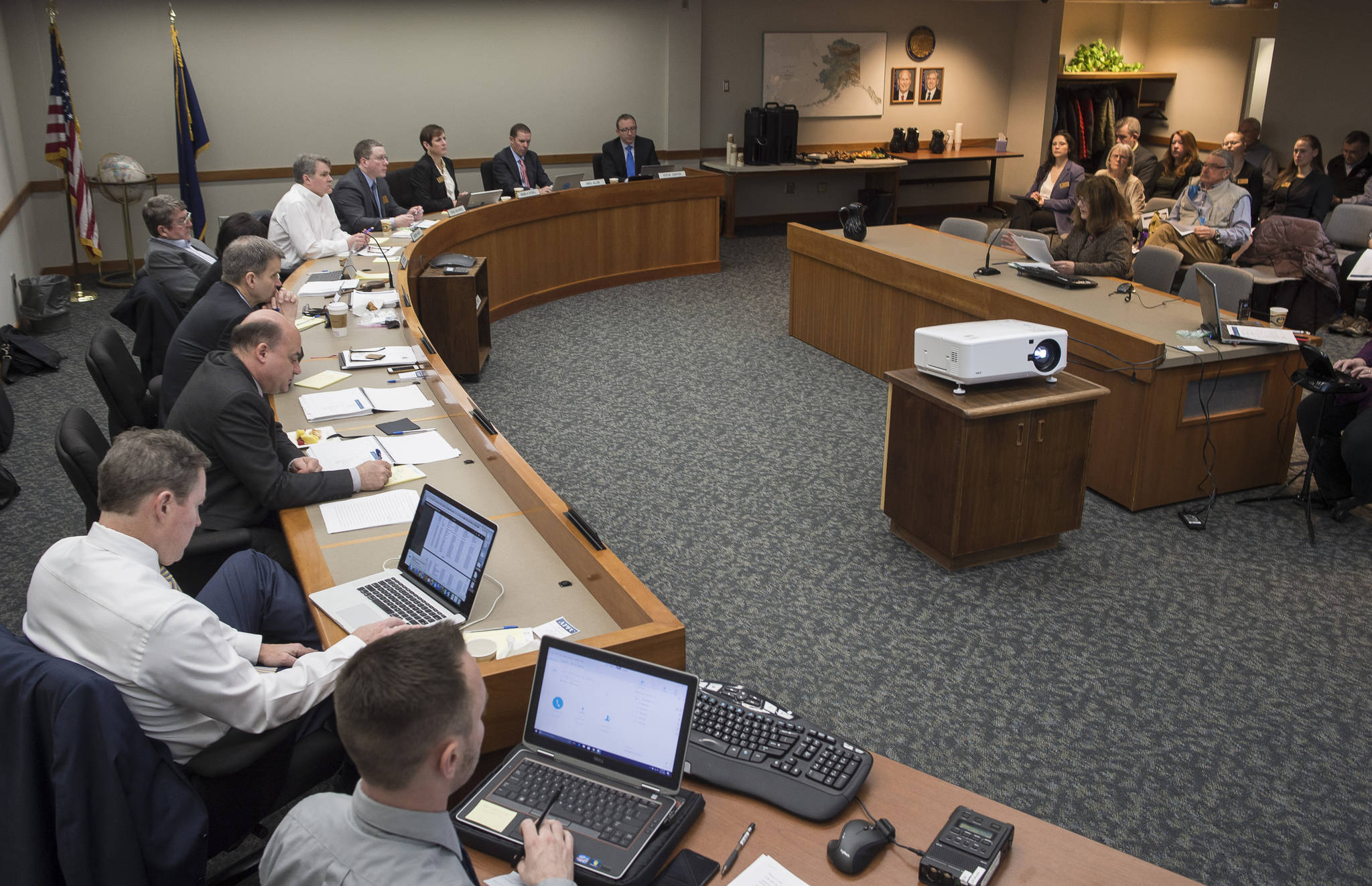
The Alaska Permanent Fund Corporation’s Board of Trustees listens to public testimony on divesting from fossil fuel investments during its quarterly meeting in Juneau on Wednesday, Feb. 21, 2018.

The Alaska Permanent Fund Corporation’s Board of Trustees listens to public testimony on divesting from fossil fuel investments during its guarterly meeting in Juneau on Wednesday, Feb. 21, 2018.
