
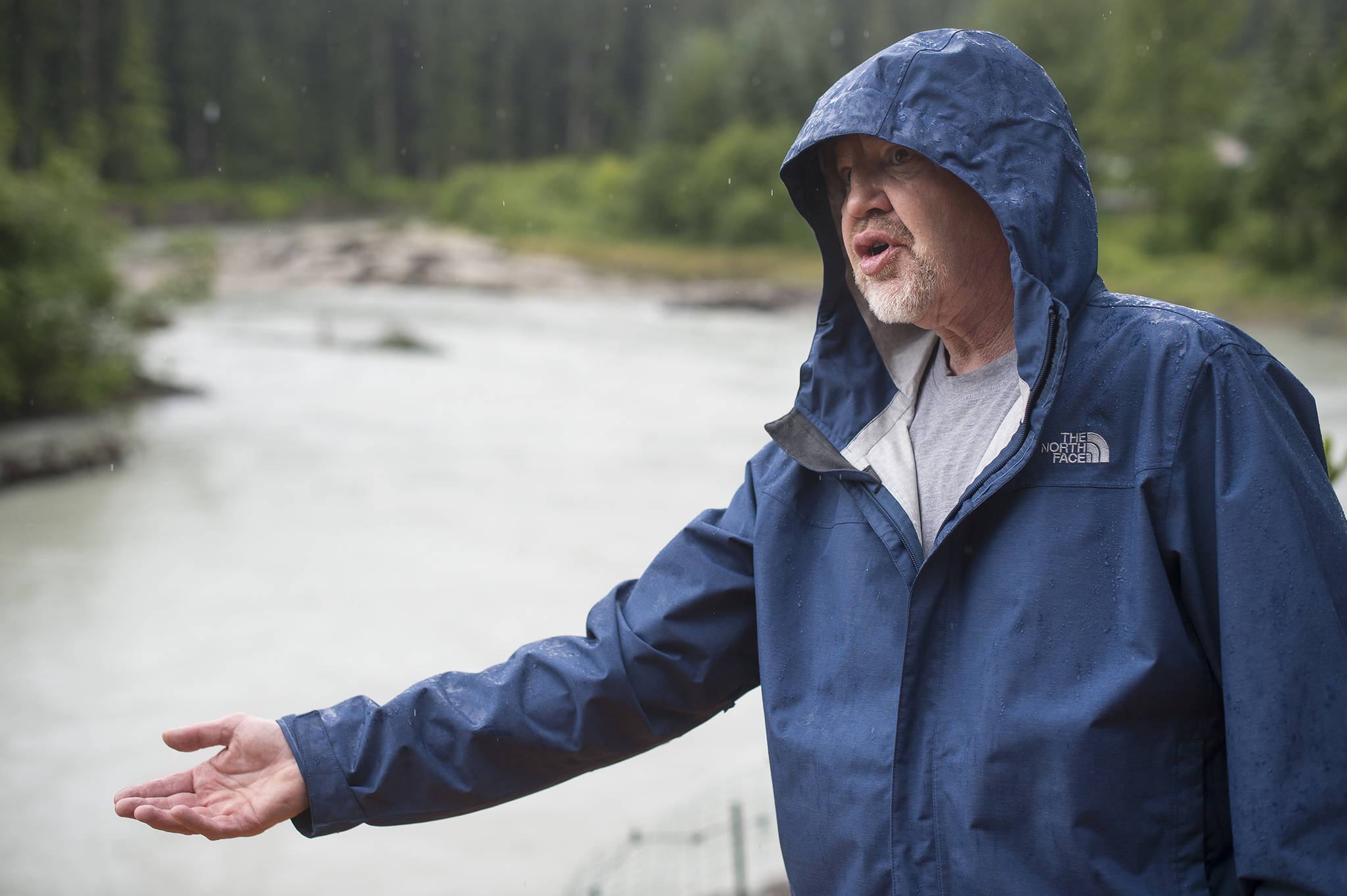
For the first time, the City and Borough of Juneau offered to commit funds to battling erosion on the Mendenhall River — in a way.
Erosion on the Mendenhall River is threatening houses, particularly on Meander Way. The Natural Resources Conservation Service (NRCS) has been putting a plan together to install siding along the river to protect 28 homeowners from further erosion, but the plan would cost the homeowners an estimated $78,500 each.
The project is still only a proposed one, and has not yet been approved. The Assembly can vote to go ahead with it, but wants to work out a plan that is as fair as possible to the homeowners.
Assembly member Loren Jones pointed out that city staff members have already devoted hours to researching this issue and will devote more, and that staff time is an expense for the city. The city will also be responsible for maintenance for 10 years after the project — if the project ends up going through — which would be another expense. In the NRCS plan, the homeowners would end up footing the bill and paying the city for this staff time and maintenance.
At Thursday’s meeting, the Assembly members voted that the city would pay for those expenses on its own if the plan ends up going through. The costs of staff time, they agreed, will not fall on the homeowners, as was the previous plan. Assembly member Jesse Kiehl has been vocal in past meetings about wanting the city to move this process along as quickly as possible, and reiterated his thoughts Thursday.
[City faces tough decision on Mendenhall River erosion]
“It’s a public project for a lot of reasons,” Kiehl said. “I think it’s really important that we look at the totality of what we do as a city. We protect public safety, health and welfare.”
Director of Engineering and Public Works Roger Healy said that the most recent estimate for city costs (which was done in March) is $260,000. Both Healy and City Attorney Amy Mead said that number could change as the project goes along.
Assembly member Debbie White advised that the committee should be cautious about how much the city devotes to this project. If this current Assembly gets heavily involved in this project, White argued, it would set an expectation for future Assemblies to also bear costs for a variety of natural challenges.
“I’m more concerned about precedent,” White said. “Are we now gonna take care of wetlands? Are we gonna take care of every river and stream? Are we gonna take care of avalanche areas?”
Searching for fairness
The ideas of equality and fairness have been at the center of the discussion about the project. Though 20 of 25 homeowners who responded to a survey in April said they were in favor of the plan, those in the minority have cited unequal benefit.
Some homes are experiencing much more erosion than others, and the ones that are further away from the erosion are less inclined to pay the large sum of money. At Thursday night’s meeting, Assembly members proposed one factor that could divide the costs in a fairer way: property value.
City Manager Rorie Watt said that judging costs based on property value would likely be the fairest way to go about this.
“You’re looking at the ultimate benefit,” Watt said, “and the ultimate benefit is gonna be the best you can quantitatively analyze the value of the home. …the benefit would be the protection of the asset of the home.”
The committee unanimously approved a motion for city staff to divide the estimated cost based on property value and then present those numbers to the homeowners. The homeowners will then have another informal poll on their thoughts. There’s also an option that if the homeowners can meet with each other and come up with a solution, the city will consider that.
According to the CBJ Assessor’s website, property values vary greatly in the affected area. Of the 27 households that were polled in April, there’s a range of $196,100 to $623,372 in property value. Fourteen of the homes are assessed at between $400,000 and $500,000, but five are valued at or below $315,000.
Jones pointed out that these property values are suffering because of the eroding banks of the river, and that if the city doesn’t figure out a way to help stop the erosion, the situation could get much worse.
“As I understand it right now, most of those homes, if they were put on the market, are not sellable,” Jones said. “I think on one hand, the value of the property for resale or refinancing or whatever is pretty negligible just because we don’t have a solution to the fact that those homes may not exist in three or four years after a major flood, and I don’t think that’s acceptable.”
• Contact reporter Alex McCarthy at alex.mccarthy@juneauempire.com.
