
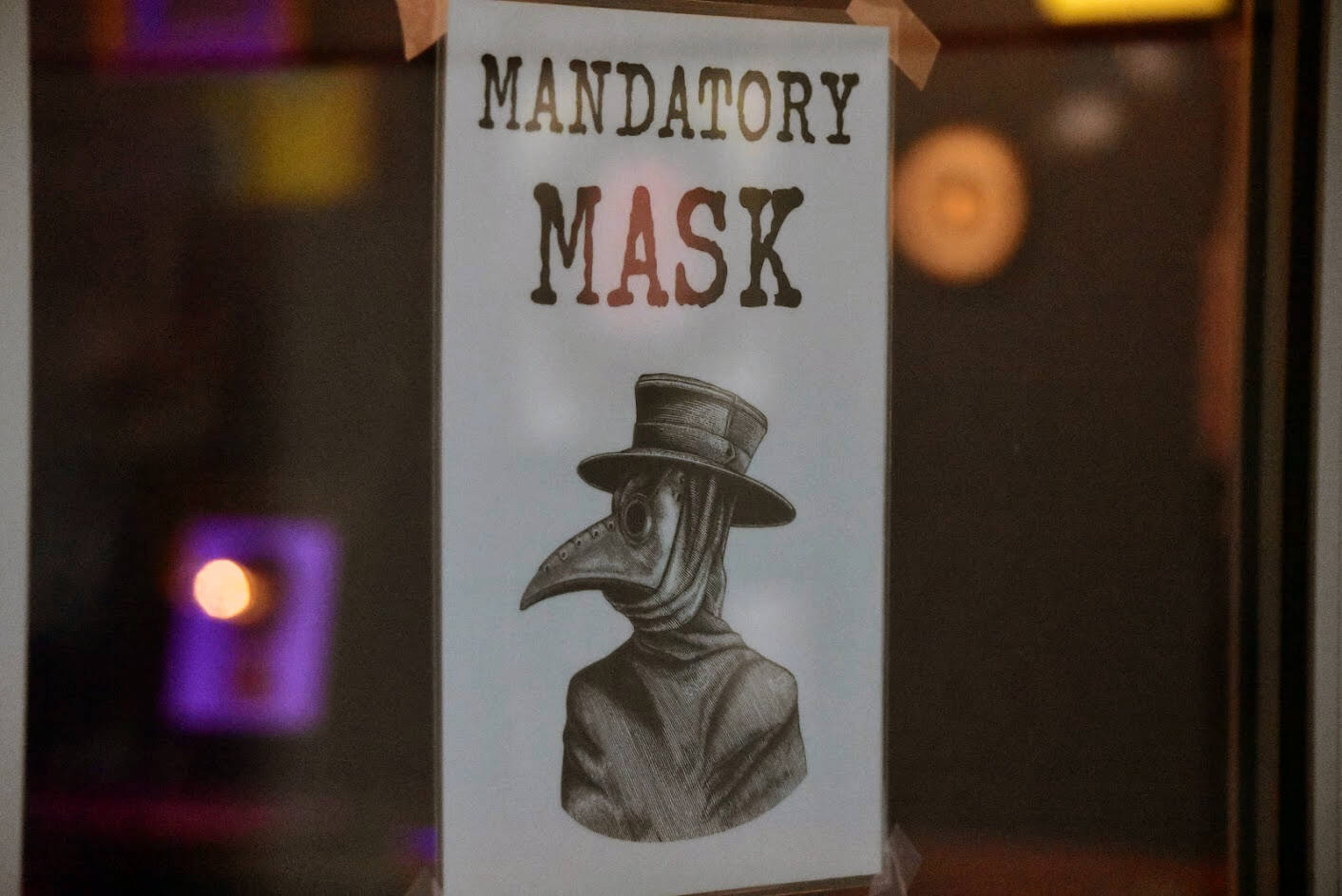
Monday evening, Members of the City and Borough of Juneau unanimously approved an extension of the city’s current COVID-19 mitigation strategies. Rather than expiring March 1, city leaders agreed to extend the measures to April 30–a deadline one day shy of the May 1 expiration suggested by city staff members.
The Assembly met via Zoom due to COVID-19 cases among Assembly members and staff.
Deputy City Manager Robert Barr said moving the expiration date out to May 1 accommodates the timeline for city ordinance changes, which require two readings and 30 days before an ordinance becomes effective.
“We are just as hopeful that May 1 will be the end,” Barr told the Assembly. “We hope omicron is a variant that burns bright and declines, and we are certainly watching for that.”
In a memo to the Assembly before the meeting, Barr said the mitigations could end before May 1, if conditions warrant.
“If an extension occurs and it is advisable to end the Community Mitigation Strategies earlier, the EOC will do this either by bringing strategies back to the Assembly for early sunsetting and/or by moving to the Fully Open risk level,” Barr said in his memo.
As part of the renewal, the assembly approved minor modifications Barr suggested. The changes tinker around the edges to relax the mitigations by removing the very high category from the strategies and changing rules around mask use and capacity limits for fully vaccinated people in certain circumstances.
[Two buildings collapse as rain and ice accumulate on roofs]
Robust public input
Assembly members listened to about two hours of public testimony — much of it critical of the policy as well as Assembly members and city staff before agreeing to extend the measures.
Most callers objected to the migitation measures and asked the Assembly to remove the rules.
However, last week, assembly members told the Empire that comments coming in before the meeting generally supported staying the course and extending the measures.
In an interview with the Empire last week, Mayor Beth Weldon said that she was getting about five emails a day from constituents in advance of the meeting and most of the emails endorsed keeping the measures in place.
During the meeting, a few callers shared support of the mitigations and asked the Assembly to keep the rules during the omicron surge.
“I urge you to please adopt the ordinance,” said Luann McVey, who said she was calling from Douglas. “Your leadership has kept Juneau safer than most Alaskans. We need you to continue this vigilant approach.”
Phillip Moser, who said he was calling from the Mendenhall Valley, encouraged Assembly members to consider the perspective of front-line workers who are most at risk of contracting the virus at work.
“My ideal stance would be to keep them,” Moser said. “My employer does not have a health care plan. I can’t afford to take days off for being sick. Even if I don’t die, there are health issues that can crop up,” he said, adding that the expense of health issues can lead to financial concerns.
Opponents questioned the metrics used to assess the community risk level, asked Assembly members to consider if case counts are the correct measure for determining risk level, and cited concerns about the mental health toll of masking and capacity limits for events.
Some questioned the efficacy of vaccines and masks and said the city’s rising case rates prove that mitigation measures don’t work. Case rates are rising rapidly across the city, state and country, driven mainly by the omicron variant.
Several suggested that the current situation is no longer an emergency and that the city should stop treating the virus as such.
Sharon Wildes, who said she was calling from the Mendenhall Valley, urged Assembly members to “be brave.”
“I know it’s difficult,” Wildes said, saying that prior testimony that evening showed that fear is prevalent throughout the community.
“The news is broadcasting a lot of fear. Maybe we should end the two sneezes and the country freezes approach,” she said.
Wildes said that asking people to wear masks “is not without consequence” and said masks are “quite unhealthy.”
The federal Centers for Disease Control and Prevention, the American Academy of Pediatrics and the World Health Organization have all declared that masking is safe and effective.
[City Assembly poised to consider COVID mitigations]
“We do not consent”
Several of those who called into the meeting said they would not comply with the mitigation measures, regardless of the Assembly’s decision. Some ended their statements by saying, “we do not consent.”
Some accused Assembly members of being criminals and behaving like tyrants. Several callers said the city’s actions are destroying local businesses and prompting them to consider leaving Juneau. Some said city officials are responsible for driving fear and division throughout the community.
Others accused Assembly members of trampling constitutional rights, committing war crimes, profiting from the EOC, and participating in medical segregation.
A handful of callers engaged in personal attacks against officials and staff members.
The vitriol prompted a plea for more constructive dialogue.
“Many people had good points on both sides,” said Kirby Day, who said he was calling from the Mountainside area.
He said the testimony from some was “maddening” and “embarrassing” and said that people should not be “called out” and “ridiculed” over policy disagreements.
Day said that Assembly members have “been brave and had guts” for two years.
About the measures
Last passed in October, the measures are often called the “mask mandate.” But, the measures cover areas beyond masks. They include a collection of mitigation strategies that vary based on the level of viral spread, local and regional hospital capacity, and public health’s ability to conduct contract tracing. Public masking is a measure in place during times of high community spread. As the community risk level changes, the corresponding mitigation measures adjust.
Last week, rapidly rising numbers of COVID-19 infections in Juneau prompted city officials to change the city’s risk level to “Level 3-Modified High,” a level that requires masking in public regardless of vaccination status.
• Contact reporter Dana Zigmund at dana.zigmund@juneauempire.com or 907-308-4891.
